Friday, November 18, 2022

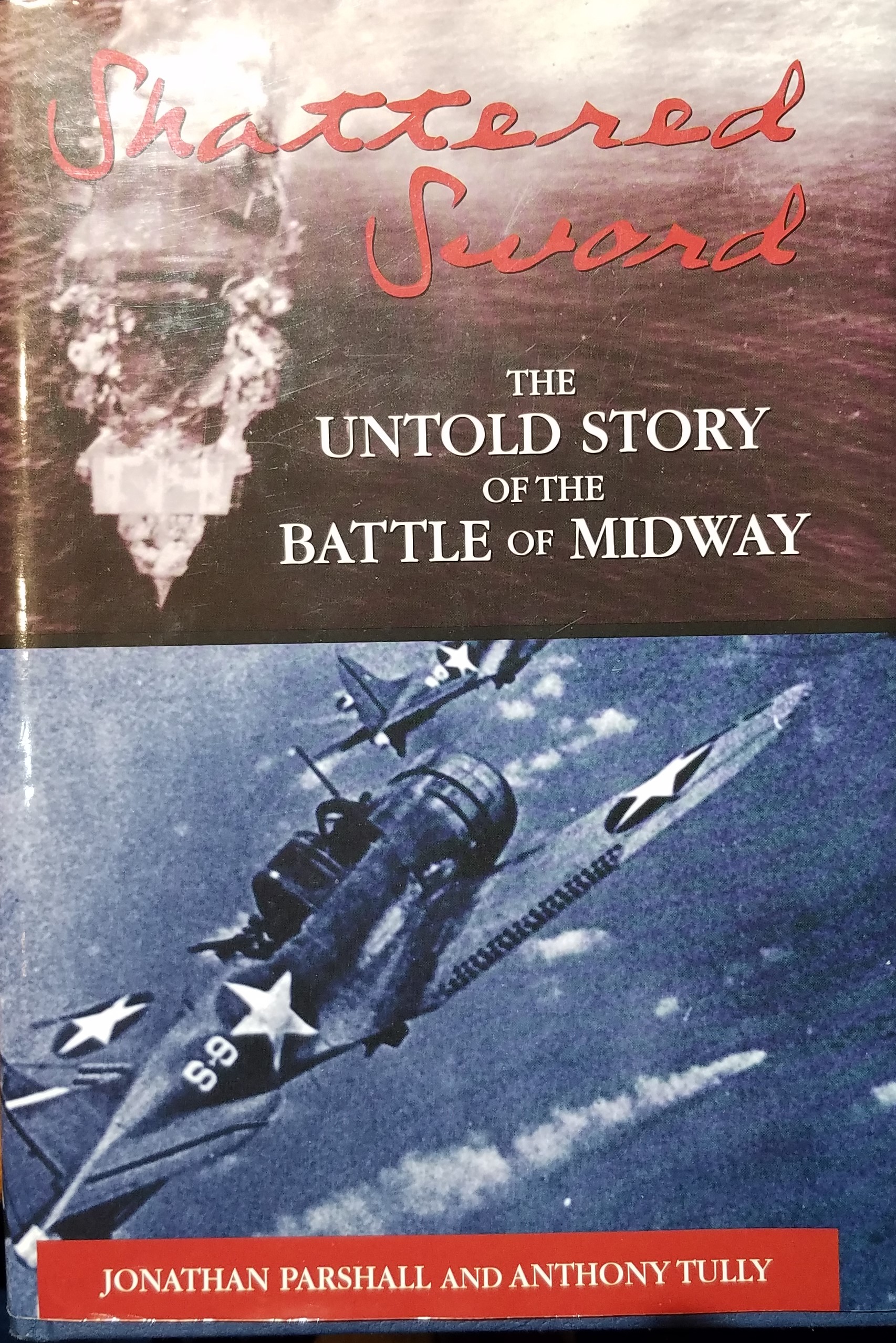
Book Review: Shattered Sword: The Untold Story of the Battle of Midway

 Review of Shattered Sword: The Untold Story of the Battle of Midway, by Jonathan Parshall and Anthony Tully.

I enjoy military history, especially when it’s wrapped around the events and happenings of World War 2. Usually, the author is trying to tell the story in a way both accurate and compelling, explaining and exploring command decisions and engagements, and the manner in which the battlefield itself, the action of individual units, and the vagaries of combat shaped the outcomes.

But Shattered Sword is in a class by itself. The writers have an agenda much larger than most—they intend to correct the received narrative of the battle of Midway, an erroneous narrative that has held sway for half a century. Their comprehensive research, which relies heavily on Japanese primary sources, has proven that most, if not all, of the popular accounts of the battle are significantly flawed, especially as regards the ultimate question of why the American naval forces won.

The book was a delight to read. The authors begin by delving deeply into the backgrounds of each of the principal characters, as well as the cultural ethos of the Imperial Japanese Navy. They explore the merits and demerits of each of the Japanese carriers and carrier aircraft. They expose the mind-numbing and initiative-stealing complexity of the overall Japanese battle plan for Midway. The entire process of preparing and arming the planes and spotting the flight deck for a strike is analyzed, down to the length of time a Zero’s powerplant needs to be warmed up in order to prevent damage to the engine upon launch.

I found the parts on Japanese naval doctrine, carrier operations, damage control, and air defense to be fascinating. Spoiler: the study of Japanese carrier operations became a major piece of evidence in substantiating the authors’ claims regarding the flaws in the received narrative, evidence that is buttressed by photographs taken during the battle.

The American side of the battle is also explored extensively, so the reader gets a sense for the simultaneity of the actions on the bridges and flight decks of ships on both sides of the conflict, as well as the strike and opposing defense aircraft. The reader is given precise timestamps (down to the minute) when the various decisions, communications, and actions were taken.

The book includes charts and drawings showing the relative dispositions of the carriers and their escorts, and once the attacks begin the direction of approach of the enemy aircraft. Eleven appendices detail the names of the personnel, the order of battle, technical details of the carriers, and a host of other matters that will be a goldmine for any writers or researchers that come after Parshall and Tully.

The book is fascinating, even gripping in places, exhaustively researched, and extensively documented. The authors successfully attain their agenda of correcting the record—conclusively in my opinion. Shattered Sword is the definitive resource for accurate information about the battle of Midway. Five stars, highly recommended.

Tuesday, July 26, 2022

Book Review: Three views on The Millennium and Beyond


This is an excellent book on what is fundamentally a very narrow question: is there an intermediate kingdom (a millennium) between the present age and the eternal state? The contributors chosen to represent their position (Kenneth Gentry for postmillennialism; Robert Strimple for amillennialism; Craig Blaising for premillennialism) are excellent scholars and skilled ambassadors of their particular take on the subject.

Each contributor outlines his position on the issue, followed by responses from the other two scholars. The postmill view goes first (along with the responses), the amill view is second, and the premill view (the longest section by far) wraps up the consideration. The overall tone is irenic and gracious--the book contributes light on the topic rather than heat--something I really appreciate.

Darrell Bock, the editor, writes an outstanding summary essay identifying the major interpretive issues that appeared repeatedly in the writing of the three contributors. This summary is excellent in its own right. In fact, I recommend reading the summary first, especially for those readers who are not very familiar with the debate. Bock does a good job of laying the issues out on the table and explaining their implications in a simple-to-understand format.

A recommendation: don't speedread this book. Read it slowly and carefully, looking up and thinking carefully about the Scriptures the writers cite. I forced myself to slow down and study the book carefully--as a result, I have gained a great deal more understanding about all three positions. And this even though I was already familiar with the issues, have studied the Bible for over 40 years, and have a graduate degree in Bible. Five stars, heartily recommended no matter what your starting position might be on the millennial question.

Saturday, January 1, 2022

Book Review: Eric Foner's The Fiery Trial

Excellent book. Foner traces the evolution of Abraham Lincoln's views regarding slavery, emancipation, black suffrage, colonization (meaning, the opinion during his day that blacks should be relocated out of the country), and the civil and social equality of the negro.

Several things stand out about this book. Foner unveils the gross and malicious racism of not only the southern states, but even the northern states. The Republicans were distinctly uncomfortable with the contradiction between the high ideals of the Declaration of Independence and the actual experience of the black population, but many were willing to live with that contradiction. The Democrats were fighting to preserve that contradiction, in many cases arguing that the blacks were either subhuman or too inferior to handle freedom (the growing popularity of Darwinism was used to buttress their argument, by the way).

Foner teases out the factions (radical abolitionists, conservative Republicans, moderate Democrats, Unionists, etc) with great skill and copious documentation. He also makes clear the complexity and tension of the competing priorities of ending slavery while preserving the Union, keeping the border states from seceding, all the while defending the Constitution. Reading Foner provides a much clearer picture of the difficulties the country faced than does the modern progressive evaluation of American slavery.

Once the gross sin of slavery was introduced into the colonies, the die was cast for a bloody reckoning in the future, a reckoning that the Declaration would exacerbate--because that document demonstrated that men knew what was right even if they chose not to do it.

Reading Foner's The Fiery Trial is a worthwhile education as to the morals and mood of mid nineteenth century America. Not only does it display the dark, sinful underbelly of our history, it also demonstrates that within the seeds of the American experiment were the tools of correction, the ability to right a gross injustice.

Five stars--well worth the read.

Wednesday, October 27, 2021

Book Review: Kidner's commentary on Jeremiah

There are times that Kidner's words in this brief commentary rise beyond mere explanations to profound observations. I was repeatedly delighted with his applications of biblical truth.

If you're looking for a technical commentary, this one isn't it. If you are a busy individual looking for a popular level commentary, something concise to keep you on the guardrails of responsible, orthodox interpretation, Kidner's commentary is what you need. The book of Jeremiah is fifty-two chapters long: an academic treatment would run to over 600 pages. Kidner does an excellent job with the text in 176 pages.

For the layman, the turbulent period of Jeremiah's ministry can be very difficult to untangle from a historical perspective, a task made more difficult because the swinging door of Judah's throne is complicated by the use of multiple names for the same monarch (e.g. Jehoiachin is Coniah is Jeconiah; Shallum is Jehoahaz is Joahaz). The organization of the Hebrew text of Jeremiah's prophecy reflects that tangled sense. Kidner does a great job helping the reader to sort things out and place them in the proper historical context.

Sometimes commentaries lose the big picture of the movement of the text, getting lost in arcane details. Kidner does an excellent job of tracking the overall direction of the text, never losing sight of its main thrusts, and pointing the reader to ultimate fulfillments in Christ. Five stars, highly recommended.

Sunday, September 5, 2021

Writing Update for Outlander Chronicles: Icarus, book three of the series

Three years ago next month (October, 2018) I started writing Outlander Chronicles: Icarus. Within two months I gave up--the story just was not coming. A year or so later I gave it another brief shot, only to give up again. The story just wasn't working and I wasn't happy with what I had written. I pretty much gave up on a book 3 of the Outlander series.

After several years off from working on the Outlander series, finally this past January I picked up the tale again, pretty much starting from scratch, (although I was able to use some scenes from my earlier attempts with significant re-writing).

Now I am a little over 1/3 of the way to my target word count of 100K, and I am excited about the tale--it's developing into a great story.

I'm also a little nervous. Normally I know how I want the tale to end before I even start writing it. Not so with Icarus. This is the first novel I've written without being sure exactly how I'm going to "land the plane."

I've often said that, as an author, I don't find out what's happening next in my tales until I actually write the scene. If you've read Outlander Chronicles: Phoenix, you're aware of a pretty shocking event near the end of the book (no spoilers, please) (and by the way, some of my readers STILL haven't forgiven me!!). I did not know that event was going to happen until I was actually typing the words. It was unplanned.

Not true with respect to the endings of my books. I know the ending when I'm writing the opening scene (although I haven't the foggiest notion of how I will get from 'A' to 'B').

Right now, the ending of Icarus in my mind is a blank page. Guess I'll find out when I get there...

Thursday, August 19, 2021

Book Review of Jim Newheiser's Marriage, Divorce, and Remarriage

Marriage, Divorce, and Remarriage is a terrific book to use as a reference, or to read cover-to-cover.

Newheiser's writing style is very accessible and clear. I'm tempted to use the first part of the book ("Part 1: Marriage") as a tool for pre-marital counseling.

The book is comprehensive. It's hard to imagine situations arising which have not been somehow 
dealt with in this volume. As such it is a go-to reference for Bible-believing pastors and counselors.

Newheiser is also relentlessly biblical, and makes it clear when he's just offering an opinion as opposed to a clear biblical principle. He is very even-handed and gracious to those scholars who disagree with his interpretations of the texts. For instance, when it comes to the exception clause, he very faithfully represents and interacts with the arguments of those who see no exception at all.

The book is organized in two major sections broken into seven segments:

Part 1: Marriage

A. The Foundations of Marriage
B. Entering into Marriage
C. Having a Successful Marriage
D. Challenges in Marriage

Part 2: Divorce and Remarriage
A. The Foundations of Divorce and Remarriage
B. Divorce and Remarriage Controversies
C. Practical Questions

Each of the forty chapters are titled in the form of a question (for example, chapter 12 is entitled, "What are the responsibilities of a husband"). This format enables Newheiser to deal very concisely with the particular issue. In my opinion, the expectations raised by the chapter titles are fulfilled by the content.

Newheiser has made an outstanding and important contribution to the biblical counseling movement with this book. Five stars, highly recommended.

Wednesday, August 18, 2021

Psalm 44, and a prayer for Afghani believers

On first glance, Psalm 44 seems to have a conflicting message. It begins with praise for God’s work of delivering Canaan into the hand of Israel (vv 1-3) followed by a confession that the psalmist does not trust in himself, but in God for deliverance (vv. 4-8).

But then the psalm takes a difficult twist in verses 9-19, as the psalmist complains that God has nonetheless rejected them (v 9), saying “You sell Your people cheaply” (v 12). God’s actions towards them seem to contrast with their continued faithfulness to Him (vv 17-18).

In the final section (vv 20-26) the psalmist asserts their faithfulness (vv 20-21), even while “for Your sake we are killed all day long; we are considered as sheep to be slaughtered” (v 22). The psalm ends with a desperate plea, “Arouse Yourself, why do you sleep, O Lord? Awake, do not reject us forever” (v 23), followed by the petition, “Rise up, be our help, and redeem us for the sake of Your lovingkindness” (v 26).

This is not what we expect to see. Why does God treat His people so, when they are seeking to be faithful? Derek Kidner’s comments on this seemingly conflicted psalm are excellent

“The psalm is exploring the baffling fluctuations that have their counterpart in Christian history: periods of blessings and barrenness, advance and retreat, which may correspond to no apparent changes of men’s loyalty or methods. Although its picture of the sleeping Lord may seem naive to us, it was acted out in the New Testament, to teach a lesson which we still find relevant: cf. verse 23 with Mark 4:38.
But the crux is in verse 22, with the phrase for thy sake. The psalm does not develop it, but it implies the revolutionary thought that suffering may be a battle-scar rather than a punishment: the price of loyalty in a world which is at war with God. If this is so, a reverse as well as a victory may be a sign of fellowship with him, not of alienation.” [Kidner, Psalms 1-72, Intervarsity Press, 2008, p.187. Emphasis mine.]
Paul cites Psalm 44:22 in Romans 8:36 and brings the psalmist’s complaint to its biblical theological conclusion, revealing God’s deeper purposes: “Who will separate us from the love of Christ? Will tribulation, or distress, or persecution, or famine, or nakedness, or peril, or sword? Just as it is written, “For Your sake we are being put to death all day long; We were considered as sheep to be slaughtered.” But in all these things we overwhelmingly conquer through Him who loved us. For I am convinced that neither death, nor life, nor angels, nor principalities, nor things present, nor things to come, nor powers, nor height, nor depth, nor any other created thing, will be able to separate us from the love of God, which is in Christ Jesus our Lord.” (Romans 8:35–39)

God was pleased to crush His own suffering Son on the cross (Isaiah 53:10), despite Jesus’ absolute faithfulness to His Father. Jesus Christ was led like a lamb to the slaughter (Isaiah 53:7), to pay for the sins of His people (Isaiah 53:4-6). But that was not the end of the story. By His death, resurrection and ascension to the right hand of the Father, Jesus Christ overwhelmingly conquered death and hell in order to save His precious people. And because of His victory, God’s people likewise overwhelmingly conquer, even in the face of death and intense persecution.

May our faithful God grant to the precious Afghani believers protection, shelter, and safety from raging lion who walks about, seeking to devour them. And when God in His wise and faithful providence determines not to grant temporal protection, may He give His people courage, strength, endurance, grace, mercy, and comfort as they faithfully bear their honorable battle-scars for His name’s sake. He will wipe away every tear.

After you have suffered for a little while, the God of all grace, who called you to His eternal glory in Christ, will Himself perfect, confirm, strengthen and establish you.” (1 Peter 5:10)

Tuesday, July 13, 2021

Book Review: Voddie Baucham's Fault Lines


Baucham’s book, Fault Lines, is an indispensable guide to how the modern Social Justice movement is affecting the otherwise orthodox Christian Church in America. Heavily footnoted with plenty of primary sources, Baucham makes the case that America’s preoccupation with “antiracism” is not simply a social movement but an inherently religious movement, and that evangelicals are jumping on the bandwagon without perhaps realizing the origins, goals, and theology of the movement they are supporting.

Frankly, in our current climate this is a book only a black man could write. As it is, Baucham is having to endure much criticism from all points of the compass for standing up and exposing the lies, the fallacies, the media exaggerations, the duplicitous statistics, and the religious nature and hidden agendas of Critical Race Theory and BLM. For example, Baucham walks through the latest examples of the shootings of black people by police, and using documented facts that are beyond dispute, eviscerates the narrative promoted by the media and BLM.

He’s not shy about naming names and organizations of evangelicals who have capitulated to the modern cultural current, and he demonstrates that biblical truth is the real victim. In all cases, Baucham critiques by using the individual’s or organization’s own explicit, public statements. The Southern Baptist Convention in particular takes it right on the nose, as well as a number of popular preachers.

The seduction of the antiracism movement is located in the fact that many of their particular concerns are indeed legitimate. There is a measure of racism in America (as there is everywhere). There are benefits that accrue automatically to the majority culture. Black people in America have suffered historically and have experienced oppression. These statements are true, but the conclusions and solutions which the Social Justice movement elicits from these observations are neither true nor helpful.

The Social Justice Warriors are engaged in an argumentation involving major premise, minor premise, conclusion. A sample of their logic looks something like this: major premise: all white people are racist; minor premise: you are white; conclusion: therefore you are a racist. As constructed it is a logically valid argument. However it is a true argument only if both premises are true. But the major premise is false, and from a biblical perspective, slanderous.

What Baucham shows is that if you accept the assumptions that begin the Social Justice contentions (i.e., the major premise), you will inevitably lose the argument. But in truth, those assumptions are terribly flawed (and unbiblical). There’s also a compression of history in the Social Justice thinking, as though it was only yesterday that slavery existed in America. There’s a willing blindness to the fact that that equality before the law for all races and ethnic groups has long been established in America.

If you’ve been struggling with (a) knowing that there are forms of oppression in our society, but (b) sensing that the Social Justice Warriors have grossly overstated the problem and seem to be following a hidden agenda, then Voddie Baucham’s Fault Lines is the book you need to read. It is irenic in tone, accessible and well-documented. Five stars, highly recommended.

Monday, July 12, 2021

He's not a mere man, Mark 5:21-43

There is an interesting incident recorded in Mark 5:21-43, in which a synagogue official begs Jesus to heal his dying daughter. While He is walking to the man’s house, a woman who was hemorrhaging blood touches His garment, creating a delay—a delay in which the man’s daughter dies. After speaking with the woman, Jesus continues on to the synagogue official’s house, and raises his twelve-year-old daughter from the dead. All three synoptic gospels contain the account (Matthew 9:18-26, Luke 8:41-56).

I’ve always found this account interesting, imagining the agony that father goes through when he sees Jesus delayed by the woman, only to hear that his daughter has died. I have wondered how he responded to that fatal interruption. “If only this woman had not distracted the Teacher, my little girl would still be alive!” Did he then have faith that Jesus could not only heal, but restore life to the dead? The account does not make clear his reaction, other than that Jesus told him, “Do not be afraid any longer, only believe” (Mark 5:36). Jesus then goes on to bring the man’s daughter back to life.

There’s an interesting side story to this, and it revolves around “touching.” There are several references to physical contact in the account. In 5:27, 28, and 30 are references to the fact that the woman touches Jesus. Verse 31 contains the disciples’ exasperated reaction to the affair. Once Jesus arrives at the synagogue official’s home, he takes the little girl’s hand. While Mark 5:41 does not use the verb “touch” it is obviously physical contact with her corpse.

So what’s the big deal? It’s a little subtle, but it is significant. In Leviticus 15:17-27 Moses instructs the people that a woman with a discharge of blood is “unclean,” and anything or anyone who touches her during that time also becomes unclean. In Numbers 19:22 it is clear that ceremonial “uncleanness” is contagious. Anything an unclean person touches becomes unclean, and if someone else touches what the unclean has touched, they, too, become unclean.

Were Jesus a mere man then He would have been made unclean by contact with the woman. As unclean, it is unthinkable that the power of God would have been present with Him to raise the little girl. And by the way, touching the corpse of the little girl would have likewise rendered Jesus unclean (Numbers 19:11).

But Jesus is not a mere man. He is the Glory of God tabernacled among us, as John tells us: “And the Word became flesh, and dwelt among us, and we saw His glory, glory as of the only begotten from the Father, full of grace and truth.” (John 1:14, NASB95).

The word “dwelt” in John 1:14 is the verb form of the noun translated “tabernacle” in the LXX, the Greek version of the Old Testament. Jesus Himself is both God’s tabernacle and the final offering made there. And Exodus 30:26-29 tells us that the consecrated articles of the tabernacle are holy—and that anything that touches them becomes holy (Exodus 30:29).

The fact that Jesus did NOT become unclean through His contact with either the woman or the little girl, but rather THEY were “cleansed” through contact with Him demonstrates conclusively that He is no mere man but rather God in the flesh. He is the One who is able to make the unclean, clean, and the broken, whole.