Showing posts with label David Powlison. Show all posts

Friday, October 11, 2019

Book Review: Safe & Sound: Standing Firm in Spiritual Battles, by David Powlison


David Powlison entered the presence of Jesus on June 7, 2019. The church lost one of its modern-day giants with his passing. But he left behind a great legacy of material for troubled souls, and those who minister to them.

His final gift to the church was this little, 103-page book about spiritual warfare. While intended primarily for those who minister to others, Safe & Sound is an excellent resource for those who are suffering themselves.

Part One deals with the reality and description of spiritual warfare. The first chapter urges the reader to acknowledge and accept the truth that Satan is real and life is a spiritual battle in which the enemy of our souls plays a terrible role. The following chapter consists of an exploration of the key passages in the Pauline corpus that instruct us as to how to understand and wage spiritual warfare. Chapter three examines the weapons of the whole armor in Ephesians 6, and shows us that the imagery is not drawn from the panoply of the Roman soldier (which is how most teach this passage), but rather from images of the Messiah in Isaiah and the Psalms. Jesus is our Divine Warrior (a term I first heard from Tremper Longman) who both battles for us, and shows us how to conduct spiritual warfare.

Part Two of the book applies the teaching of the first part to specific struggles. Powlison introduces this section by showing how, first, Jesus models this mode of warfare, and second, how Paul himself—taking his cues from Jesus—also employs this manner of fighting. For counselors and counselees—as for Paul and Jesus—prayer takes a central role as we seek the Lord on behalf of those who are suffering the moral and situational evil of this fallen world.

This chapter is followed by a selection of major issues that a counselor will encounter with those he helps. Fighting the normal battles of anger, fear, and escapism; the battle with the shadow of death; conflict with the occult; and the battle with animism; these are the chapters in which Powlison demonstrates that the classic mode of ministry—finding our answers in Christ and His gospel rather than some sort of direct encounter with a demon—is first of all that which Scripture commends, and secondly, able to deal with any problem God’s people face regardless of the presence or absence of demonic involvement.

Chapter 9 contains a case study of a truly bizarre encounter with a very troubled individual. Powlison’s intent is to show that the classic mode of ministry (as opposed to what he labels EMM—the ekballistic mode ministry which focuses on casting out demons) is called for even in such situations. By focusing on the person rather than the demonic aspect, and applying the gospel to that suffering heart with all its combination of hurts and sins, genuine deliverance is accomplished. “True spiritual warfare looks beyond the problems and sees the person” [76].

The last chapter is Powlison’s testimony of his own final battle with cancer, one that ultimately took his life. In it he demonstrates that Jesus Christ and the gospel are sufficient to enable us to meet with—and defeat—all of our troubles.

The book closes with an appendix in which Powlison contrasts classic mode ministry with EMM, and shows how classic mode is what the New Testament urges upon us. This brief appendix is a condensation of his larger exegetical studies on the matter, which are contained in a different, somewhat larger volume entitled Power Encounters: Reclaiming Spiritual Warfare. That volume provides the foundation for the applications Powlison makes in Safe & Sound.

Safe & Sound is a book every biblical counselor should have. Five stars, highly recommended.

Sunday, June 16, 2019

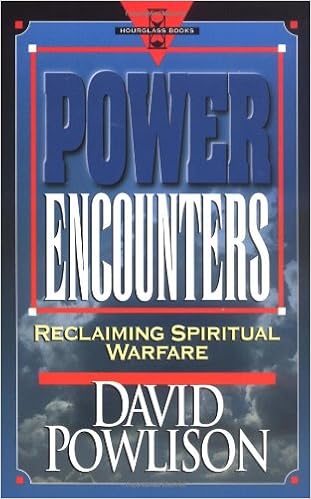
Book Review: David Powlison's Power Encounters: Reclaiming Spiritual Warfare


One of the things that struck me first about this book was the irenic way Powlison handles those he disagrees with. The doctrine of spiritual warfare has a wide variety of self-styled experts vying for the attention of Christians. Many of these “experts” appear to draw their doctrine of demonology and spiritual warfare more from the writings of novelist Frank Peretti than from Scripture.

Practitioners and writers on spiritual warfare typically concentrate on what Powlison terms the Ekballistic Ministry Mode (EMM). The Greek derivation of ekballistic means “to cast out.” The idea of identifying, naming, and then casting out demons is the central feature of EMM. Sin, rather than being sourced from our old nature, is largely seen as the product of demons of lust, greed, etc.

Powlison challenges the entire EMM schema. He does so without using any cheap shots (which would be frankly easy to do, given some of the ideas of EMM practitioners). Rather, he makes his points with careful, contextual, exegetical precision, dismantling the careless interpretations of the scripture texts normally cited in support of an EMM-style ministry. In fact, I would say the skillful exegesis Powlison employs is the defining characteristic of this little book.

Another treasure of Power Encounters is the wise manner in which Powlison distinguishes between moral evil and situational evil. His point is that the distinction between the two different kinds of evil calls for a different response to each, a matter that EMM completely overlooks.

Powlison’s answer to EMM is what he calls “classic mode” ministry: helping Christians deal with troublesome sin in their lives, as well as demonic oppression, by taking them straight to the cross. The gospel is the most powerful weapon. It is the only weapon needed to completely defeat the forces of darkness.

The worst part of Power Encounters is that it has gone out of print. That should never have been allowed to happen to a resource this valuable. Every pastor and biblical counselor should have a copy of this little book. Used bookstores are charging three figures for old copies. I purchased mine from biblicalcounselingbooks@gmail.com and more are available from them. They have secured permission to make reprints. For a slender book weighing in at 160 pages, $30 was a fairly steep price. It was worth every penny. Five stars, highly recommended.

Friday, January 5, 2018

Review of David Powlison's Making All Things New

Making All Things New: Restoring Joy to the Sexually Broken” is an outstanding book, suitable for both counselors and counselees, and in all probability needed by both (and for the same reasons). Even if we’ve never crossed the line in sexual sin (possible, but highly unlikely in light of Matthew 5:27-28), we’ve all been tempted to find our comfort in resources other than God Himself. That’s ultimately the issue David Powlison addresses.

Though expressing himself in prose Powlison writes like a poet, with deep empathy and suffused with understanding and hope. The intended audience includes both the victimized and the victimizer, and both men and women. This book is no “bible band aid,” but is a theologically responsible, Christ-centered look at the knotty problem of sexual sin.

Powlison spends Chapter 1 orienting the reader to his approach; it is grounded in the realities of the biblical Christian faith: sexual fidelity is good, sexual sin is wrong, and Christ alone can transform the unfaithful into the faithful. The reader is questioned in Chapter 2 about where he or she stands in relation to the topic of sexual brokenness. Hope wrapped in warm understanding of life’s suffering and difficulty is offered. The road of healing is characterized as “walking toward the light,” a metaphor that disabuses us of the notion of quick fixes, all the while holding forth hope for the future.

In Chapter 3 he explores the wide varieties of behaviors that can turn God’s wondrous gift of sex into tragic darkness. At each turn he reveals how such behaviors fall short of and pervert God’s good intentions, and how God in Christ draws near to offer deliverance and healing to both the victim and the predator.

Chapter 4, Renewal is Lifelong, is outstanding. Though aspects of sanctification are indeed crisis events, and God does sometimes deliver in a single stroke, more frequently the process is a long one involving progress, regress, and sometimes standing still. Both healing and growing in obedience are challenges requiring endurance and patience. For biblical counselors, this is a helpful corrective to some of Jay Adams’ earlier writings. One could get the impression from, say, “ChristianCounselor’s Manual,” that nouthetic counseling fixes problems in a relatively short time. Sometimes it does. But the more frequent experience (and I think Adams would agree) is that progress in overcoming habitual sin issues is often slow, beset with setbacks, and in many cases continues until the end of life. Powlison makes the important point that the crucial issue in sanctification is that we are oriented in the right direction—towards Christ.

In Chapter 5, Powlison pulls the dirty veneer off long-term sexual sin, demonstrating that there is more going on in the heart than simply the fall to lust. In fact, what’s going on in the heart might be even more abominable: a reduction of grace to an inverted retribution theology (“I serve You, but You haven’t given me what I want, therefore I will take revenge by indulging in sexual sin”).

In Chapter 6, Powlison discusses some of the motives that might be at work behind sexual transgression, and some of the motivations that might be behind a victim’s responses.

Chapter 7 is spent peeling back the layers of the onion to show that the battle is not simply against the outward, obvious, “big” sin. There are progressive levels of sin and temptation on which the battle for Christ-glorifying purity will be fought, some of which are so subtle and insidious we can barely detect them except in retrospect.

Powlison reminds the reader in Chapter 8 that the goal is much larger than merely not sinning: it is Christlikeness. God’s words to us, “I am with you,” become the focus of the final chapter, in which Powlison encourages us to “get down to today’s skirmish in the great war.”


David Powlison is a gifted counselor and writer: this book just might be Powlison at his best. Highly recommended.