Showing posts with label Tozer. Show all posts

Wednesday, May 29, 2019

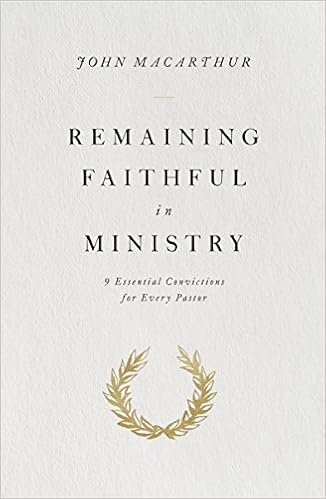
Book Review: MacArthur's Remaining Faithful in Ministry


Often it is the slender books, the brief books, that are most profound. In this class I would include such writings as Andrew Murray’s Humility: the Journey toward Holiness, Tozer’s Knowledge of the Holy, and Stott’s Basic Christianity. I can now add MacArthur’s RemainingFaithful in Ministry to this list. At just seventy-seven pages it is a book that punches far above its weight.

MacArthur writes on selected texts from 2 Corinthians 1-4, drawing nine points of faithful ministry out of Paul’s testimony to the Corinthian church. In one sense it is standard MacArthur: solid yet accessible exegesis, comparing Scripture with Scripture, delving into Greek terms when it enhances the meaning of the English text, combined with biblically faithful application. The power of his writing lies wholly within his skillful use of the biblical text.

The subtitle is 9 Essential Convictions for Every Pastor, and the book delivers abundantly on that theme. Every man in pastoral ministry should read this book and come under the weight of its convictions. Five stars, highly recommended.

Wednesday, October 9, 2013

And a little more Tozer!

Lost in today’s religious world is the radical antithesis between the redeemed and the unregenerate. “Coming to church” has become the test of faith, rather than joyful belief in and submission to the pure, unadulterated message of the Gospel. But “coming to church” is a duty attended to by all the world’s religions, and no more makes one a Christian than a visit to a clinic makes one a medical doctor.

Christianity is first and last a relationship with a real, living Person—Jesus Christ, a relationship possible only when one has been regenerated, brought from a state of spiritual death to life. It is not wrapped up in the confession of a concept, the reciting of a creed, the joining of a church, or warm religious feelings. Jesus Christ is the Living God—which means He actually exists as a real person, a thinking, choosing, volitional, emotional Being. He exists wholly independently from creation, from people, from human consciousness. He was before all things, and by Him all things exist.

Any religious sensibility that names Jesus and confesses to love and admire Him yet falls short of a genuine redemptive relationship with Him as a real, living Person is in no way Christian. Tozer’s comments on this sort of “Christianity”—which is essentially unchanged by an encounter with Christ and feels equally comfortable with the world and the Church—are helpful.

It is no more than a religious platitude to say that the trouble with us today is that we have tried to bridge the gulf between two opposites, the world and the Church, and have performed an illicit marriage for which there is no biblical authority. Actually no real union between the world and the Church is possible. When the Church joins up with the world it is the true Church no longer but only a pitiful hybrid thing, an object of smiling contempt to the world and an abomination to the Lord.

The twilight in which many (or should we say most?) believers walk today is not caused by any vagueness on the part of the Bible. Nothing could be clearer than the pronouncements of the Scriptures on the Christian’s relation to the world. The confusion which gathers around this matter results from the unwillingness of professing Christians to take the Word of the Lord seriously. Christianity is so entangled with the world that millions never guess how radically they have missed the New Testament pattern. Compromise is everywhere. The world is whitewashed just enough to pass inspection by blind men posing as believers, and those same believers are everlastingly seeking to gain acceptance with the world. By mutual concessions men who call themselves Christians manage to get on with men who have for the things of God nothing but quiet contempt.

This whole thing is spiritual in its essence. A Christian is what he is not by ecclesiastical manipulation but by the new birth. He is a Christian because of a Spirit which dwells in him. Only that which is born of the Spirit is spirit. The flesh can never be converted into spirit, no matter how many church dignitaries work on it. Confirmation, baptism, holy communion, confession of faith—none of these nor all of them together can turn flesh into spirit nor make a son of Adam a son of God [Tozer, ThePursuit of Man, pp 115-7].

Tuesday, October 8, 2013

More Tozer

The true Christian has a passion and love for truth, and feels not at all uncomfortable with the imperialistic, exclusive nature of truth. And yet if that passion for truth is not regulated by warm love for our neighbor, we are to the lost but frowning, bitter advocates of something the world finds to be foolish. Truth riding on the crest of love is appealing, but mired in the muck of pride it can be disgusting. In the nature of God these two great forces are never in tension: "Lovingkindness and truth have met together; righteousness and peace have kissed each other" (Ps. 85:10). Not so in man. If we are not trained by humility, we will attempt to wield truth as a battering ram with which we try to bludgeon our neighbors, our children, and our spouse into submission.

As Tozer focuses on the Holy Spirit in the last third of his book, The Pursuit of Man, he speaks about love and truth:

The blight of the Pharisee's heart in olden times was doctrine without love. With the teachings of the Pharisees Christ had little quarrel, but with the pharisaic spirit He carried on unceasing warfare to the end. It was religion that put Christ on the cross, religion without the indwelling Spirit. It is no use to deny that Christ was crucified by persons who today would be called fundamentalists. This should prove most disquieting if not downright distressing to us who pride ourselves on our orthodoxy. An unblessed soul filled with the letter of truth may actually be worse off than a pagan kneeling before a fetish. We are safe only when the love of God is shed abroad in our hearts by the Holy Ghost, only when our intellects are indwelt by the loving Fire that came at Pentecost. For the Holy Spirit is not a luxury, not something added now and again to produce a deluxe type of Christian once in a generation. No, He is for every child of God a vital necessity, and that He fill and indwell His people is more than a languid hope. It is rather an inescapable imperative [A. W. Tozer, 106].

Nowhere is this human, fallen, and wholly unnecessary contradiction between love and truth seen so clearly as in our communications on the Internet. Our flame wars do little more than demonstrate how little the truth has changed us, and I am as guilty as the next. We are like the sons of thunder, who in the face of rejection asked Jesus, "Lord, do You want us to command fire to come down from heaven and consume them?" (Luke 9:54). Jesus' response to James and John is one we still need to heed today: "But He turned and rebuked them, and said, “You do not know what kind of spirit you are of; for the Son of Man did not come to destroy men’s lives, but to save them" (Luke 9:55-56, while there is a textual issue with His precise words, there is none with the fact of His rebuke).

May God invade us with His Holy Spirit, that our stand for truth would be unyielding but bathed in warm-hearted love and respect for those who do not yet know the Truth, Whom to know aright is life eternal.

Monday, September 30, 2013

Tozer: Victory through defeat

On Facebook I've been posting excerpts from A. W. Tozer's The Pursuit of Man. I'm continuing that series here. The following is from chapter 4: Victory through Defeat. Tozer's basic point in this chapter is that we must be conquered by the cross and know death thereon, before we can truly know life.

We might well pray for God to invade and conquer us, for until He does we remain in peril from a thousand foes. We bear within us the seeds of our own disintegration. Our moral imprudence puts us always in danger of accidental or reckless self-destruction. The strength of our flesh is an ever present danger to our souls. Deliverance can come to us only by the defeat of our old life. Safety and peace come only after we have been forced to our knees. God rescues us by breaking us, by shattering our strength and wiping out our resistance. Then He invades our natures with that ancient and eternal life which is from the beginning. So He conquers us and by that benign conquest saves us for Himself.

With this open secret awaiting easy discovery, why do we in almost all our busy activities work in another direction from this? Why do we build our churches on human flesh? Why do we set such store by that which the Lord has long ago repudiated and despise those things which God holds in such high esteem? For we teach men not to die with Christ but to live in the strength of their dying manhood. We boast not in our weakness but in our strength. Values which Christ has declared to be false are brought back into evangelical favor and promoted as the very life and substance of the Christian way. How eagerly do we seek the approval of this or that man of worldly reputation. How shamefully do we exploit the converted celebrity. Anyone will do to take away the reproach of obscurity from our publicity-hungry leaders: famous athletes, congressmen, world travelers, rich industrialists; before such we bow with obsequious smiles and honor them in our public meetings and in the religious press. Thus we glorify men to enhance the standing of the Church of God, and the glory of the Prince of Life is made to hang upon the transient fame of a man who shall die. . . .

. . . The loss, the rejection, the shame, both belong to Christ and to all who in very truth are His. The cross that saves them also slays them them, and anything short of this is pseudo-faith and not true faith at all. . . . How can we face Him who was crucified and slain when we see His followers accepted and praised? . . .

. . . [I]f I see aright, the cross of popular evangelicalism is not the cross of the New Testament. It is, rather, a bright new ornament upon the bosom of self-assured and carnal Christianity whose hands are indeed the hands of Abel, but whose voice is the voice of Cain. The old cross slew men; the new cross entertains them. The old cross condemned; the new cross amuses. The old cross destroyed confidence in the flesh; the new cross encourages it. The old cross brought tears and blood; the new cross brings laughter. The flesh, smiling and confident, preaches and sings about the cross; before the cross it bows  and toward the cross it points with carefully staged histrionics--but upon that cross it will not die, and the reproach of that cross it stubbornly refuses to bear. . . .

. . . The life that halts short of the cross is but a fugitive and condemned thing, doomed at last to be beyond recovery. That life which goes to the cross and loses itself there to rise again with Christ is a divine and breathless treasure. Over it death hath no more dominion. . . .