Showing posts with label Book Review. Show all posts

Wednesday, January 22, 2025

Review of Andrew Snelling’s two-volume Earth’s Catastrophic Past

Earth's Catastrophic Past 

It would not be hyperbole to say that these 1100 pages are Snelling’s magnum opus. Extensively documented, irenic in tone, accessing the works and research of both conventional scientists as well as creation scientists, Snelling makes a solid case that the Genesis record of both Creation and Flood is well supported by painstaking science and empirical data.


In the Introduction, Snelling spells out why it is important to take Genesis seriously. In Section 1, he reviews the biblical record pertaining to Creation and the Flood from both the Old Testament as well as the New. This review enables the reader to understand exactly what Snelling is arguing for, as well as what he is NOT arguing for.

Section 2 considers the opposing arguments that arise outside of geology from other academic disciplines. Noah’s ark and the events surrounding it comprise Section 3. Snelling offers ideas on how the gathering, care, and Post-Flood distribution of species might have been accomplished. A suggested framework for a biblically committed geology occupies Section 4. Volume 1 concludes with Section 5, a look at the modern, conventional geologic synthesis. The Geologic Column and the rock types included in it are discussed extensively, as well as an examination of Plate Tectonics.

Section 6 leads off Volume 2 by an honest examination of the geological implications of both the Creation and Flood models. Such catastrophic events could not help but leave their finger prints on the geologic record, and Snelling shows that those finger prints do in fact exist in the geologic record. Section 7 proposes a biblical geologic model of earth history.

Section 8 considers specific problems in radioactive dating methods. Section 9 exposes contradictions in conventional geology’s treatment of comets, fluctuations in the earth’s magnetic field, sea salts and sediments, volcanic activity and the presence of helium, radiohalos, and population statistics.

Finally, Snelling concludes his magisterial work by examining geologic formations that, on the surface, seem to imply slow deposition over long time periods (i.e. conventional geological interpretations). Using actual observations and experiments Snelling shows that the supposed problems for a biblical understanding of Creation and the Flood are not as intractable as they might first appear.

Earth’s Catastrophic Past is a work of science, not primarily an exposition of Scripture, although it honors and argues for the literal biblical perspective on Creation and the Flood. Snelling documents all his assertions, statistics, facts, and experimental outcomes, whether quoting a conventional geologist or the work done by geologists committed to a biblical paradigm. The two volumes are somewhat accessible for the layman. I say somewhat, because back in the 70’s I got halfway through a degree program in geology at Colorado State before switching schools and majors, but reading Snelling’s work was stretching for me from a scientific standpoint.

In conclusion, Snelling has made a case that requires an answer. He has challenged conventional geological interpretations of earth’s history, exposing theories and conclusions that are not only not supported by the data, but blatantly contradicted by both observation and experiment. Snelling has shown that empirical observations from multiple disciplines not only make room for a biblical view of Creation and the Flood, but beyond that, are best explained by the biblical view. 

Five stars, highly recommended.


Wednesday, December 20, 2023

Review of Surprised by Doubt: How Disillusionment can Invite us to Deeper Faith, by Chatraw and Carson

Surprised by Doubt: How Disillusionment can Invite us to Deeper Faith

This is a really good book. It has several problems, which I’ll discuss last, but if you just skim book reviews, I want to make my point early on: this is indeed a good book and can be used effectively with those wrestling with doubt.

As you might guess, the title is a take-off on C. S. Lewis’s Surprised byJoy. The similarities rise to more than just the title. The authors quote Lewis frequently as they make their case for genuine Christianity. Their writing style is warm and not overly academic—also like Lewis’s. On balance the book is an invitation to carefully rethink the issues that have provoked many moderns toward skepticism, or even outright rejection, of the claims of the Christian faith.

One thing that adds to their credibility is that the authors themselves have struggled with doubts about their own faith. Another is that they honor questions and doubt without dismissing or belittling the skeptic. Instead, they engage with the doubts. Another is their humility: they freely admit they don’t have answers for all of the questions. Carson and Chatraw make a case for mystery—that unanswerable mystery should be expected when investigating a sovereign God.

I’m thankful that they are going after base hits, not home runs—they admit repeatedly that they cannot prove the existence of God or the claims of the faith. Instead they are building a “wager” that the Christian explanation of reality is far more likely than alternative explanations.

The principal metaphor they employ for the Christian faith is that of a great house with many rooms, each representing a different flavor of historic, orthodox Christianity. Chatraw and Carson divide the book into three sections: The Attic, Outside the House, and The Main Floor. The rooms on the main floor all share the same load-bearing walls. The load-bearing walls represent the unifying commonality of the essentials of the orthodox faith. In other words, while each room might differ on peripheral issues, if you’re on the main floor, you are a legitimate, true Christian.

In Part 1, the first five chapters of the book, Chatraw and Carson flesh out the metaphor, saying that some people have moved up to the attic and erected new walls consisting of peripheral issues that the attic dwellers insist are load-bearing. These individuals tend to say, “if you don’t have the same walls I do, you’re not really a Christian.” Like most attics, the ceiling is not high, and these Christians have adopted a stooped posture, unable to stand up straight. That stooped posture skews how they see others and how they read the Bible.

The authors provide several examples of attic dwellers. Evangelicalism on the left, with its nouveau catechisms of social justice and sexual/gender doctrines gets a mention. Fundamentalism on the right, with its dogma specifying the approved positions on culture (politics and political parties, forms of entertainment, use of alcohol and tobacco) or theology (eschatology, position on modern Israel, the ordinances, church governance), occupies a large part of the authors’ concerns. Some churches and fellowships (right and left) become vitriolic in their insistence that all true believers must share their particular distinctives.

The authors’ chief concern in the book is for believers who grew up in an “attic church” and have reached a point of disillusionment in which they are ready to jettison the faith because they see these questionable and peripheral issues being confidently elevated as though they are essentials alongside the actual Gospel.

In Part 2, chapters six through nine, Chatraw and Carson encourage the reader to examine closely the ground outside the house before jumping out of the Attic window (the metaphor is escape, not suicide). Four alternate philosophies are explored: the New Atheism, Optimistic Skepticism, Open Spirituality, and Mythic Truth. Chatraw and Carson drive the presumptions attached to each of these secular philosophies to their logical conclusions, demonstrating that the ground outside the house is not quite as inviting as it might first appear. Jumping out the Attic window simply trades one set of problems for an even worse set.

In Part 3, chapters ten through sixteen, Chatraw and Carson invite the reader to come down to the main floor and have a look around. “Now, as we turn to explore the main floor of the Christian house, we are asking a different question: Does Christianity offer a better foundation, better explanatory power, and a better way to live than the [outside] spaces we explored in part 2” [93]? They employ three perspectives: C. S. Lewis’s device of “Looking at” and “Looking Through,” to which they add “Stepping In.”

“Looking at” is a serious exploration of the historical evidences of the resurrection in chapter ten. What explanation provides the best understanding of the claim that Jesus was raised from the dead: Fraud? Hallucinations? Chatraw and Carson provide multiple reasons why the claims of Jesus’ resurrection are best explained by His actual, historic, physical resurrection.

Next, in chapter eleven, the reader is asked to look at the Person in the Center—Jesus Himself. Are the four gospels credible? Did they misrepresent Jesus? What kind of man was He? The authors point out that the gospels present Jesus as one who challenged and scandalized the orthodoxies of His day, rather than one whose ministry was calculated to win wide approval.

In chapter twelve, we are invited to examine the load-bearing walls that are absolutely essential to the integrity of the house over all. “This brings us to the load-bearing walls of the Christian faith. Attic Christianity mistakenly makes the house appear as though most of its walls are load-bearing or at least integrally attached to the load-bearing walls” [113]. The authors’ answer is to step back and look at the historic creeds which have stood the test of time over the centuries, such as the Apostles’ Creed. The Apostles’ Creed has been accepted by the Church at large as a legitimate statement of faith for at least fifteen hundred years by believers in different faith streams of Christianity. It provides common ground for the Christian faith.

Moving to the motif of “looking through,” in chapter thirteen the authors explore Pascal’s critique of Descartes’ skeptical approach to knowledge. In Pascal’s view, the human appreciation of and desire for transcendent truth, beauty, and goodness is itself an argument for God. Pascal’s “wager” is to “take all of the aspects of human behavior into account, and ask this question: Where might true joy be found” [131]?

Chapter fourteen suggests that justice, human dignity, beauty, and meaning are all markers “gesturing toward a profound and mysterious meaning” [140]. In the authors’ words, “Christianity provides a window that makes sense of the world, including human nature and our deepest aspirations” [134]

The third perspective, “Stepping in,” occupies chapters fifteen and sixteen. Chatraw and Carson suggest that the skeptic “try” Christianity. “If you’d like to believe in Christianity, but don’t think you can, you might be going about things the wrong way. It could be that you have been trying to control contingencies in order to achieve a certain kind of certainty, your own two-plus-two approach to the God question” [147]. They provide three reasons for staying on the “main floor” rather than bolting through the window:

  • There are good reasons to take the core claims of Christianity seriously [149];

  • What other options do you have [149]?

  • Since we can’t opt out of formative practices altogether, the question becomes which practices best form us for flourishing [151].

The chapter ends with this hopeful sentence: “But the collective witness of his people and the Scriptures is that those who humbly continue to seek God will eventually find him” [153]. Chapter sixteen suggests the spiritual practices the seeking skeptic should engage in: participate in the sacred by observing birth, death, and marriage; commit to a room on the main floor of the house that is serious about worship; slow down and pray; meditate on Scripture; slow down to appreciate the beauty of creation; and continue to look both at and along the faith.

Though I believe Surprised by Doubt is a helpful book to give someone who is considering “deconverting” from the faith because of disillusionment, I do have several concerns. For one, the authors don’t consider the matter of recent creation to be one of the load-bearing walls of the faith. It is presented as a (losing) argument with science that contributes to the disillusionment of doubting believers. But the doctrine of creation refuses to play nice. Once you give ground on recent creation by accepting some combination of theistic evolution or old-earth theories, you’ve started pulling on a thread integrally connected to nearly every major doctrine of Scripture. Besides, “science” is not speaking with a unified voice on evolution and long ages: genuine empirical science is calling into question major assumptions made by evolutionists. “Received truth” like James Hutton’s principle of uniformitarianism, the bedrock of evolutionary geology, is being seriously challenged (even by secular geologists). Andrew Snelling’s magisterial work Earth's Catastrophic Past Geology, Creation and the Flood (two volumes) documents the modern scientific discoveries that dispute doctrinaire evolutionism. Is the doctrine of recent creation a load-bearing wall of the Gospel? Perhaps not, but the loss of the doctrine throws a great deal of historic orthodoxy into difficulty. Just like the authors were courageous to drive the four secular philosophies to their logical conclusions, it might be wise for them to do the same thing if one jettisons recent creation: the resulting theological problems are daunting.

Like C. S. Lewis, Chatraw and Carson also admit to the possibility of universalism, as though the doctrine of eternal judgment is a non-load-bearing wall. Despite the authors’ loyalty to historic orthodoxy, apparently that’s a historic doctrine they have chosen to overlook.

My final concern has to do with their closing advice—engage in spiritual disciplines. For readers who are genuinely regenerated but are struggling with doubts, that is precisely the right advice. Their re-immersion into spiritual disciplines will eventually have its intended effect. But for readers who are disillusioned because they’ve never truly been regenerated (in other words, to whom 1 John 2:19 applies), Chatraw’s and Carson’s advice sounds like preparationism—a highly disputed practice in orthodox circles. In their own words: “Without claiming a mechanistic and universal demonstration of the truth of Christianity through these practices, in this chapter we’ve been inviting you to wager on Christianity by developing habits that allow you to step into its light. If there is a God and Christianity is true, these practices are some of the means of experiencing his grace” [160].

These problems aside, I think this book can be greatly used of God for people who are wrestling with doubts. The authors’ gentle tone and style, the focus on the essentials, the easily understood metaphor, and the excellent reasoning combine to make this a useful book. Four stars, highly recommended.

Thursday, August 17, 2023

Book Review: The Toxic War on Masculinity


Nancy Pearcey is one of the premier Christian thinkers of the modern age. At one time a student of Francis Schaeffer, she has extended and elucidated the thought of Schaeffer into the current cultural morass, particularly Schaeffer’s analysis of the secular idea of upper- versus lower-story truth. Also like Schaeffer, she does an excellent job of tracing the evolution of cultural trends through history, providing numerous footnotes—no less than 775 in The Toxic War on Masculinity. This excellent volume demonstrates that she does not shrink back from confronting both secular and Christian cultures with the sharp edge of her intellect.

Pearcey begins with full disclosure as to why she wrote the book. Her father lived two different lives: in public a respected university professor and in private an angry, abusive father. After initially rejecting Christianity because of her father’s hypocrisy, a sojourn at L’Abri showed her what true Christianity looks like, resulting in her conversion to genuine Christianity. The book serves as her way of tracing the cultural and psychological factors that produced an abusive man like her father and the current broad-brushed societal tendency to attribute such bad behavior to all men.

Chapter one is devoted to exploring where the modern culture is with regard to its view of men. Pearcey brings forward a contrast she’ll use in the rest of the book: “real men” versus “good men.” So-called real men kowtow to twisted cultural expectations of men (such as the expectation and encouragement of bad behavior), whereas good men pursue the best and most noble aspects of masculinity.

Exploding the myths begins in the second chapter, in which she quotes suprising statistics regarding men and abuse and divorce. Pearcey examines the studies more closely and reveals that while nominal Christian men score in the highest category of abuse—which is what is usually reported in the media—committed evangelical Christian men actually score in the lowest (which you will never see in the media).

In the third chapter, Pearcey unfolds what a truly biblical marriage looks like, along with biblical concepts of headship and submission. She demonstrates that it doesn’t look anything like the slanderous stereotypes of the secular culture.

The second part of the book (nine chapters) traces “how the secular script turned toxic.” In these lavishly-documented chapters, Pearcey follows the progression—and destruction—of family life from the original agricultural model of every family member working together at home, through the Industrial Revolution that took men out of the home, thus weakening or eliminating the father’s beneficial influence. The absence of fathers (who were now working long hours in the factories) meant that they were not home to teach their sons skills and moral discipline and to mold them into responsible men. Absence from home and hearth left men open to temptations (particularly illicit sex and alcoholism) that before had been under better control. Men began behaving badly with the result that, comparatively, women were placed on a moral pedestal of righteousness. Men behaving badly, i.e. “real men,” became the expectation and somewhat of a self-fulfilling prophecy. Men lost interest in attending church, with the result that most of the attenders in the average church were women.

Pearcey points out that one of the consequences of this terrible trajectory is that Christianity came to be seen as a religion of women. Men wanted nothing to do with it because it seemed feminized. The image of the “real man” became stamped in the culture; the “good man” was something no self-respecting man wanted to be part of.

In chapter ten, Pearcey examines the reaction against feminized Christianity that developed in some quarters. A so-called “muscular Christianity” was promoted in order to redeem “manliness.” Churches began to host events of interest to men (fight clubs, gun giveaways, etc.) in an attempt to draw men back into the sanctuary. Fundamentalism got involved, with macho preachers engaging in violent antics on stage to assert that Christianity was for real men. Just as a pendulum that swings in one direction soon returns to the other, this began a backlash against women. Whereas in the 19th century women were thought of as superior, in the 20th century they began to be thought of as inferior—weak creatures whose primary responsibilities were bearing children and being subservient to their husbands.

Secular culture rejected the polarizing fundamentalism. In chapter eleven, Pearcey unfolds the path that led to men (dads in particular) being presented by Hollywood as dimwits. Feminists poured gasoline on the fire: “men are unnecessary,” they claimed. Out of the resentment that developed on the male side came the playboy and pornography culture.

It’s easy to critique culture—but advocating solutions is harder. Nancy Pearcey does a great job on the solution side in chapter twelve, entitled “Bringing Fathers Back: Fix the Workplace, Fix Your Family.” She gives many creative ways to bring the unity of the home, father and mother together, back to the fore.

The third section of the book is basic triage: how to fix the problems that develop when “Christian Men Absorb the Secular Script.” Two excellent chapters are devoted to fixing broken marriages and dealing with abuse in Christian homes.

Pearcey is the real deal: a Christian and biblical thinker, a scholar, and one who has suffered under an abusive father. She brings her intellect, her scholarship, her faith, and her experience to the table and shares it with the reader. The book includes a study guide at the end, suitable for individuals or groups. Nancy Pearcey’s The Toxic War on Masculinity is an outstanding book and well worth your time. 

Five stars—highly recommended.

Tuesday, April 25, 2023

Review of Matthew Barrett's Simply Trinity

Review of Simply Trinity:The Unmanipulated Father, Son, and Spirit, by Matthew Barrett.


This is a hard book to review. The author is attacking the view that Jesus Christ is, functionally, eternally subordinate to the Father even while being ontologically equal with Him. This view is known as eternal functional subordination (EFS). Barrett’s tone at the beginning was so unnecessarily off-putting to me that I had to get over my irritation before I was ready to fairly assess his argument. Eventually he was able to convince me.

As far as the positives go, Barrett is clearly an accomplished expert on the church fathers, both pre- and post- Nicene. His arguments are firmly grounded in logic, philosophy, and the historical development of the theology of the Trinity. The vast bulk of his assertions come from these quarters, less so from Scripture (though he handles the Scripture well). Unfortunately, Barrett dismisses opposing arguments that rise from Scripture by perjoratively labeling his opponents as “biblicist,” as though they were unaware of the context and larger narrative of Scripture.

Barrett’s main argument is that the only distinctions between the persons within the ontological Trinity (ad intra) are “eternal relations of origin:” the Father is unbegotten, the Father eternally begets (generates) the Son (meaning the Father eternally communicates to the Son His own essence and nature), and the Father and the Son spirate, or send forth, the Holy Spirit. Barrett admits to additional distinctions in the outward operations (ad extra) of the economic Trinity.

In chapter three, Barrett does a good job in tracing modern liberalism’s illegitimate reconstruction of the Trinity to fit their own agenda for society. But in my opinion, he wrongly accuses conservative, biblical theologians of doing the same thing: starting with their desired construct of social relations and then imposing that construct on the Trinity. This seems to me to be a grossly uncharitable charge: is it not possible that those theologians derive their view of the Trinity (even though incorrect) from their honest understanding of Scripture and then see analogs in human relationships? Barrett gets in the way of his own message repeatedly with accusations like this. Another example is found on page 36 where he throws out the accusation that sola scriptura has been interpreted as “me and my Bible alone.” This is unfortunate: Barrett’s debate is with theologians, not the average believer in the pew. Does he really think any credible theologian would hold such a silly view?

Occasionally Barrett appears to overstate his point. On page 104 we find this statement:

For the first-century believer, to become a Christian was to embrace the salvation given and accomplished by none other than the triune God: Father, Son, and Holy Spirit…. For these early Christians, to believe the gospel was to believe that the one God of Israel was triune. Anything less was simply not Christian. A gospel that was not trinitarian was no gospel at all.
Well, yes. And, no. While belief that Jesus is the divine Son of God was (and is) crucial to salvation, there was still much confusion, even among believers, as to exactly how that truth was to be reconciled with the historic monotheism of the Jews. Barrett’s confident assertion flies in the face of 400 years of church history, in which godly men were seeking to untangle the mystery of the Trinity. Barrett seems to claim that the first century Christians had it all figured out. But does not the early history of the church record their debates, disagreements, and difficulty in fitting the pieces together?

On the other hand, there are places in which Barrett is able to condense his argument to a single, brilliant statement, and this constitutes a large part of the value of his book. For example, on page 123 Barrett states: “[Christ’s] eternal relation to the Father constitutes his redemptive mission to the world, but not vice versa. Get that order right, and we see the gospel in proper trinitarian perspective; get that order wrong, and we misuse the gospel to redefine the Trinity in eternity.”

In my view, Barrett makes his strongest argument against EFS on pages 138-9. He builds a case that to be one in essence but manifested in three persons, means of necessity that there cannot be three different wills. Because the three (persons) are one in essence, there can only be one unified (simple) will. The one shared will of the Trinity rises out of the one shared divine nature of the Trinity. The problem with EFS is this: if Christ is eternally submitted to the Father’s will (rather than sharing the one and same will), it implies that there are two different wills—the Father’s, and Christ’s—which would then argue for two different natures. This creates an untenable division in the ontological Trinity; such a thing cannot be.

Barrett makes another powerful argument on page 239:
But EFS is asking the wrong question. The right question is this: is submission ad intra or ad extra; is it intrinsic to the immanent Trinity, or is it something that occurs in the economy (in the context of salvation history)? Biblical Christian orthodoxy has always acknowledged that the economy of salvation involves the incarnate Son submitting to the mission his Father has given to him for the purpose of salvation.
Barrett goes on to flesh out the thought. I think this is the point in which I finally allowed Barrett to sharpen my understanding, by understanding the Son’s submission to the Father to be connected to his redemptive mission but not to his eternal relation to the Father. Barrett deals with 1 Corinthians 15:24-28 on page 243, stating that it applies not to the Son in the form of God, but to the Son in the form of a servant: “The context is not the immanent Trinity but the economy, the redemptive mission of the incarnate Son.”

Like Barrett’s book, this review has already gone on too long. In conclusion I believe Barrett makes his principal point, demolishing EFS and asserting that the distinctions in the immanent Trinity have to do with eternal relations of origin. It is unfortunate that Barrett occasionally gets in his own way by unnecessary and uncharitable characterizations of people on the other side of the fence. For his excellent command of the early church fathers, Barrett gets five stars. For his at-times-uncharitable tone and the excessive length of the book and the sense of repetition, three stars. For the fact that he did ultimately convince me that my former position (EFS) on the Trinity was wrong, we’ll settle with four stars. Recommended.


If you don’t have the time to read Barrett’s book, read Mike Riccardi’s excellent five-page blog post entitled, “EFS Redux: Aiming for Closure on the Trinity Debate.” Google it. Riccardi gets right to the point (in five short pages), and his logic is unassailable.


Monday, March 27, 2023

Book Review: The Myth of Voter Suppression

Fred Lucas has the deep journalistic experience that qualifies him to write this book; his expertise is evident on every page. The Myth of Voter Suppression is an exhaustively documented treatment of the burning political question of the day: how can we ensure that each vote in an election has been cast by a legitimate, qualified voter without making the voting process so onerous that it keeps people from the polls? What becomes clear in the book is that not everyone has the same desire for fair and accurate elections. Kevin Roberts, the president of the Heritage Foundation, puts a real zinger in the foreword on page xiii: “That’s the Left’s real fear here: not that election integrity laws are evil, but that they are effective.”

The need to secure the vote in a day of bitter political divisions is crucial. Some on the Left allege that any implementation of effective voter identification laws is actually a surreptitious attempt to suppress the vote of the poor, the under-privileged, and minorities. Such a charge deserves to be examined carefully and closely: Lucas does just that. His treatment of the subject is open handed in one respect: he exposes cheating on both the Democrat and Republican sides. It is the practice of the Left (which I must admit is generally Democrat) to oppose any attempt to secure the integrity of elections, calling such attempts “voter suppression.” Lucas coins a rather clumsy term he uses repeatedly to label these opponents: the “voter suppression hysteria industrial complex.”

The book is written in two parts. Part 1 provides a history of the ways and means of fraud in elections, as well as legislative attempts to secure the vote. Lucas’ statement in the Introduction sets the tone and direction of the book:
“A war is being fought in this country. The battlefields are Congress, in state legislative chambers, and in the courts. At stake are American democracy and the integrity of elections. The two warring narratives overlap—voter fraud vs. voter suppression—and both have historical legitimacies. But regarding the current times, only one narrative has facts to support it. The other has only emotion and inflammatory rhetoric” [xxii].
Chapter 1 explores the historical linkage between fraud and suppression. As he does repeatedly, Lucas demonstrates that legislative attempts to secure the vote since the bipartisan Voting Rights Act of 1965 have generally resulted in higher, not lower, turnouts—even among minorities.

In Chapter 2, Lucas walks through the data and statistics from Arizona, Florida, Georgia, and Texas, exposing the lies that have been spun about “voter suppression” in those states. During President Biden’s January 2022 trip to Atlanta, Biden made the claim that Georgia’s efforts to put protections on the integrity of the vote were actually efforts to suppress the vote. Biden claimed, “It’s no longer about who gets to vote; it’s about making it harder to vote… It’s not hyperbole; this is a fact.” Lucas responds firmly, supplying data to back up his response to Biden’s claim: “It’s neither hyperbole nor fact. It’s demonstrably false” [31].

The author examines the data, in Chapter 3, regarding the historical voting practices of minorities to demonstrate that state-level voter ID laws have not negatively affected minority groups. Chapter 4 reveals the political forces arrayed against such common-sense efforts as purging the voter registration roles of people who have died or who have moved into a different district. Part 1 concludes with Chapter 5 detailing historical examples of the methods and attempts that have been aimed at tampering with an election.

Part 2 studies various aspects of the 2020 election. Lucas does not necessarily believe the election was stolen. On page 94 he says,
“Although the full story of the 2020 election hasn’t been told, subsequent investigations have provided noteworthy discoveries. Trump has overplayed the significance of each new discovery as absolute proof that he was the real winner—which the discoveries don’t prove.”
The anomalies of the 2020 election are explored in Chapter 6. Chapter 7 details various Democratic legislative attempts at the federal level that would make election fraud easier to commit. Chapter 8 exposes President Biden’s attempts to wrest the regulation of elections from the states to the federal government (whereas Article I, Section 4, Clause 1 of the US Constitution grants that power to the states).

Lucas examines Stacy Abrams in Chapter 9, and her multitudinous claims to the effect that the 2018 Georgia gubernatorial election was stolen from her. Lucas shows that she has enjoyed a rather lucrative career making such claims. “Follow the money” is the essence of Chapter 10, as Lucas uncovers the various organizations funding the opposition to voter identification and election integrity laws. Spoiler alert: they are all on the Left.

The threads Lucas has traced in the book find their summary in the Conclusion, entitled “Stopping Tammany Hall 2.0.” He argues that legislative reform must happen at the level of individual states, and he explores several efforts that are underway.

My copy of The Myth of Voter Suppression has 453 endnotes, each providing documentation enabling the reader to go back to the original sources to substantiate the factual claims presented in the book. Lucas concludes with this thought:
“History shows there have always been demagogues resisting changes to bring more integrity to elections. It’s important the public arm itself with the facts—both historical and contemporary. This is the only way to combat the lies of the new political machine” [178].
For the citizen who wants to arm himself or herself with the facts, The Myth of Voter Suppression is a good place to start. Five stars, highly recommended.

[Full disclosure: I received a free PDF copy of the book from the author for the purposes of review. I was not compensated in any way for this review.]

Tuesday, December 6, 2022

The Outlander Chronicles Series


Set in the future, but not futuristic, the year is 2120 when the Outlander Chronicles series begins. The global population is sliding south of eight million souls. Global warfare eighty years earlier had involved biological weapons; a near mass-extinction of the human population was the result. The diminishing, scattered population is inadequate to sustain any manufacturing, mining, electrical generation, refining, communications, or transportation. There are no governments, national or local. Separated by nearly a century from the world that was, the survivors’ knowledge of the old technologies has virtually disappeared.
Here and there, tiny knots of population—the Townies—have coalesced, people banding together for safety. Opposing them are small gangs of violent raiders (Anarchs and Slavers), who make surviving in an already-intolerable environment almost impossible.


Surrounded by the rusting ruins of the former world, a young man (Jacen Chester) decides there must be more to life than avoiding death. He determines to challenge the status quo and to found a community committed to the rediscovery and revival of art, education, and technology. Jacen encounters a mysterious stranger (Hakim Abdul al Malik), an older man who ultimately becomes Jacen’s mentor, instructor, and protector. The two join forces to pursue Jacen’s dream. But they must first survive the predations of the violent groups, and their own deep disagreements with one another.
The Outlander Chronicles series is a coming-of-age adventure in which Jacen’s most deeply held views on life, religion, and morality are severely challenged by the raw, bleeding edge of life and death. As his community grows and experiences tragedy and disastrous setbacks, Jacen’s developing leadership skills are put to the test.

Book #1, Outlander Chronicles: Phoenix, chronicles the beginning of the relationship between Jacen and Hakim, and the growing community they establish.

Book #2, Outlander Chronicles: Pegasus, traces the community and the many challenges and heartaches they face as they travel toward their chosen destination near the ruins of Denver, Colorado.

Book #3, Outlander Chronicles: Icarus, records Jacen’s and his community’s response to a horrific disaster, as well as the dangers of employing technology not fully understood.

The Outlander Chronicles series is available on Amazon in both Kindle and print formats, as well as from your local independent bookseller (through the Ingram catalog). Signed copies are available from the Doorway Press store. See all the C. H. Cobb novels at my website.


Friday, November 18, 2022

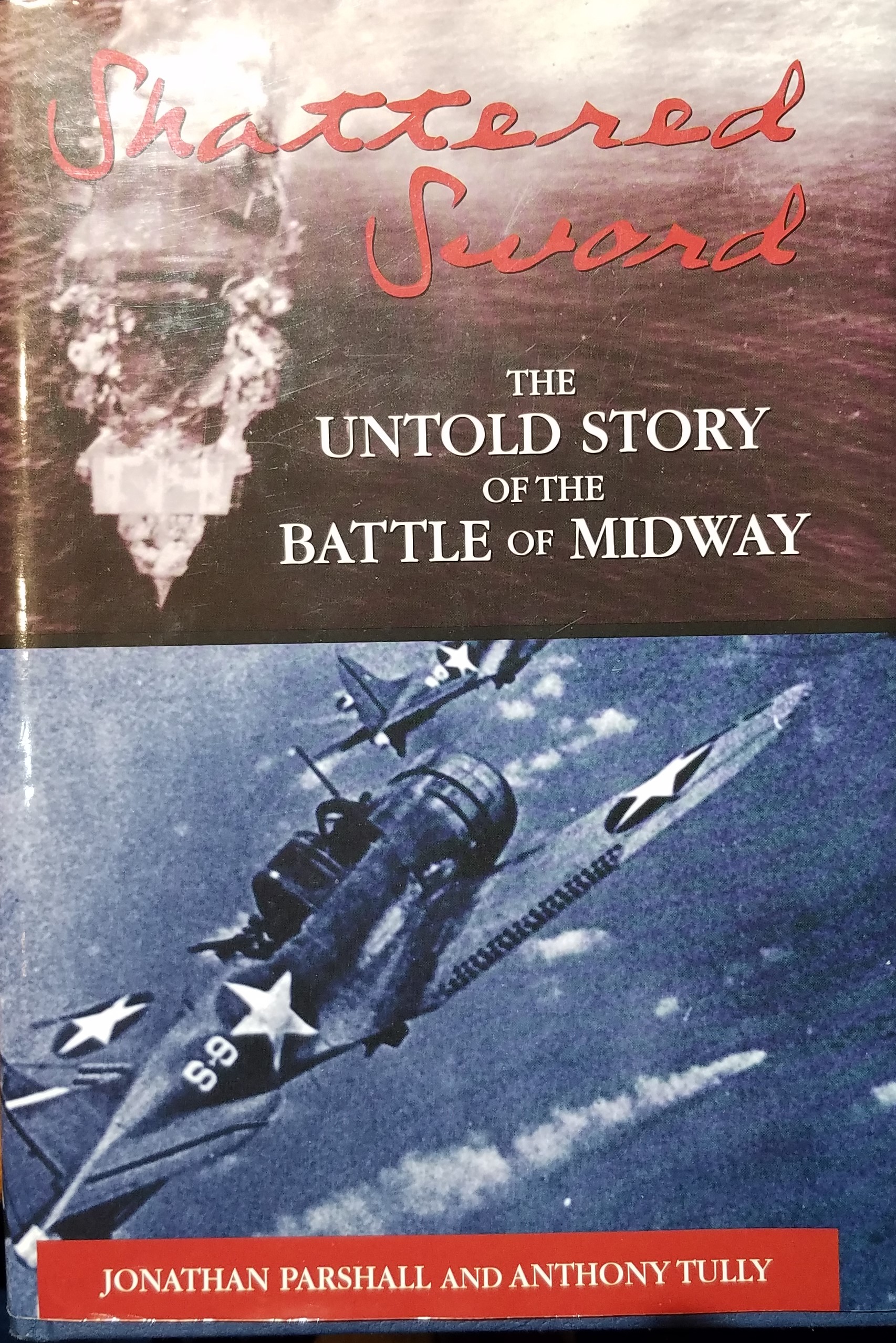
Book Review: Shattered Sword: The Untold Story of the Battle of Midway

 Review of Shattered Sword: The Untold Story of the Battle of Midway, by Jonathan Parshall and Anthony Tully.


I enjoy military history, especially when it’s wrapped around the events and happenings of World War 2. Usually, the author is trying to tell the story in a way both accurate and compelling, explaining and exploring command decisions and engagements, and the manner in which the battlefield itself, the action of individual units, and the vagaries of combat shaped the outcomes.

But Shattered Sword is in a class by itself. The writers have an agenda much larger than most—they intend to correct the received narrative of the battle of Midway, an erroneous narrative that has held sway for half a century. Their comprehensive research, which relies heavily on Japanese primary sources, has proven that most, if not all, of the popular accounts of the battle are significantly flawed, especially as regards the ultimate question of why the American naval forces won.

The book was a delight to read. The authors begin by delving deeply into the backgrounds of each of the principal characters, as well as the cultural ethos of the Imperial Japanese Navy. They explore the merits and demerits of each of the Japanese carriers and carrier aircraft. They expose the mind-numbing and initiative-stealing complexity of the overall Japanese battle plan for Midway. The entire process of preparing and arming the planes and spotting the flight deck for a strike is analyzed, down to the length of time a Zero’s powerplant needs to be warmed up in order to prevent damage to the engine upon launch.

I found the parts on Japanese naval doctrine, carrier operations, damage control, and air defense to be fascinating. Spoiler: the study of Japanese carrier operations became a major piece of evidence in substantiating the authors’ claims regarding the flaws in the received narrative, evidence that is buttressed by photographs taken during the battle.

The American side of the battle is also explored extensively, so the reader gets a sense for the simultaneity of the actions on the bridges and flight decks of ships on both sides of the conflict, as well as the strike and opposing defense aircraft. The reader is given precise timestamps (down to the minute) when the various decisions, communications, and actions were taken.

The book includes charts and drawings showing the relative dispositions of the carriers and their escorts, and once the attacks begin the direction of approach of the enemy aircraft. Eleven appendices detail the names of the personnel, the order of battle, technical details of the carriers, and a host of other matters that will be a goldmine for any writers or researchers that come after Parshall and Tully.

The book is fascinating, even gripping in places, exhaustively researched, and extensively documented. The authors successfully attain their agenda of correcting the record—conclusively in my opinion. Shattered Sword is the definitive resource for accurate information about the battle of Midway. Five stars, highly recommended.

Tuesday, July 26, 2022

Book Review: Three views on The Millennium and Beyond


This is an excellent book on what is fundamentally a very narrow question: is there an intermediate kingdom (a millennium) between the present age and the eternal state? The contributors chosen to represent their position (Kenneth Gentry for postmillennialism; Robert Strimple for amillennialism; Craig Blaising for premillennialism) are excellent scholars and skilled ambassadors of their particular take on the subject.

Each contributor outlines his position on the issue, followed by responses from the other two scholars. The postmill view goes first (along with the responses), the amill view is second, and the premill view (the longest section by far) wraps up the consideration. The overall tone is irenic and gracious--the book contributes light on the topic rather than heat--something I really appreciate.

Darrell Bock, the editor, writes an outstanding summary essay identifying the major interpretive issues that appeared repeatedly in the writing of the three contributors. This summary is excellent in its own right. In fact, I recommend reading the summary first, especially for those readers who are not very familiar with the debate. Bock does a good job of laying the issues out on the table and explaining their implications in a simple-to-understand format.

A recommendation: don't speedread this book. Read it slowly and carefully, looking up and thinking carefully about the Scriptures the writers cite. I forced myself to slow down and study the book carefully--as a result, I have gained a great deal more understanding about all three positions. And this even though I was already familiar with the issues, have studied the Bible for over 40 years, and have a graduate degree in Bible. Five stars, heartily recommended no matter what your starting position might be on the millennial question.

Saturday, January 1, 2022

Book Review: Eric Foner's The Fiery Trial

Excellent book. Foner traces the evolution of Abraham Lincoln's views regarding slavery, emancipation, black suffrage, colonization (meaning, the opinion during his day that blacks should be relocated out of the country), and the civil and social equality of the negro.

Several things stand out about this book. Foner unveils the gross and malicious racism of not only the southern states, but even the northern states. The Republicans were distinctly uncomfortable with the contradiction between the high ideals of the Declaration of Independence and the actual experience of the black population, but many were willing to live with that contradiction. The Democrats were fighting to preserve that contradiction, in many cases arguing that the blacks were either subhuman or too inferior to handle freedom (the growing popularity of Darwinism was used to buttress their argument, by the way).

Foner teases out the factions (radical abolitionists, conservative Republicans, moderate Democrats, Unionists, etc) with great skill and copious documentation. He also makes clear the complexity and tension of the competing priorities of ending slavery while preserving the Union, keeping the border states from seceding, all the while defending the Constitution. Reading Foner provides a much clearer picture of the difficulties the country faced than does the modern progressive evaluation of American slavery.

Once the gross sin of slavery was introduced into the colonies, the die was cast for a bloody reckoning in the future, a reckoning that the Declaration would exacerbate--because that document demonstrated that men knew what was right even if they chose not to do it.

Reading Foner's The Fiery Trial is a worthwhile education as to the morals and mood of mid nineteenth century America. Not only does it display the dark, sinful underbelly of our history, it also demonstrates that within the seeds of the American experiment were the tools of correction, the ability to right a gross injustice.

Five stars--well worth the read.

Wednesday, October 27, 2021

Book Review: Kidner's commentary on Jeremiah

There are times that Kidner's words in this brief commentary rise beyond mere explanations to profound observations. I was repeatedly delighted with his applications of biblical truth.

If you're looking for a technical commentary, this one isn't it. If you are a busy individual looking for a popular level commentary, something concise to keep you on the guardrails of responsible, orthodox interpretation, Kidner's commentary is what you need. The book of Jeremiah is fifty-two chapters long: an academic treatment would run to over 600 pages. Kidner does an excellent job with the text in 176 pages.

For the layman, the turbulent period of Jeremiah's ministry can be very difficult to untangle from a historical perspective, a task made more difficult because the swinging door of Judah's throne is complicated by the use of multiple names for the same monarch (e.g. Jehoiachin is Coniah is Jeconiah; Shallum is Jehoahaz is Joahaz). The organization of the Hebrew text of Jeremiah's prophecy reflects that tangled sense. Kidner does a great job helping the reader to sort things out and place them in the proper historical context.

Sometimes commentaries lose the big picture of the movement of the text, getting lost in arcane details. Kidner does an excellent job of tracking the overall direction of the text, never losing sight of its main thrusts, and pointing the reader to ultimate fulfillments in Christ. Five stars, highly recommended.

Thursday, August 19, 2021

Book Review of Jim Newheiser's Marriage, Divorce, and Remarriage

Marriage, Divorce, and Remarriage is a terrific book to use as a reference, or to read cover-to-cover.

Newheiser's writing style is very accessible and clear. I'm tempted to use the first part of the book ("Part 1: Marriage") as a tool for pre-marital counseling.

The book is comprehensive. It's hard to imagine situations arising which have not been somehow 
dealt with in this volume. As such it is a go-to reference for Bible-believing pastors and counselors.

Newheiser is also relentlessly biblical, and makes it clear when he's just offering an opinion as opposed to a clear biblical principle. He is very even-handed and gracious to those scholars who disagree with his interpretations of the texts. For instance, when it comes to the exception clause, he very faithfully represents and interacts with the arguments of those who see no exception at all.

The book is organized in two major sections broken into seven segments:

Part 1: Marriage

A. The Foundations of Marriage
B. Entering into Marriage
C. Having a Successful Marriage
D. Challenges in Marriage

Part 2: Divorce and Remarriage
A. The Foundations of Divorce and Remarriage
B. Divorce and Remarriage Controversies
C. Practical Questions

Each of the forty chapters are titled in the form of a question (for example, chapter 12 is entitled, "What are the responsibilities of a husband"). This format enables Newheiser to deal very concisely with the particular issue. In my opinion, the expectations raised by the chapter titles are fulfilled by the content.

Newheiser has made an outstanding and important contribution to the biblical counseling movement with this book. Five stars, highly recommended.

Tuesday, July 13, 2021

Book Review: Voddie Baucham's Fault Lines


Baucham’s book, Fault Lines, is an indispensable guide to how the modern Social Justice movement is affecting the otherwise orthodox Christian Church in America. Heavily footnoted with plenty of primary sources, Baucham makes the case that America’s preoccupation with “antiracism” is not simply a social movement but an inherently religious movement, and that evangelicals are jumping on the bandwagon without perhaps realizing the origins, goals, and theology of the movement they are supporting.

Frankly, in our current climate this is a book only a black man could write. As it is, Baucham is having to endure much criticism from all points of the compass for standing up and exposing the lies, the fallacies, the media exaggerations, the duplicitous statistics, and the religious nature and hidden agendas of Critical Race Theory and BLM. For example, Baucham walks through the latest examples of the shootings of black people by police, and using documented facts that are beyond dispute, eviscerates the narrative promoted by the media and BLM.

He’s not shy about naming names and organizations of evangelicals who have capitulated to the modern cultural current, and he demonstrates that biblical truth is the real victim. In all cases, Baucham critiques by using the individual’s or organization’s own explicit, public statements. The Southern Baptist Convention in particular takes it right on the nose, as well as a number of popular preachers.

The seduction of the antiracism movement is located in the fact that many of their particular concerns are indeed legitimate. There is a measure of racism in America (as there is everywhere). There are benefits that accrue automatically to the majority culture. Black people in America have suffered historically and have experienced oppression. These statements are true, but the conclusions and solutions which the Social Justice movement elicits from these observations are neither true nor helpful.

The Social Justice Warriors are engaged in an argumentation involving major premise, minor premise, conclusion. A sample of their logic looks something like this: major premise: all white people are racist; minor premise: you are white; conclusion: therefore you are a racist. As constructed it is a logically valid argument. However it is a true argument only if both premises are true. But the major premise is false, and from a biblical perspective, slanderous.

What Baucham shows is that if you accept the assumptions that begin the Social Justice contentions (i.e., the major premise), you will inevitably lose the argument. But in truth, those assumptions are terribly flawed (and unbiblical). There’s also a compression of history in the Social Justice thinking, as though it was only yesterday that slavery existed in America. There’s a willing blindness to the fact that that equality before the law for all races and ethnic groups has long been established in America.

If you’ve been struggling with (a) knowing that there are forms of oppression in our society, but (b) sensing that the Social Justice Warriors have grossly overstated the problem and seem to be following a hidden agenda, then Voddie Baucham’s Fault Lines is the book you need to read. It is irenic in tone, accessible and well-documented. Five stars, highly recommended.

Saturday, January 23, 2021

Book Review: Dangerous calling by Paul Tripp

Some writers make a living off cheap shots. It’s pretty easy to create a patina of profundity by manipulating guilt in your readers. It’s been done all too often in Christian circles, especially in books dealing with the modern church or modern ministry. That is not what Paul Tripp does in his terribly convicting book, Dangerous Calling, as he takes the reader on a tour of the lethal dangers associated with the ministry.

None of the hazards he explores come from the outside—they all come from within the minister himself. Pride, anger, hypocrisy, the danger of celebrity, the danger of personal isolation, thinking one has “arrived,” thinking that theological knowledge equals spiritual maturity, are just some of the minefields and pitfalls Tripp covers. It’s a wake-up call, whether you’ve been in ministry for forty years, or have just entered the ministry.

Tripp’s warnings are all the more powerful as he makes it clear that he himself has failed multiple times in multiple ways. He bares his soul—and his sins—to the reader. I think the book gains in two ways from Tripp’s painful self-disclosures. First it encourages those of us who struggle with transparency to become transparent ourselves, knowing that we are safe and forgiven in the grace of Christ. Second, when I see what Tripp struggles with, I know he knows what he is talking about. It’s not pastoral practice according to the ivory tower; it’s blood-and-guts practical.

But the book is not a negative downer. Each chapter contains reminders of the love and grace of Christ for broken sinners like us, and practical steps and suggestions for accountability, transparency, and a renewal of our love for Christ and passion for ministry.

Read this book. It might save both your marriage and your ministry. Five stars. Highly recommended.

Tuesday, January 19, 2021

Book Review: The Last Stand of the Tin Can Sailors, by Hornfischer

In October of 1944, the Japanese threw the remainder of their naval power into an attempt to destroy MacArthur’s invasion of the Philippines, particularly the landing on Leyte. In a three-pronged desperate operation called Sho-1, employing powerful naval task forces under the command of admirals Nishimura, Kurita, Shima, and Ozawa, the Japanese sought to stall the American island-hopping advance. While Ozawa martialed Japan’s remaining fleet carriers in hopes of drawing Halsey’s Third Fleet north, away from its position blocking the San Bernadino Strait, the other three Japanese forces would advance on Leyte in a pincer movement from north and south.

When Halsey took the bait and left his assigned station to chase north after Ozawa, the only thing standing between the massively powerful Japanese fleet and the Leyte landings was Taffy 3 (Task Unit 77.4.3) consisting of 6 light carriers, three destroyers and four destroyer-escorts, under the command of Admiral Sprague.

Hornfischer’s fascinating book details the heroic stand of Taffy 3, which faced the largest battleship in the world whose 18” guns had a range of 20 miles, plus three more battleships armed with 14” guns, six heavy cruisers with 8” rifles, two light cruisers, and eleven destroyers. The 5” guns on Taffy 3’s small force had a range of only about 7 miles, and their shells were insufficient to put even a dent in the armored sides of the Japanese battleships and heavy cruisers. And yet Taffy 3 slowed the Japanese onslaught, and eventually caused Admiral Kurita to lose his nerve and withdraw.

The author does a superb job of introducing the reader to the human combatants, from cook to admiral, primarily on the American side. The book is full of riveting first-person accounts of the fear and courage of the men of Taffy 3, sailors and airmen, as they faced the devastating punishment of an opponent that overmatched them in every category except courage.

Hornfischer points out it was a battle of firsts and lasts: first time in history that an aircraft carrier was sunk by a surface fleet, and the last time this sort of surface melee involving battleships ever happened. His writing is superb: you can feel the spray and the concussion from the Japanese shells as they straddle the ships of Taffy 3.

If you enjoy military history, this is a must read. Five stars, highly recommended.

Saturday, January 2, 2021

Book Review of Ruth Batstone's Moving On: Beyond Forgive and Forget

Ruth Batstone’s writing style is warm and engaging—this book will be very helpful in teaching and encouraging victims to deal biblically with their trauma, particularly when it comes to forgiving the perpetrator. The author does a powerful job of connecting with those who have suffered greatly at the hands of an abuser. Her empathy and understanding of the emotional damage such suffering produces is compelling as she gently nudges the reader toward the imperative to forgive.

Batstone constantly leads the reader back to the Gospel as the landmark and source of forgiveness. She repeatedly reminds us that the grounds on which we are commanded to forgive others is God’s forgiveness of our own sins through the sacrifice of Jesus on the cross. Moving On is fully Christ-centered and is an excellent tool for presenting the Gospel to a counselee who’s not yet professed faith in Christ but who has suffered at the hands of others.

The strengths of the book include the writer’s sharing of her own suffering. Her personal experience provides Batstone with a deep-level understanding of the complex emotions swirling in the heart of a victim. Each chapter ends with questions for reflection, making the book a great homework tool for biblical counselors. She also does a good job covering the various peripheral topics surrounding the issue of forgiveness, such as anger, desire for revenge, the danger of not forgiving, and the relationship of forgiveness to worship.

There are a few matters that weaken the volume. One of the book’s strengths is also its weakness: Batstone deals mostly with the subjective aspects of forgiveness; there are a few glaring holes when it comes to her treatment of the objective, transactional nature of forgiveness. The best example of this is her failure to deal with the little word “if” in Luke 17:3. Jesus says very clearly, “if he repents, forgive him.” Batstone, on the other hand, claims boldly that “forgiveness is not contingent on another’s repentance” (p. 96). She presents forgiveness as a unilateral, one-sided transaction. I don’t recall her dealing with Psalm 86:5, in which God is said to be “ready to forgive, and abundant in loving kindness to all who call upon You” (NASB). This is the posture a believer is to take with someone who refuses to repent: the heart attitude is that of forgiveness, but without actually making the transaction of forgiveness. This is more than a semantic difference when it comes to restoring relationships broken by sin: restoration is always a two-way interaction. Batstone’s unilateral idea of forgiveness unintentionally weakens that interactive dynamic.

Another weakness is apparent in her treatment of the notion of “forgiving oneself.” Again, she deals with the subjective, emotional matters and never touches on the fact that our sins are not primarily against ourselves to begin with, but against the Lawgiver. We are not the lawgiver, and therefore there is no need to “forgive ourselves” (texts such as 1 Corinthians 6:18 really speak to self-damage we wreak, not to moral transgression against our own law thereby requiring “self-forgiveness”). While she does a excellent job of exploring what issues might be rattling around in the heart of someone who “just can’t forgive themselves,” she does not deal plainly with the fact that sin is against God, not ourselves.

I recommend this book highly, but I would suggest Jay Adam’s From Forgiven to Forgiving as a companion text to anchor the subject in a more thoroughly biblical frame work. Four stars.

Thursday, December 10, 2020

Review of Stephen Ambrose' The Victors

When I began reading The Victors and realized that it was compiled from many of Stephen Ambrose’s other books on World War II, I was disappointed. I thought I’d be reading the literary equivalent of ‘refried beans.’

It was a needless concern.

Although I recognized some passages from Citizen Soldiers, D-Day, and Pegasus Bridge, the book read as a fresh telling of the momentous stream of actions that comprise the Allied victory in the Eastern Theater of Operations. Ambrose begins with D-Day and continues the account to the signing of surrender on May 7, 1945 in Reims. Most of the account details the actions of the Americans and the Brits, with less about the Canadians, even less about the French, and practically nothing about the Soviets.

Effusive in his praise of Eisenhower but equally unafraid to critique and criticize, Ambrose gives the reader a clear picture of what Ike had to deal with as he led a multinational coalition of competing egos, competing national and strategic priorities, and competing deficits in the character or competence of the general officers serving under him. Marshall, Montgomery, Bradley, and Patton occupy the lion’s share of attention when Ambrose writes of the generals, although accounts of many other general officers are included in the pages.

Most importantly, Ambrose exercises one of his great strengths as a writer and historian: he brings the reader down to the squad level of combat, with the privates, sergeants, and lieutenants. Through numerous interviews with the men who were actually there, the author puts the reader in the soggy foxholes with the soldiers as they battle the Germans plus rain, snow, mud, hunger, cold, trench foot, dysentery, and extreme sleep deprivation.

The book includes some good photographs, but only one master map. I would have enjoyed more maps, especially when the author invested several pages detailing specific battles. Here and there Ambrose embeds passages explaining tactics, weapons, policies, or even the politics hidden behind strategic decisions—these digressions were always fascinating.

Ambrose’s respect for the common soldier crafted from the common citizen is on display in The Victors. He concludes the book with a retrospective tribute to the enlisted men without whom no victory would have been possible. It is well deserved.

I walk away from The Victors marveling at the near superhuman endurance of the teens and twenty-year olds who not only survived the extreme conditions, but beat back the powerful German army. Will there ever again be such a generation? May God grant that there will never be the need. Five stars, highly recommended.

Sunday, November 15, 2020

Book Review: Cynical Theories: How Activist Scholarship Made Everything about Race, Gender, and Identity—and Why This Harms Everybody

Pluckrose and Lindsay dismantle Critical Theory in an intellectually rigorous way. It's frankly refreshing. The
book begins with an examination of the historical development and foundational ideas of postmodernism. They contrast it with classical liberalism. Although Critical Theory is rooted in postmodern ideas, postmodernism became little more than a faddish philosophical plaything because it ultimately deconstructed itself. If all knowledge is subjective and socially constructed and all truth claims are oppressive, well, that applies to postmodernism, too.

What rose in its place Pluckrose and Lindsay identify as "applied postmodernism." The main distinction is that applied postmodernism arbitrarily considered claims of oppression to be objectively real, while continuing to view most other claims of knowledge as mere social constructions. Applied postmodernism makes up the foundation of all variations of Critical Theory.

Most of the remainder of the book, chapter by chapter, examines the following branches of Theory: Postcolonial Theory, Queer Theory, Critical Race Theory and intersectionality, Feminism and Gender Studies, and Disability and Fat studies.

The book concludes with a close look at Social Justice scholarship and Social Justice in its real-world application.

Though it is a much overused cliche, Pluckrose and Lindsay demonstrate that the emperor of Social Justice and Social Justice "scholarship" indeed has no clothes. In fact, the authors demonstrate how Social Justice themes and emphases frequently hurt the very identity groups they are seeking to help.

The book is heavily documented with primary sources, and engages Theory's various scholars by the use of their own words and writings (perhaps 25% of the length of the book is composed of the extensive documentation and end notes). If one is researching Theory, I imagine this book is a virtual catalog of the most important sources.

In my opinion, Cynical Theories is a hugely important contribution towards rolling back the progressive tidal wave of intellectual irrationality that has taken control of virtually all aspects of modern culture. Five stars: highly recommended.

Thursday, August 27, 2020

Review of Nancy Pearcey’s Saving Leonardo: A Call to Resist the Secular Assault on Mind, Morals, and Meaning

 Saving Leonardo is an extremely well written, heavily documented and illustrated exploration of how the dominant Christian, Western worldview of the Middle Ages evolved into contemporary Postmodernism. Pearcey’s thesis is that worldview drives culture and the artistic expressions of culture.


One of the foundational concepts of the book is the historical splintering of the concept of truth. The Western worldview for centuries viewed truth as unified; in other words, the material truths of the natural world pointed to equally certain spiritual truths. The design of nature revealed the moral intent of the Creator. The book of nature and the book of Scripture pointed to the same unified truths. But the Enlightenment began splitting the concept of truth: empirical, material facts versus religious/moral opinions and values. Facts are certain and objective; religious/moral values are subjective and therefore relative.

Pearcey demonstrates the beginning, widening, and final bifurcation of the fact/value split with numerous quotations from the preeminent philosophers of each age (Enlightenment, Romanticism, Modernism, Postmodernism). She then illustrates how the shifting worldviews were represented in art, providing examples of architecture, paintings, musical compositions, etc., and quotations from both the artists themselves and art critics.

In a word, Saving Leonardo is a virtual instruction manual for identifying the links between the spirit of the age, art (in all its forms) and the artist’s worldview. The book is heavily documented, which will be useful for researchers wishing for further exploration. Nancy Pearcey is one of the premier modern writers on the the philosophical concepts truth, worldview, and how they intersect with and drive culture. I’ve read Total Truth and Finding Truth and now Saving Leonardo, and found them all fascinating and instructive.

Note to the reader: if you are not already familiar with philosophical systems (materialism, existentialism, positivism, and a host of others), something that will greatly help as you read Saving Leonardo is to make a brief list of the various philosophical systems and their meanings when she initially defines them, because she will be referring back to them frequently throughout the book. There are so many it is easy to forget the salient points of each.

Saving Leonardo reminds me of Francis Schaeffer’s How ShouldWe Then Live: The Rise and Decline of Western Thought and Culture. Pearcey has been greatly influenced by Schaeffer’s thought, but she does a good job of moving the ball forward (I recommend both books highly).

Five stars—highly recommended.