Showing posts with label Creative Writing. Show all posts

Monday, June 10, 2024

Decommissioning the Doorway Press store

Over the next week or so I will be decommissioning the Doorway Press store website. Doorway Press is my publishing imprint for C.H. Cobb novels. Visitors to my author website, chcobb.com, will no longer be directed to Doorwaypress.com when they press a ‟Buy Now!” button under one of my books. Instead, they’ll be directed to the appropriate page on Amazon, where they can purchase the book as a normal Amazon transaction.

The Doorway Press website was a means by which folks could buy the books directly from me if they wished (I get a much better financial return when you buy my books from me). For the last year there’s been no traffic on that site, so I am cutting my web hosting expenses and shutting it down, though I will keep the Doorwaypress.com domain name.

The name ‟Doorway Press” (as well as the doorway logo) is significant. I intend my novels to be a ‟doorway” inviting the reader to re-examine some of the modern myths of secular thinking even while being engrossed in an action-packed story. The best representatives of that agenda are The Candidate and the Outlander Chronicles series, particularly Outlander Chronicles: Phoenix. While all my books are written from a thoroughly Christian worldview, the Falcon series (book 1 is Falcon Down) does not display quite as strong of a philosophical apologetic as the others.

As far as ‟works in progress,” at present I am not working on any full-length novels. I’ve been tinkering on and off with several different short stories, but that’s pretty much stalled out for the time being.

You can still get books directly from me by contacting me by text, email, or Facebook. All my books are available at Bread of Life Christian Bookstore in Greenville, and of course, on Amazon. Most of my books are also available in the Greenville Public Library, however, I think some of them might have walked off.

While the Doorway Press store has been shut down, the mission continues:


The Mission of Doorway Press

DOORWAY PRESS IS THE PUBLISHING IMPRINT OF INDEPENDENT AUTHOR C. H. COBB.

FICTION

It is the mission of Doorway Press to publish well-written, exciting tales that captivate the reader on the strength of the story and characters alone. If you find a Doorway Press book hard to put down, we’ve done our job.

Along the way, we also want to provoke questions in the reader’s mind about life, death, meaning, purpose, faith, and postmodern myths of Western society, without bogging the story down in philosophical baggage. If you find yourself taking a second look at your most cherished beliefs after reading a Doorway Press story, we’ve done our job.

NON-FICTION

It is the mission of Doorway Press to publish well-written, interesting books and studies that properly represent the truths of the Bible as they have been understood since the Reformation. If you have gained a greater love and understanding of Jesus Christ, and a greater passion for the glory of God after reading a Doorway Press non-fiction, we’ve done our job.


Friday, October 6, 2023

The Solo Flight

Lambert Field, MO, November 14, 1942 

 [NOTE TO READERS: This is one of a series of short stories about my dad’s experiences in WW2, based on his letters, his diary, his pilot’s log book, and the many documents he saved from his time in the Navy, and other historical records. Individual conversations and scenes I have invented, though they are informed by the records in my possession.]

I had to fly with one hand and blow my nose with the other. Depending on how fast your nose is running, that can be quite a trick, especially when it’s time to land. It was my very first solo flight—I could not have picked a worse time to get a bad cold. More on that in a minute. But first, the back story on how I wound up in the cockpit of that N3N-3 on November 14, 1942, at Lambert Field, Missouri.

Photo Credit: Alan Wilson, Creative Commons License

I have wanted to fly since my very first airplane ride. It was 1928 and I was five years old. The Curtis JN-4 “Jenny” was a two-seater biplane, with controls at both places. Daddy put me in the front seat where he could keep an eye on me as he flew. I was bundled up and wearing goggles that were way too big for me. I probably looked like I had bug eyes. After buckling me in and giving me stern instructions, “Don’t touch anything!”, dad started that throaty Hispano-Suiza 8 engine. Being a boy, I wasn’t scared by the noise—I loved it. The noisier the better! As soon as the ship lifted off the ground, I was hooked. Whatever it took, whatever I had to do, someday my future was going to include a cockpit.

In 1928, dad (D. K. as he was known to his friends) was fully invested in the fledgling aviation industry. He had been a sophomore engineering major at Georgia Tech when the Great War interrupted his academic plans. He enlisted in the US Naval Reserve Force (USNRF) in June of 1918, when World War 1 was creating a lot of widows. Fortunately the war ended before he got to Europe.

Naval budgetary issues produced a massive drawdown of the military when the war ended, and dad was squeezed by it like everyone else. He was honorably discharged from the Navy in September of 1921.

As the years rolled and the Depression set in, work for most people became difficult to find. Thankfully, dad’s rare aviation skills kept him employed at one job or another. He was a certified flight instructor, a commercial-rated pilot, a certified aircraft mechanic, and a ground school instructor. For a time, dad was a salesman dealing with Aeromarine-Klemm aircraft and Salmson and LeBlond aircraft engines. I suppose dad could lay claim to being the first “equal-opportunity” instructor, because he taught both men and women to fly.

**********

So, there I am at Georgia Institute of Technology in my sophomore year, studying mechanical engineering. Late at night on December 7, 1941, my roommate and I were in the dorm studying for semester finals when we heard a news flash that Pearl Harbor had been attacked. We looked at each other across the room, snapped our books shut, and said, “Let’s get with it!”

He enlisted right away in the Army Air Corps. Unfortunately, I had to wait until May of ‘42, when I was old enough to enter the Navy Reserves in the aviation program. It did not occur to me at the time, but my dad had virtually the same experience at Georgia Tech in 1918. Same school and course of study, same navy, same intention to fly. Different war.

**********

“Greetings, gentlemen. You people can set your bags on the ground, right there,” said the grinning man as we got off the bus. We had pulled up to a building that looked a lot like a barracks. We were in Athens at the University of Georgia, where we would get pre-flight ground school instruction as well as physical training for strength conditioning. We were all a little anxious, not quite sure what to expect. Had it not been for that nervousness, I probably would have detected the malicious gleam in the man’s eye.

“No one will disturb them. Very well. Now, line up here behind me, gentlemen. Very good. Follow me, please.”

That was the last time he was polite to us for the next three months. As it turned out, he was our physical training (PT) drill instructor. We didn’t know that at the time, however. He simply had ambushed us as soon as we disembarked from the bus.

He took off running at a good clip. We all looked at each other and shrugged our shoulders. We’re in street shoes and traveling clothes. The man jogged about 20 yards, looked back and saw no one following.

“LADIES,” he barked, “I SAID, FOLLOW ME! NOW!” He turned and began running even faster. 

Oh, boy, I thought. What have I gotten myself in to? There was a reason I chose naval aviation and not the army. I’d had enough of ground pounders in Army ROTC at Georgia Tech. I wanted to be a pilot, not a grunt! I didn’t think running or marching would be part of the package! Boy, was I wrong!

We began chasing after him in our street shoes and traveling duds. As he ran, he shouted at us, “You are in Company H, Platoon 2. Remember that, because when we post the training schedules, you will be responsible to be in the right place at the right time, dressed appropriately. Nobody here is your mama or poppa. You want to fly for the Navy? Well then, you will learn to be responsible starting right now. You WILL be on time for every event on your schedule. If you are even one second late to ANYTHING, I will bless you with an extra three mile run.”

He was merciful that day, if you count stopping short of killing us as merciful. We ran (at a near sprint) only two miles before he led us back to our luggage and the barracks that would be our home for the next three months. Some of the guys puked, and we all had blisters from running in our street shoes. It didn’t really bother me, because I was in pretty decent shape as a runner. At least, I thought I was. As it turned out, the PT did challenge me at times.

The physical requirements necessary to graduate out of ground school included a provision to swim twenty laps—one thousand meters—in under a certain amount of time. The pool was fifty meters long with ten lanes. There were enough of us taking the swimming test that they split the pool into two five-lane sections. One section had the swimmers being tested, the other side was reserved for warm-ups for the next cadre. They would alternate, side to side, in order to run the groups of swimmers through the tests faster.

Okay, I’m ashamed to admit this next part. As it happened, I was climbing out of the pool in lane six after having done a two-lap warmup at the same time as the cadre in lanes one through five was emerging from the pool at the end of their thousand-meter test. It wasn’t anything I had planned—it just happened. In all the noise and confusion, the ensign monitoring the swimming test marked me down as having completed the twenty laps. I never said a word.

We had to pick a sport to participate in during the three months, and frankly that was a good idea, as it gave us cadets a chance to let off some steam. Although soccer was tempting, I decided that boxing sounded like fun. I’ve never been much of a scrapper, and I figured I’d learn some useful moves and combinations in the manly art of fisticuffs. My enthusiasm for the sport lasted until my second sparring session. My partner was quite a bit more experienced than me and was teaching me how to block punches. Only I missed and he didn’t, resulting in a broken nose and blood all over the floor.

I was really good at math and physics which helped a lot in ground school. As a cadet whose dad had been a pilot practically since the beginning of flight, ground school was a piece of cake for me. I pretty much aced the classes. However, we didn’t do any actual flying in ground school so I was really glad when this phase of training came to an end.

On October 13, 1942, I graduated from Pre-Flight School and was ordered to Primary Flight School at Lambert Field in Missouri. That is where my actual flight training would begin.

**********

I arrived at Lambert two days before I had to report. I wanted to get the lay of the land and find my way around the base. It was unusually cold for late October, so one of my first stops was the commissary. I wanted to draw my issued gear before the next class of cadets arrived. I’d heard a few stories that the Navy was ramping up the training programs so quickly that the commissaries were running out of stock; some of the guys had to wait a week or two to get their stuff.

“What can I do you out of,” the civilian clerk asked with a lazy midwestern drawl. He looked a little older than me, maybe twenty four, twenty five.

“Huh?”

“Whaddayah here for?” the clerk asked with a tone that spoke of weary exasperation.

“Primary Flight Training,” I answered with some degree of pride. “I want to pick up my gear.”

“ID,” he said, holding his hand out. He checked my name against a list and nodded. “Gotcha right here, Cobb. You’re a little early, ain’tcha?”

I shrugged and nodded. As he disappeared into the aisles of shelves behind him to collect my gear, I noticed that he was limping.

“Didja hear that Ghormley’s out, Halsey’s in?” he called from somewhere back in the store room.

“What? Umm, no. I’ve heard of Admiral Halsey, but who is Ghormley?”

He walked back to the counter and set my gear down, pushing a requisition chit at me to sign. “Yeah,” he said, “happened a week or so ago. Ghormley was commanding in the south Pacific. Guess the brass didn’t like how he performed at Guadalcanal, so they turned the operation over to Halsey. Halsey will kick those Jap butts, for sure.”

He stared at me for a moment and shook his head.

“What?” I asked.

“Make the most of this, buddy. I’d love to be in your shoes right now. It’s a great opportunity to learn to fly and to serve the country. Count yourself fortunate. I tried to sign up—no one will take me. Club foot,” he explained. “So figured I could at least serve by clerking here at Lambert, keep ‘em from wasting some Navy puke on stuff a civie can do.”

“Thanks,” I nodded. “I’ll do my best.”

**********

“Cobb!” the flight instructor barked. “You’re with me. I’m Lieutenant Virnig. Let’s get you up in the air. Got your logbook?”

“Yes, sir.”

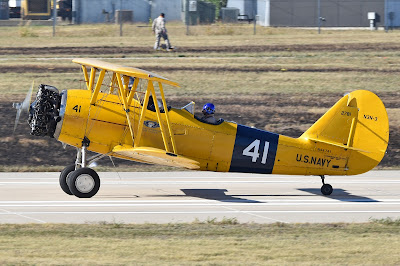
“Any air time yet?” he asked as we walked across the tarmac towards a bright yellow N3N-1 biplane. I’d heard dad chuckle about these airships, calling them the “Yellow Peril.” The “Peril” part wasn’t about the airplane—it was a solid ship that handled well—the peril part had to do with the fact that it was mostly used as a trainer, and student pilots weren’t the safest of fliers.

“Nine hours, sir, with my dad. He’s a flight instructor and former naval aviator.”

“What ship?”

“A Curtis Jenny. War surplus.”

“I’m impressed,” Virnig said. “The Jenny is a good airplane. Did your dad teach you anything about flying?”

“Ground school stuff only, sir. He said he didn’t want to teach me anything that the Navy might want me to unlearn. So those nine hours were just as a passenger.”

“You got a smart daddy, son. Did you log your nine hours?”

“No, sir.”

“Well, then, we’re starting from scratch.”

Virnig took the rear seat and put me in the front. We strapped in and took off with Virnig at the controls. We flew for about ninety minutes, during which he had me get the feel of the controls. I took the stick, tried the rudder pedals, and learned how to adjust the throttle. I was grinning the whole time.

Later that day we flew again, this time in an N3N-3. The N3N-3 was a slightly upgraded model from the N3N-1 and used the 240 horsepower Wright J-6-7 radial engine. The N3N-1 had the J-5, which only produced 220 horsepower. The N3N-3’s vertical stabilizer was a little different, too, and there were a few other minor changes.

On this hop Virnig began giving me basic instructions about recovering from stalls and spins. It’s a little nerve wracking when the airplane starts dropping like a brick. I was really glad Virnig had his hands on the controls. What he was teaching me is that, if you keep your cool, and know what to do, you can recover from these kinds of problems. It’s when you panic that stalls and spins become deadly. Toward the end of this flight, Virnig stalled the aircraft and turned the controls over to me to recover it. Well, I’m still alive, so I must have gotten something right. Virnig landed the ship, for which I was secretly thankful.

After we climbed out of the cockpit, he said, “You did okay today, Cobb. After the first couple of screw-ups, you got the hang of it.”

“Thanks, sir. It just kind of gives me the willies when we’re a thousand feet up, and the ship starts behaving like a cinder block.”

“Hey, if that doesn’t give you a shot of adrenalin, you’re not human. But you learn to master your fear and think your way out of the situation, pushing the nose down, applying the proper rudder. But if you lose your head, a stall or a spin will kill you. That’s why we always practice at altitude—the ground comes up awful fast and you need time to recover.”

I looked back at the aircraft as we walked toward the hangar. “So who makes these beauties, anyway, sir? Boeing? Martin? Grumman?”

“No, not the N3Ns. We do,” Virnig said. “We, meaning the Navy. There’s a factory in Philly that pumps ‘em out for us. Navy owns it—lock, stock, and barrel.”

“The Navy has its own factory? That’s odd. How did that happen?”

We stopped and turned, looking at the flight line of trainers parked on the tarmac. Virnig pulled out a Lucky Strike and his Zippo and lit up. After he exhaled a cloud of smoke, he looked at me. “It was WW1, Cobb. The Army soaked up all the private manufacturing capacity, so the Navy built it’s own factory. Things have changed since then. Now everyone is building for us: Grumman, Boeing, Douglass. Nuts, even outfits like Ford have turned their production lines from cars to bombers.”

“I reckon war changes everything. It sure changed my direction,” I said.

He nodded. “I reckon so. See you here tomorrow, 0900.”

**********

I could feel Virnig pushing the stick forward, even as I heard him shouting at me through the speaking tube. “Doggone it, Cobb! Push the stick forward. Otherwise you’ll never get the airspeed to lift off. It’s like you’re stalling the aircraft, even though we’re still on the ground!”

The N3N was wallowing down the runway, nose too high. Virnig took over before we ran out of runway. Once we got in the air, he gave the controls back to me.

“Remember your basics from ground school, son,” he said to me, noticeably calmer, as I started a climbing turn. “You need to achieve takeoff speed before the aircraft will lift off. When the plane’s nose is too high, it creates greater air resistance, and the airplane can’t achieve takeoff speed. The solution is to keep your nose low until you have plenty of airspeed to rotate.”

I nodded, showing that I’d heard him. This was my second takeoff today, and I’d made the same mistake on both of them. I was angry with myself and rattled.

Virnig could tell I was upset. “Take it around, land, then taxi back to the beginning of the runway, and let’s try again.”

I nodded again, checked the traffic around me, and got into the landing pattern. My landing was nothing to write home about, but it wasn’t terrible either. I taxied back to the beginning of the runway and stopped short, to let two students take off ahead of me. When it was my turn, I did a visual check for incoming traffic, and was rewarded with a “Good boy.” Jamming the throttle forward, I started rolling. Although it went against my natural inclination, I forced myself to push the stick forward, and held it there as the ship gained speed.

“Good, good, son. Not yet… not yet… okay now, ease the stick back a little. There! See how easy that was,” Virnig said through the voice tube.

I was grinning again. It was a much better takeoff, and I noticed how much more responsive to the controls the N3N was at the higher speed.

After another ninety minute hop and an acceptable landing, I taxied the N3N back to the flight line and shut her down. We both disembarked from the airplane, and I stood waiting, as Virnig wrote up the evaluation.

“You’re doing okay, Cobb, and you’re improving. We’ve got a lot to work on, but you catch on fast.”

“Yes, sir,” I responded, secretly disappointed. I’d thought that I’d be further along by now, but it was all turning out to be more complicated than I had ever imagined. It gave me a renewed appreciation for how skilled dad was in his Jenny. I was really wrestling with simple maneuvers like banking the airplane in a turn. But it wasn’t simple! When you bank, the airplane loses altitude unless you goose the throttle slightly or pull back on the stick. And if you don’t coordinate your pedal movements with your stick movement on turns, you wind up skidding instead of banking. When you level off, you have to retard the throttle or you’ll pick up speed, which causes the airplane to climb. Will I ever master this?

“Okay, son, you’re flying again on Tuesday. Meet me here at 0900.”

“Yes, sir.”

**********

Over the next two weeks, I cringed as I saw Virnig’s comments on my evaluation sheets.

On November 4: “Always fails to throttle back after leveling off. Can’t remember to push stick forward on takeoff.”

On November 11: “Always takes off with left wing low. Breaks glide OK but doesn’t continue to bring stick back for a landing.”

This discouraging remark was on November 12: “Has trouble keeping plane straight and wings level on takeoff. Tries hard but forgets to do the right thing at the right time.”

I’ll tell you whose tail was dragging, and it wasn’t the N3N’s. It was mine. I was beginning to think I’d never be ready to solo. I even wondered if Virnig was going to wash me out of the program.

I got up on Friday morning and didn’t feel too spunky. I wondered if maybe I was coming down with something. I went for an early morning run, showered, geared up, and went to the cadets’ mess hall. Sat with a couple of my buddies, and we were all pretty down in the mouth about the instructor evaluations we were receiving. That actually cheered me up a little, knowing I wasn’t the only guy with my tail between my legs.

“You know what today is, guys?” Johnson asked mournfully. I’d finished breakfast and was about to head for the flight line. I was meeting Virnig at 0900 for today’s hop.

“Friday, genius. Why do you ask?” Carpenter answered.

“Yeah, but it’s Friday the 13th,” Johnson replied. “I don’t know about you guys, but I sure don’t need anymore bad luck in the cockpit.”

“That goes for me, too, Johnson,” I said. “I’ve had enough problems flying, I don’t need any new ones.”

Carpenter looked at me and said, “Buck up, Cobb. My dad used to say, ‘Son, any hop you can walk away from was a good hop.’”

I chuckled. “Think my daddy said the same thing to me.” I checked my watch. “Anyway, if you boys are scheduled at 0900, we’d better get a wiggle on.”

Virnig was waiting for me at our aircraft. “You ready, Cobb?”

“Yes, sir. Ready and rarin’.” I didn’t feel good, but I wasn’t about to tell him that.

“That’s the spirit. Show me some good stuff today, boy.”

He put me through my paces, and about the best thing I can say is that I didn’t crash the airplane. After we’d been up for just shy of an hour, he called to me through the speaking tube and told me to land and taxi to the flight line. I felt crushed, because he was ending our ninety minute session half an hour early. I wondered what I’d done wrong.

My landing was actually pretty good and so was my taxiing. When I cut the engine we both got out of the plane, and he marked his evaluation sheet.

“Want to know how you did, Cobb?” Virnig asked.

“Yes, sir,” I said. I was already feeling worse physically, so I braced myself for what I was about to read. There were only three words: “Safe for solo.” I whooped loud enough to turn heads all the way down the line.
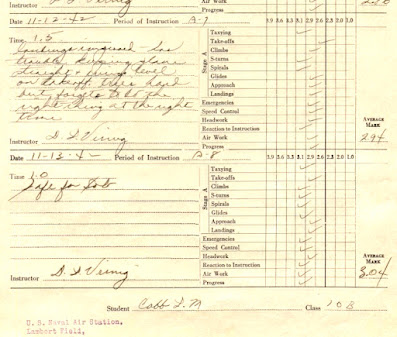
Photo: Cobb family collection


Virnig grinned at me. “Go hit the head if you need to. Come back here immediately and wait for your check pilot. It’s going to be Lieutenant Rothchild. You’ll take him up for a check ride. He’ll have the final say as to whether you are ready to solo.”

I couldn’t believe it, but my check ride was nearly flawless. So much for bad luck on Friday the 13th. Rothchild approved me for solo and gave me an upcheck, meaning that he graduated me from Stage A flight training into the Stage B training.

Although I was riding on cloud nine, I felt awful physically. As soon as I could get away from the flight line I went to sick bay. The doctor checked me over and pronounced, “No flying for you until you’ve got this cold under control.”

“But sir, I’m supposed to solo tomorrow.”

“Yes, and I’m supposed to make admiral tomorrow, but that won’t happen either. It’s life, son, get used to it.”

I looked at him, then saw the captain’s bars on his coat on the hall tree. “Captain, sir, are you really about to be promoted?”

He rolled his eyes. “It was a joke, son, a little bit of sarcasm. You’re not going to fly tomorrow. If you think you’ve got a headache now, just wait till you’re at 3000 feet or so. It will hurt so bad you’ll probably black out, and that could really ruin your day.”

He gave me medicine, and I went straight back to the barracks and straight to bed.

**********

“Look, Doc, I’m feeling much, much better this morning. Headache is completely gone, and I have a lot more energy than I did yesterday.”

He looked at me, unimpressed. “Care for a kleenex, son? Your nose is dripping.”

I sneezed and blew my nose. “Doc, now it’s just a runny nose. You’ve got to let me fly.”

He just looked at me.

“Please, sir.”

The man must be a good poker player, because he just stared at me without answering, his face giving away nothing. He pointed to the kleenex box, and I blew my nose again.

“Listen, Doc, I… I’ll, um… Ah! I promise I won’t go any higher than 1500 feet. I’ll stay below that.”

He sighed. “You promise?”

“Yes, sir, scout’s honor.” It sounded dumb as I said it, but I was desperate.

“You’re in the Navy, son, not the Boy Scouts, and you’ve been entrusted with some very expensive equipment—only the good Lord knows why.

“If you break your promise, Cobb, I’ll throw you in the brig. Understood?”

“Yes, sir, absolutely.”

“Okay. You’re cleared to fly. But if you’re gonna crash, don’t run into anything important.”

“Got it, sir. And thank you.”

He just raised his eyebrows and shook his head.

Grinning, I turned to go.

“Hold up, Cobb.”

I turned around, “Sir?”

He pointed at the box of Kleenex. “Take it with you.”

And that is why I was flying with one hand and blowing my nose with the other for my first solo flight. I kept my promise to the doctor, and I graduated to the next stage of Primary Flight Training.


Tuesday, June 20, 2023

Need a great beach book?

 Wondering what to read this summer? 

How about some action-packed page-turners, exciting stories from a Christian worldview? Both adults and teens will find these tales fascinating. You won’t have to wash your brains out after reading one of these exciting novels—but you will find it hard to put them down. Of his novels Cobb says, “If I don’t make you miss your bedtime, I’m not doing my job.” All titles are available locally (Greenville, OH) at the Bread of Life Bookstore, or on Amazon in print and Kindle format. You can find Cobb at chcobb.com.


Falcon Down

(military/espionage thriller, book one of four)

Sometimes what you don’t know can hurt you!

The chief test pilot for a highly classified F-16 weapons-development project, Major Jacob “Falcon” Kelly is shot down and captured by the Soviet Union in a hi-tech kidnapping during the Cold War. They intend to interrogate him to learn the secrets of the new weapon. His captors have detained him at a secret GRU facility in Siberia. Holding on to him might prove difficult, however, because Kelly has some skills of which they are unaware . . .

Kirkus Reviews: “Cobb has clearly done his research on multiple counts and, like Tom Clancy or Dale Brown, masterly intertwines military technology and behavior into a tightly plotted narrative in which every development follows logically and smoothly from what came before. This deft touch extends to the characters . . .”


The Candidate

(political thriller)

It began as a blog. It became a political firestorm.

Henry Marshall is a principled Christian conservative blogger who is convinced that both major parties have abandoned the Constitution. His intention is to be nothing more than a political gadfly, but his friends won’t allow him to stay on the sidelines, and his enemies don’t intend to allow him to live.

Journalist/author TJ Martinell: “Penned before the 2016 election cycle . . . , The Candidate is a political thriller that unwittingly earns a place within the alternative history genre for its exploration of how far a man can go armed only with a message – and how far those within the establishment will go to stop him. . . . [M]any of the aspects of the plot seem prophetic, rather than slightly fanciful.

A pastor by trade, Cobb’s writing reflects extensive background knowledge of mainstream media, political strategy, the military, and of course constitutional history; . . . . The technical preciseness gives vital story subplots a sense of authenticity and realism.”


Outlander Chronicles: Phoenix

(post-apocalyptic action/adventure, book one of three)

From the ashes of a world past . . .

Eighty years after a smallpox pandemic has reduced the global population to eight million, a young man (Jacen Chester) experiences the tragic deaths of his entire family and community. Wrestling with grief and anger, he commits himself to establishing a new community (Phoenix) that will advance beyond merely subsisting on the remains of the former world.

He meets a mysterious wanderer who decides to help him accomplish his dream. Together the two gather a small community and set their sights on the empty interior of the continent—1800 miles away—where they can escape the murderous gangs of the east and pursue their project in peace.

But hatred and bitterness from within and lethal attacks from without threaten to destroy the growing Phoenix community. A painful lesson in forgiveness and tolerance is required to save Phoenix from itself.

Captivated Reading Book Blog: “With two incredibly strong main characters, Phoenix tells a story of a world lost and people who are desperate . . . I was completely enthralled in this story from beginning to end.”

Amazon Reader Review:I loved reading this book and I can't wait for more of the story! It gave me so much to think about, which I love in a book, and it was an exciting read, too! It raised ideas I had never thought about before, as well as presenting familiar ones in a new way. Cobb is very effective at evoking a world that is both radically different from our own, and also not so distant in possibility. . . . Although I disagree with most of Cobb's views as I ascertain them from the story, I really enjoyed the debates and discussions the characters have, which I think says a lot about Cobb's talent as a writer as well as his even-handedness as a thinker. . . . Bring out a sequel, please!!!”


A Prayer of Moses: A Devotional Commentary of Psalm 90

(non-fiction)

The Church has rendered God safe.

His wrath is a matter relegated to days of antiquity. It seems rare that we connect the brevity and frailty of this existence with His overflowing anger at sin. Unfortunately, having dispensed with His wrath we’ve also diminished His holiness and His majesty, and made the Cross less necessary.

This study invites the reader to take a second look at God and His wrath—and His Christ—through the eyes of Moses. Suitable for individuals or groups.

John L. Marshall, Ph.D, Christian Studies/History Department, Eastern University: Pastor Cobb's exposition of Psalm 90 combines two sets of ingredients that make it a joy to read: on the one hand, exegetical precision together with the sweep of redemptive history; on the other, technical mastery with warm, personal application. There are Scriptural studies in which the author maintains a safe distance from the reader. Pastor Cobb allows us to get to know him along with the text he is expounding. This, in my opinion, is the best way to do pastoral theology.”

Thursday, March 9, 2023

The Hollandia Combat Air Patrol: Epilogue

The Hollandia Combat Air Patrol Epilogue

What was fiction, what was fact?


Lewis and Helen Cobb
Lewis M. Cobb is my father, Helen is my mom. They were married in July of 45. Dad retired in 1966 as a Commander in the regular navy, having survived many, many carrier landings (his planes normally survived his landings, as well!). He served in combat in WW2, Korea, and Vietnam, on several different carriers. He passed away in 2011 after serving his country and his church with honor.


Theater Map, showing movements of USS Yorktown in 1944
The principal activity in the Hollandia Strike story is historical. On April 19, 1944, the carriers of Task Force 58 were softening up the defenses of Hollandia in preparation for landing the marines. 

All the data pertaining to aircraft (American and Japanese) are factual, including the positions of switches and controls. All the names in the entire story with the exception of Ray Wilson (whom I invented) are factual, including their positions and ranks in VF-5 on April 19, 1944. All of the dialog in the story is a product of my imagination but is based on research.

I hope it is not too far off from how these pilots would have communicated at the time. My dad’s use of the word “swell” is quite accurate—it appears in his diary many times!

My apologies to actual pilots in case I managed to scramble some of the details. I’ll welcome your corrections.

In Chapter 1:

The visit to the Udvar-Hazy Center with my brother, L. M. Cobb, Jr., was real, complete with the Yorktown Hellcat hanging from the ceiling, The flashback was not real. I invented it as a means of launching us into dad’s world on April 19, 1944.

The Combat Air Patrol (CAP) in which my dad was launched is factual, and as near as I can tell from records the flyers named were actually flying with him. Several inbound bogies had been detected on radar. All the information on deck and launching operations is factual, to the best of my ability to research it.

In Chapter 2:

The early-morning loss of the TBF by collision with a cruiser is actual, but according to dad's diary it  happened on 4/22/44. I conflated it into the tale.

Dad’s initial concerns about Lieutenant Jones, followed by his tremendous respect for the man, are true, and are taken from various entries in dad’s diary. The entire story about Ray Watson is a fabrication, intended to make the historical point that naval doctrine was slow to shift from large surface engagements dominated by battleships to a carrier-based air war. This constituted a major shift in both budget and priority during WW2. I added this piece also to help the reader get the sense of urgency regarding finding the snooper before it found the carrier, which in fact would be a huge concern at the time.

The detection and shootdown of the Betty (two of them, actually) did occur on 4/19, but was accomplished by a different CAP, not dad’s. My tale of dad’s engagement with the Betty on his CAP was pure fiction. However, it is true that dad’s CAP was launched because of radar-detected bogies, they just did not locate them. Consequently, there was no damage on dad’s plane when he landed on the carrier.

In Chapter 3:

As can be seen in the photograph of the upside-down Hellcat, dad did not jettison his drop tank—probably because everyone was anticipating a normal landing.

The story of dad creaming a Hellcat a week before is factual (it occurred on 4/14/44), and I might turn it into another short story. The description of the weather during that event came from his diary.

It is very likely that there were several photo-recon TBFs launched on 4/19/22. I have an original copy of the Yorktown’s Air Group Plan of the Day for 4/21, showing such launches. Whether the TBFs actually interfered with the landing of dad’s CAP, I do not know. The photo-recon guys did have both landing and launch priority, however, as the Task Force needed reliable info to plan the next strike. Whether or not the carrier would have communicated to BLUE FLIGHT the way it did I don’t know. They very likely would have been using an early form of IFF (Identification Friend or Foe).

The various descriptions of operations in the Task Group (ditching, recovery of pilots, Bosun Chair, etc.) are pretty accurate, based on my research and discussions with dad.

And that brings us to The Crash. First—it actually happened. The photos are authentic. The Bureau Number of the upside-down Hellcat is stamped on the backside of the large official photo. It matches the Bureau Number in Dad’s pilot log for the 4/19/44 CAP. How or why the crash happened—I don’t know. My description of the crash is what I envisioned might happen on a hard, tail-first landing if the hook did not catch.

Lewis Cobb's diary entry for April 19, written on April 21, 1944


Dad says his hook skipped the #5 and 6 wires, and the Hellcat tore through the first two barriers. He sustained several injuries and was taken out of the flight rotation during his recovery. The aircraft was pushed over the side.

A big thanks to my brother Lou for encouraging me to write the tale and for helping me sift through the records that dad kept. Lou and I typed up dad’s diaries from his ‘44 tour on the Yorktown, and his ‘45 tour on the Belleau Wood. It was an honor and a privilege.


Tuesday, March 7, 2023

The Hollandia Combat Air Patrol, part 3

Chapter 3

Returning to the Yorktown

April 19, 1944

As we flew back to the Yorktown, it was time to jettison our empty drop tanks. In the event of a crash landing on the carrier, the tank—full of avgas fumes—could contribute to a nasty conflagration. Reaching my left hand down, just outboard of the throttle quadrant, I triggered the drop tank release switch and felt a brief bump as it fell away.

The airspace above the carrier resembled hornets buzzing around a nest that had been kicked. There were sixteen of us in the returning CAP, waiting to be recovered. I hoped it wouldn’t take too long, as I was getting low on fuel. Chasing the Betty had taken more gas than I realized.

“BLUE FLIGHT, this is CAIRO. Descend to three angels and enter the holding pattern. We’ll get you boys down as soon we can.”

“CAIRO, this is BLUE FLIGHT. Descending to three angels and holding.”

As we descended to the holding pattern altitude, I looked below and saw that the Yorktown was busy launching the afternoon CAP. The recovery evolution had not begun, and couldn’t until the current launching operation was done.

Landing a plane on an aircraft carrier takes an immense amount of skill, teamwork, and luck. There’s a reason why the Navy calls it “recovering” aircraft and not “landing” aircraft. From one perspective, you really don’t land an airplane on a carrier, you fly it into the deck and hope that the hook catches a wire and the landing gear doesn’t collapse.
Grumman Avenger TBF, 1942

Just a week earlier I’d creamed a Hellcat’s landing gear. Twelve Hellcats and sixteen Avengers had been launched on a practice strike. I was flying wing on Jonesy. We’d already flown two hundred miles from the task force when suddenly the weather closed in. Squalls, driving rain, the ceiling down to three hundred feet. We couldn’t see a thing and had no idea where the task force was. It certainly wasn’t where we left it because it moves at about thirty miles an hour.

The Flight Leader finally pulled the plug on the mission, figuring it was foolish to risk life, limb, and aircraft on a practice strike. Flying in formation in that kind of soup can lead to midair collisions. We finally picked up the Yorktown’s YE, and were able to fly the vector back to the task force. When we got back to the carrier, we found the weather was just as nasty.
WW2 Landing Signal Officer, aka "Paddles"


The Landing Signal Officer (LSO), himself an expert pilot, was standing with his paddles at his station, buffeted by squall winds and soaked to the bone by rain and sea spray. He was desperate to get us down safely, knowing that rescuing a ditched pilot in a turbulent sea was unlikely to be successful. Consequently the LSO might have signaled a cut now and then when he should have given a wave-off. When it was my turn, he brought me down a little steep and a little hot. My hook caught, but the impact twisted my landing gear and buckled my fuselage. Believe me, I was just happy to be back on the good old Yorktown. In light of the horrible conditions, there was no blame assigned to anyone. I promised to buy the LSO a beer next time we were in an anchorage.

My headphones crackled, bringing me back to the present. “BLUE FLIGHT, BLUE FLIGHT, this is CAIRO. The aircraft approaching from two-six-five degrees are friendlies, repeat, friendlies, the TBF has landing priority. Acknowledge.”

“CAIRO, this is BLUE FLIGHT. Copy that, aircraft approaching from two-six-five are friendly, the TBF has landing priority,” skipper acknowledged.

Now, who would that be, I wondered as I scanned my instruments. My eyes settled unhappily on the fuel gauge. Adding more aircraft ahead of me in the landing pattern was not helpful. I might have to ditch, I thought. I wasn’t going to bellyache about it, though, because there were probably several other Hellcats in the holding pattern that were also on the verge of a dead-stick landing. Get ready for a swim, boys.

Orbiting in the holding pattern was pretty boring, so I kept my eyes pealed along the vector from which the newcomers were approaching. Finally I spotted them. It was a Grumman Avenger with four Hellcats escorting him. Then I remembered: a photo-recon mission had been launched ten minutes before our CAP. This particular TBF was configured as a scout plane and outfitted with a high-resolution camera. His mission was assessing strike damage on Hollandia. I watched as he landed smartly on his first approach. He didn’t really hold up the parade for very long, and his four-plane escort entered the holding pattern a thousand feet above us.

Finally our CAP began landing and not a minute too soon. With anxious eyes on my fuel gauge, I began descending little by little as the Hellcat swarm began to enter the landing pattern, one aircraft at a time. If I run out of fuel while waiting my turn to land, there’s only one option available—a water landing. And boy, do I hate the thought of ditching. It provides the perfect opportunity to drown—that is, if the sharks leave you alone. If I survive the dunking, hopefully I’ll be picked up by a destroyer or submarine, but then I’d have to endure the crazy carnival ride on a Bosun’s Chair to get back to the carrier. You’re transferred like a sack of potatotes between ships that are underway and making some twenty-odd knots. Not my idea of fun. And besides, ditching is a waste of an otherwise perfectly good airplane.


Pilot being transferred in a Bosun's Chair
Thankfully, the Pratt and Whitney was still roaring along under power when I entered the upwind leg of the landing pattern, about three hundred feet above the sea. There was the Yorktown on the same heading, steaming away from me at about twenty-five knots. I backed off on the throttle, opened the cockpit hood, and dropped the arrester hook. As I drew abeam the starboard side of the ship, I safetied my guns. So far, everything seemed normal. I was on my reserve tank, but was pretty confident I wouldn’t be making a dead-stick landing after all.

And then I noticed that the arrester hook light was not glowing. That’s not good. I pushed the circuit breaker reset, and cycled the switch again. No change. I did it again. No dice.

I had just enough time remaining on the downwind leg to try the arrester hook emergency control, a T-handle behind my seat on the left side. Reaching across my waist with my right hand, I grabbed the T-handle. Four slow pulls should do the trick, and I shouldn’t be able to complete a fifth pull if the hook is fully extended. Six pulls, seven pulls, and nothing is happening.

“CAIRO, this is BLUE 3. I don’t have a hook light. Please advise.”

“BLUE 3, this is CAIRO. I can see that your hook is deployed. Have you tried the emergency control?”

“Affirmative. And I’ve reset the breakers, twice. No light.”

By this time I was on the final approach, but decided to take another lap until Pri-fly got back to me. As I roared over the port side of the carrier, I began to wonder if perhaps the tangle with that Betty had produced a little more damage than I realized.

“BLUE 3, this is CAIRO. The air boss is encouraging you to proceed with a landing, but it’s your choice. Your hook is extended, and will probably catch a wire.”

“This is BLUE 3 acknowledging. Gonna keep my feet dry.”

I reviewed the landing checklist again as I turned back onto the downwind leg. As I began the turn for final approach, I throttled back to ninety knots. The LSO brought me right in with minimal corrections and signaled “cut.” I killed the throttle and the plane dropped onto the carrier. I felt the tail wheel hit first, followed immediately by the harsh slam of the main gear on the deck. I tensed, expecting the sudden stop of the arresting wires, but it didn’t come. The hook didn’t catch! Without the restraint of the hook, the tail of the aircraft bounced up.

Time immediately slowed down. With agonizing inevitability I could see the first barrier approaching in slow motion while my aircraft slowly pitched nose down. At this point, I was not a pilot, but a passenger, a spectator caught in the immutable laws of physics: momentum, inertia and kinetic energy. I could see the blue-jerseys beyond the barriers, the plane handlers, scattering, mouths open, expressing warning and horror in equal quantities.

The first barrier caught my Hellcat in a slight nose-down, tail-up attitude, which caused the plane to pitch-pole over the barrier. Although my shoulder harness was tight, it was not tight enough to protect me from physical forces this extreme. I was slammed around in the cockpit like a rag doll, my head colliding with the instrument panel.

Rotating over the first barrier, my Hellcat was airborne again, tail first and upside down, just high enough to clear the second barrier, as I later learned. Slamming onto the deck, still upside down, the aircraft skated into the third barrier, which finally stopped its momentum. Everything went black—

Ensign Cobb's Hellcat

Rescuing the pilot

**********

“Dad! Dad!”

I opened my eyes. The museum guidebook lay on the floor. My sons were crouched down, peering into my face with worry. Several museum volunteers stood about looking concerned.

“Should we call the squad?” one asked.

I shook my head vigorously. My mouth was dry and my hands were sweaty. “Water,” I croaked.

Someone gave me a bottle of water, and I took a pull on it.

“No. No squad. I’m—fine. I’m fine. Guess I just fell asleep.”

“Are you sure, Dad? Are you okay?” my eldest asked.

“Oh, yeah. Ready and raring to go.”

“Okay,” he said dubiously, studying my face.

He put the guidebook on my lap, and I said, “C’mon, boys. Let’s go look at the shuttle.”

As they wheeled me away in that blankity-blank wheelchair, I glanced back at the Hellcat and smiled.

Ensign Cobb in the Ready Room several days after crash. Damage to right eye and nose visible.

**********
[Editor's Note: Stay tuned for the epilogue, to be posted in several days, in which I'll take a few paragraphs to discuss what parts of this tale are actual history, and what parts are fiction. Most of it is history.]

Photo Credits:

  • Grumman Avenger TBF: https://en.wikipedia.org/wiki/Grumman_TBF_Avenger
  • Landing Signal Officer: https://upload.wikimedia.org/wikipedia/en/thumb/f/f0/Paddles_ww2_bw.jpg
  • Hollandia Damage Assessment Cobb family collection
  • Bosun's Chair: http://www.ussbush.com/flyer1.jpg
  • Ensign Cobb's Hellcat: Cobb family collection
  • Rescuing the pilot: Cobb family collection
  • Ensign Cobb in the Ready Room: Cobb family collection


Monday, March 6, 2023

The Hollandia Combat Air Patrol, part 2

 Chapter 2

On Patrol

April 19, 1944

After scanning my instruments, I studied the sky in front, side to side, above and below, and finally behind. Failing to maintain this vigilance was liable to get me shot down. While the quality of the Japanese pilots had declined somewhat since ‘42 and ‘43, and the Zero couldn’t take the punishment my F6F could, carelessly disrespecting the enemy’s capabilities could end my career and probably my life in a flaming, downward spiral.

Mitsubishi A6M Zero
I scanned my instruments and the airspace about me again. My engine temperature was on the high side of the normal range, so I made a small adjustment to the fuel mixture and manifold pressure. Once the aircraft was all trimmed out to cruise at 20,000, I found that I had to force myself to concentrate. I couldn’t get the early morning’s tragedy out of my mind. We lost three good men during the predawn strike launch. Shortly after takeoff, one of the TBFs clipped the superstructure of a cruiser off the carrier’s starboard bow and went down in flames. Neither the pilot nor crew was recovered. Lieutenant Jones speculated that, in the darkness, the pilot had mistaken the cruiser’s running lights for that of a squadron mate and was following him, intending to form up. Losing a man to enemy action was bad enough, but losing three to an innocent mistake was a tragic waste.

I shook my head to clear it. Can’t think about it now. Focus, Cobb, or you’re liable to join them in Davy Jones’ locker. I scanned my instruments and the sky around me. Satisfied, I noticed that the engine temp was back down in the middle of its optimal range.

My headset crackled, “BLUE FLIGHT, this is BLUE-1. Stay sharp. If that snooper is still here, we should see him before long.”

I grinned to myself. Gill always began a mission with strict, by-the-book radio etiquette. But after the first thirty minutes or so—or perhaps it was once we were out of sight of the carrier, I don’t know—he would simply go informal, using last names and sometimes even first names. That’s one thing I really appreciated about Lieutenant Gill: he was straight-laced and buttoned-down when the situation required it, but otherwise he was just down-home.

I felt the same about Lieutenant Jones, who was in overall command of VF-5. He inherited the squadron back in March when our old skipper got called back to the States. I wasn’t sure about Jones when he first took over the squadron, but he turned out to be a swell guy and a great pilot.

VF-5 Insignia, circa 1944
I scanned everything again. Instruments normal, no sign of the snooper. Looking for that Jap scout plane reminded me of an argument I had when the Yorktown was anchored at Majuro in the Marshall Islands about ten days ago.

Mac had copped a jeep from the motor pool, so he and I were touring the island, exploring the buildings and defensive emplacements the Japanese had constructed when the island was theirs. We ran into a black-shoe lieutenant named Ray Wilson. Wilson was assigned to the USS New Jersey, one of the Task Force 58 Iowa-class battleships. He seemed like a pretty good guy, so we invited him to tour with us. We got to talking about TF-58’s next target—Hollandia. It was supposed to be a secret, but the rumors of the upcoming operation were everywhere.

“It’s a good thing Mitscher is sending battleships to protect your carrier when we hit Hollandia. You’d be pretty helpless without us as an escort,” he said confidently.

“That’s the dumbest thing I’ve heard in a long time. You’re nuts, Ray,” I said. “What are you talking about?”

“Really, Lou, think about it: the Yorktown’s biggest gun is, what, a five incher? That’s a popgun compared to the armament on my ship. The New Jersey can throw a sixteen inch shell twenty-five miles. And scuttlebut says the Japs are mounting eighteen-inchers on their big battleships. Your carrier would not last five minutes in a surface engagement.”

McClelland laughed. “Hey, Ray, haven’t you ever heard of Pearl Harbor?”

“Of course, flyboy. What’s that got to do with anything?”

“Carrier-based aircraft made mincemeat of the battleships.”

“That’s just because it was a dirty sneak attack.”

“No, it’s because a carrier can hit your battleship from three hundred miles away, long before the carrier is in range of your sixteen inchers.”

I grinned at Wilson. “He’s right, Ray. How many battleships engaged at Midway? None of them ever came close to firing a shot at another ship. They were too busy fending off aircraft. And who scored at Midway? It was the carriers. Your big boat is good for shore bombardment and for providing an anti-aircraft screen. But other than that, the day of the battleship is over. We’ll hit you before you even know where we are.”

He didn’t like hearing that, but it’s true. The brass ring of naval warfare has transformed into a contest to find and sink the enemy’s carriers before he finds ours. That’s why we had to find that snooper before he found the Yorktown.

Lewis Cobb's Pilot Log
Skipper banked left in a standard two-minute turn, and I goosed the throttle a bit to stay on his wing. We’d reached the edge of our patrol sector, and he was turning back into it for another pass. I looked over and saw Boze and Mac expertly maintaining station on the other side of Gill, keeping a tight formation. It made me proud to be part of this group of skilled, professional pilots.

Making another scan of my instruments and airspace, I observed scattered clouds below, down around ten thousand feet. The view from up here was really swell—a broad expanse of blue, punctuated by a few cotton-ball clouds scattered across it. As the afternoon was drawing on, the sea to my west glittered with reflected sunlight. Beautiful.

Suddenly I caught something out of the corner of my eye. I focused in that direction, but could not detect what attracted my attention. I scanned my instruments again and all around me. Then I looked back toward where I thought I’d seen something. There it was! By chance I was looking in the right direction when a dark dot appeared against the white of one of the scattered clouds, traversing it. I would have never picked it out if it had not been against the whiteness of the cloud. Against the backdrop of the dark sea, the aircraft was almost invisible.

I keyed my mask microphone. “Tallyho! This is BLUE 3. Two o’clock down, maybe four miles, one Betty, angels fifteen.”

After a moment, Gill responded. “BLUE 3, this is BLUE 1. Negative, negative, I don’t see anything, Lou.”

“He was silhouetted against a cloud, sir. Look! There he is again!”

“Ah, roger that, now I got him. BLUE Flight, this is BLUE 1, acknowledging one Betty.

“Boze, Lou and I are engaging him. You and Mac keep your eyes open. He could be a decoy. Might be a second one down on the deck that we’re not supposed to see. I reckon he might even have fighter cover, so stay sharp.”
Mitsubishi G4M "Betty"

I reviewed what I knew about the Mitsubishi G4M as we prepared to jump him. The Betty was the Imperial Japanese Navy’s long range bomber. Fast and capable, it had a long range, high ceiling, and could carry a lot of ordnance. It was an excellent land-based scout plane. It was prickly, too, with deadly armament in the nose, tail, waist, and top, a mix of 20mm cannon and 7.7mm machine guns. But it couldn’t take much punishment. One hit could turn the thing into a flaming funeral pyre, a characteristic that resulted in American fliers nicknaming it the Zippo, after the venerable lighter.

Gill maneuvered until he could attack out of the sun, and I stayed with him until he rolled over into his dive. I orbited in a tight circle, ready to back him up if he was jumped by any fighters we had not seen. The Jap didn’t realize he was under attack until skipper started firing—then the Betty began jinking and dove for the deck.

Once skipper was clear I started my attack, only by now the Jap was ready and waiting for me. I could see the winking muzzle flashes coming from his tail and dorsal cannons and machine guns as he brought his weaponry to bear. The tracer rounds looked like bright fireflies, floating up toward me with deceptive slowness. As they drew nearer they seemed to gain incredible speed, flashing past in a deadly streak of light. I could sense some of his rounds striking home. To this day I’m not sure if I actually heard them hit, or maybe I imagined it as I felt the impacts on my Hellcat, but it sounded like pouring a handful of gravel into an empty metal bucket.

I sent my own fireflies back, triggering my starboard fifty cals. I was working a low angle deflection shot, leading him the way I used to lead ducks on the wing back home. As I roared past the bomber I saw that I’d scored a lucky hit on the dorsal cannon. The gunner was limp, face down, probably held in place by his shoulder harness.

Flying under the bomber, I banked to the left and did several fast rolls to throw off his waist gunner’s aim as I put some distance between us before climbing for a second pass. I pulled into a climbing turn and saw Lieutenant Gill pop out of a cloud beneath the diving Betty. He rolled right behind the bomber and leveled out, triggering his guns. He was scoring hits on the bomber’s starboard wing. Even from where I was, I could see he was chewing off pieces of it. The Betty began trailing smoke momentarily, and then the whole aircraft caught fire. Skipper followed it down, recording the kill on his gun camera.

We rejoined Boze and Mac at twenty thousand feet. For the next several hours our patrol was uneventful as we crisscrossed the sector. Nothing but clouds and the deep blue sea. Toward the end of our patrol period a layer of stratus clouds developed just above us.

Gill keyed his mic, “Boze, you and Mac climb up to thirty angels. See if you can get above the layer. I want to make sure nothing is sneaking past us, shielded by those clouds.”

“Aye, aye, Skipper. Climbing to thirty.”

In a few minutes Lieutenant Bozard radioed that the layer only went up to twenty eight, and that the sky was just as empty up there as it was down below. Thirty minutes later it was time to return to the ship, and the four of us formed up together.
Ensign Lewis M. Cobb (on left) and friends

“Lou, are you picking up the YE radial? That Jap must have clobbered my antenna, because I got nothing.”

“Skipper, I’ve got the Yorktown’s YE at one-hundred-five degrees.”

“Roger that. One-hundred-five. Thanks.”

A few minutes later I noticed Lieutenant Gill staring at my Hellcat. He motioned for me to stay put and then fell back a bit, circling under me. “BLUE 3, you’ve got a little road rash. I can see some damage to your tail. You must have caught a little lead from that Betty. How do your controls feel?”

I waggled my wings and used the rudder to slew it back and forth, checking the yaw, pitch, and roll. It felt fine. “Pretty normal, sir. The aircraft seems responsive.”

“Okay, good. That Betty must not have hit anything important.”

**********
[Editor's Note: Stay tuned for Chapter 3, to be posted in several days. If you are wondering how much of this story is true, and how much is fiction, I will post an epilogue after chapter 3 explaining what was actual history, and what was fiction. Most of it is history.]

Photo Credits:

  • Ensign Cobb: Cobb family collection
  • Mitsubishi A6M Zero: https://wikipedia.org/wiki/File:Zero_11_on_China.JPG
  • Mitsubishi G4M "Betty": Public Domain, https://commons.wikimedia.org/w/index.php?curid=848915
  • Pilot's Logbook: Cobb family collection
  • VF-5 Insignia: https://upload.wikimedia.org/wikipedia/commons/thumb/7/78/VF-5_Yorktown_Fighting_Hellcats.jpeg/68px-VF-5_Yorktown_Fighting_Hellcats.jpeg

Tuesday, December 6, 2022

The Outlander Chronicles Series


Set in the future, but not futuristic, the year is 2120 when the Outlander Chronicles series begins. The global population is sliding south of eight million souls. Global warfare eighty years earlier had involved biological weapons; a near mass-extinction of the human population was the result. The diminishing, scattered population is inadequate to sustain any manufacturing, mining, electrical generation, refining, communications, or transportation. There are no governments, national or local. Separated by nearly a century from the world that was, the survivors’ knowledge of the old technologies has virtually disappeared.
Here and there, tiny knots of population—the Townies—have coalesced, people banding together for safety. Opposing them are small gangs of violent raiders (Anarchs and Slavers), who make surviving in an already-intolerable environment almost impossible.


Surrounded by the rusting ruins of the former world, a young man (Jacen Chester) decides there must be more to life than avoiding death. He determines to challenge the status quo and to found a community committed to the rediscovery and revival of art, education, and technology. Jacen encounters a mysterious stranger (Hakim Abdul al Malik), an older man who ultimately becomes Jacen’s mentor, instructor, and protector. The two join forces to pursue Jacen’s dream. But they must first survive the predations of the violent groups, and their own deep disagreements with one another.
The Outlander Chronicles series is a coming-of-age adventure in which Jacen’s most deeply held views on life, religion, and morality are severely challenged by the raw, bleeding edge of life and death. As his community grows and experiences tragedy and disastrous setbacks, Jacen’s developing leadership skills are put to the test.

Book #1, Outlander Chronicles: Phoenix, chronicles the beginning of the relationship between Jacen and Hakim, and the growing community they establish.

Book #2, Outlander Chronicles: Pegasus, traces the community and the many challenges and heartaches they face as they travel toward their chosen destination near the ruins of Denver, Colorado.

Book #3, Outlander Chronicles: Icarus, records Jacen’s and his community’s response to a horrific disaster, as well as the dangers of employing technology not fully understood.

The Outlander Chronicles series is available on Amazon in both Kindle and print formats, as well as from your local independent bookseller (through the Ingram catalog). Signed copies are available from the Doorway Press store. See all the C. H. Cobb novels at my website.