Showing posts with label Aircraft Carriers. Show all posts

Thursday, March 9, 2023

The Hollandia Combat Air Patrol: Epilogue

The Hollandia Combat Air Patrol Epilogue

What was fiction, what was fact?


Lewis and Helen Cobb
Lewis M. Cobb is my father, Helen is my mom. They were married in July of 45. Dad retired in 1966 as a Commander in the regular navy, having survived many, many carrier landings (his planes normally survived his landings, as well!). He served in combat in WW2, Korea, and Vietnam, on several different carriers. He passed away in 2011 after serving his country and his church with honor.


Theater Map, showing movements of USS Yorktown in 1944
The principal activity in the Hollandia Strike story is historical. On April 19, 1944, the carriers of Task Force 58 were softening up the defenses of Hollandia in preparation for landing the marines. 

All the data pertaining to aircraft (American and Japanese) are factual, including the positions of switches and controls. All the names in the entire story with the exception of Ray Wilson (whom I invented) are factual, including their positions and ranks in VF-5 on April 19, 1944. All of the dialog in the story is a product of my imagination but is based on research.

I hope it is not too far off from how these pilots would have communicated at the time. My dad’s use of the word “swell” is quite accurate—it appears in his diary many times!

My apologies to actual pilots in case I managed to scramble some of the details. I’ll welcome your corrections.

In Chapter 1:

The visit to the Udvar-Hazy Center with my brother, L. M. Cobb, Jr., was real, complete with the Yorktown Hellcat hanging from the ceiling, The flashback was not real. I invented it as a means of launching us into dad’s world on April 19, 1944.

The Combat Air Patrol (CAP) in which my dad was launched is factual, and as near as I can tell from records the flyers named were actually flying with him. Several inbound bogies had been detected on radar. All the information on deck and launching operations is factual, to the best of my ability to research it.

In Chapter 2:

The early-morning loss of the TBF by collision with a cruiser is actual, but according to dad's diary it  happened on 4/22/44. I conflated it into the tale.

Dad’s initial concerns about Lieutenant Jones, followed by his tremendous respect for the man, are true, and are taken from various entries in dad’s diary. The entire story about Ray Watson is a fabrication, intended to make the historical point that naval doctrine was slow to shift from large surface engagements dominated by battleships to a carrier-based air war. This constituted a major shift in both budget and priority during WW2. I added this piece also to help the reader get the sense of urgency regarding finding the snooper before it found the carrier, which in fact would be a huge concern at the time.

The detection and shootdown of the Betty (two of them, actually) did occur on 4/19, but was accomplished by a different CAP, not dad’s. My tale of dad’s engagement with the Betty on his CAP was pure fiction. However, it is true that dad’s CAP was launched because of radar-detected bogies, they just did not locate them. Consequently, there was no damage on dad’s plane when he landed on the carrier.

In Chapter 3:

As can be seen in the photograph of the upside-down Hellcat, dad did not jettison his drop tank—probably because everyone was anticipating a normal landing.

The story of dad creaming a Hellcat a week before is factual (it occurred on 4/14/44), and I might turn it into another short story. The description of the weather during that event came from his diary.

It is very likely that there were several photo-recon TBFs launched on 4/19/22. I have an original copy of the Yorktown’s Air Group Plan of the Day for 4/21, showing such launches. Whether the TBFs actually interfered with the landing of dad’s CAP, I do not know. The photo-recon guys did have both landing and launch priority, however, as the Task Force needed reliable info to plan the next strike. Whether or not the carrier would have communicated to BLUE FLIGHT the way it did I don’t know. They very likely would have been using an early form of IFF (Identification Friend or Foe).

The various descriptions of operations in the Task Group (ditching, recovery of pilots, Bosun Chair, etc.) are pretty accurate, based on my research and discussions with dad.

And that brings us to The Crash. First—it actually happened. The photos are authentic. The Bureau Number of the upside-down Hellcat is stamped on the backside of the large official photo. It matches the Bureau Number in Dad’s pilot log for the 4/19/44 CAP. How or why the crash happened—I don’t know. My description of the crash is what I envisioned might happen on a hard, tail-first landing if the hook did not catch.

Lewis Cobb's diary entry for April 19, written on April 21, 1944


Dad says his hook skipped the #5 and 6 wires, and the Hellcat tore through the first two barriers. He sustained several injuries and was taken out of the flight rotation during his recovery. The aircraft was pushed over the side.

A big thanks to my brother Lou for encouraging me to write the tale and for helping me sift through the records that dad kept. Lou and I typed up dad’s diaries from his ‘44 tour on the Yorktown, and his ‘45 tour on the Belleau Wood. It was an honor and a privilege.


Tuesday, March 7, 2023

The Hollandia Combat Air Patrol, part 3

Chapter 3

Returning to the Yorktown

April 19, 1944

As we flew back to the Yorktown, it was time to jettison our empty drop tanks. In the event of a crash landing on the carrier, the tank—full of avgas fumes—could contribute to a nasty conflagration. Reaching my left hand down, just outboard of the throttle quadrant, I triggered the drop tank release switch and felt a brief bump as it fell away.

The airspace above the carrier resembled hornets buzzing around a nest that had been kicked. There were sixteen of us in the returning CAP, waiting to be recovered. I hoped it wouldn’t take too long, as I was getting low on fuel. Chasing the Betty had taken more gas than I realized.

“BLUE FLIGHT, this is CAIRO. Descend to three angels and enter the holding pattern. We’ll get you boys down as soon we can.”

“CAIRO, this is BLUE FLIGHT. Descending to three angels and holding.”

As we descended to the holding pattern altitude, I looked below and saw that the Yorktown was busy launching the afternoon CAP. The recovery evolution had not begun, and couldn’t until the current launching operation was done.

Landing a plane on an aircraft carrier takes an immense amount of skill, teamwork, and luck. There’s a reason why the Navy calls it “recovering” aircraft and not “landing” aircraft. From one perspective, you really don’t land an airplane on a carrier, you fly it into the deck and hope that the hook catches a wire and the landing gear doesn’t collapse.
Grumman Avenger TBF, 1942

Just a week earlier I’d creamed a Hellcat’s landing gear. Twelve Hellcats and sixteen Avengers had been launched on a practice strike. I was flying wing on Jonesy. We’d already flown two hundred miles from the task force when suddenly the weather closed in. Squalls, driving rain, the ceiling down to three hundred feet. We couldn’t see a thing and had no idea where the task force was. It certainly wasn’t where we left it because it moves at about thirty miles an hour.

The Flight Leader finally pulled the plug on the mission, figuring it was foolish to risk life, limb, and aircraft on a practice strike. Flying in formation in that kind of soup can lead to midair collisions. We finally picked up the Yorktown’s YE, and were able to fly the vector back to the task force. When we got back to the carrier, we found the weather was just as nasty.
WW2 Landing Signal Officer, aka "Paddles"


The Landing Signal Officer (LSO), himself an expert pilot, was standing with his paddles at his station, buffeted by squall winds and soaked to the bone by rain and sea spray. He was desperate to get us down safely, knowing that rescuing a ditched pilot in a turbulent sea was unlikely to be successful. Consequently the LSO might have signaled a cut now and then when he should have given a wave-off. When it was my turn, he brought me down a little steep and a little hot. My hook caught, but the impact twisted my landing gear and buckled my fuselage. Believe me, I was just happy to be back on the good old Yorktown. In light of the horrible conditions, there was no blame assigned to anyone. I promised to buy the LSO a beer next time we were in an anchorage.

My headphones crackled, bringing me back to the present. “BLUE FLIGHT, BLUE FLIGHT, this is CAIRO. The aircraft approaching from two-six-five degrees are friendlies, repeat, friendlies, the TBF has landing priority. Acknowledge.”

“CAIRO, this is BLUE FLIGHT. Copy that, aircraft approaching from two-six-five are friendly, the TBF has landing priority,” skipper acknowledged.

Now, who would that be, I wondered as I scanned my instruments. My eyes settled unhappily on the fuel gauge. Adding more aircraft ahead of me in the landing pattern was not helpful. I might have to ditch, I thought. I wasn’t going to bellyache about it, though, because there were probably several other Hellcats in the holding pattern that were also on the verge of a dead-stick landing. Get ready for a swim, boys.

Orbiting in the holding pattern was pretty boring, so I kept my eyes pealed along the vector from which the newcomers were approaching. Finally I spotted them. It was a Grumman Avenger with four Hellcats escorting him. Then I remembered: a photo-recon mission had been launched ten minutes before our CAP. This particular TBF was configured as a scout plane and outfitted with a high-resolution camera. His mission was assessing strike damage on Hollandia. I watched as he landed smartly on his first approach. He didn’t really hold up the parade for very long, and his four-plane escort entered the holding pattern a thousand feet above us.

Finally our CAP began landing and not a minute too soon. With anxious eyes on my fuel gauge, I began descending little by little as the Hellcat swarm began to enter the landing pattern, one aircraft at a time. If I run out of fuel while waiting my turn to land, there’s only one option available—a water landing. And boy, do I hate the thought of ditching. It provides the perfect opportunity to drown—that is, if the sharks leave you alone. If I survive the dunking, hopefully I’ll be picked up by a destroyer or submarine, but then I’d have to endure the crazy carnival ride on a Bosun’s Chair to get back to the carrier. You’re transferred like a sack of potatotes between ships that are underway and making some twenty-odd knots. Not my idea of fun. And besides, ditching is a waste of an otherwise perfectly good airplane.


Pilot being transferred in a Bosun's Chair
Thankfully, the Pratt and Whitney was still roaring along under power when I entered the upwind leg of the landing pattern, about three hundred feet above the sea. There was the Yorktown on the same heading, steaming away from me at about twenty-five knots. I backed off on the throttle, opened the cockpit hood, and dropped the arrester hook. As I drew abeam the starboard side of the ship, I safetied my guns. So far, everything seemed normal. I was on my reserve tank, but was pretty confident I wouldn’t be making a dead-stick landing after all.

And then I noticed that the arrester hook light was not glowing. That’s not good. I pushed the circuit breaker reset, and cycled the switch again. No change. I did it again. No dice.

I had just enough time remaining on the downwind leg to try the arrester hook emergency control, a T-handle behind my seat on the left side. Reaching across my waist with my right hand, I grabbed the T-handle. Four slow pulls should do the trick, and I shouldn’t be able to complete a fifth pull if the hook is fully extended. Six pulls, seven pulls, and nothing is happening.

“CAIRO, this is BLUE 3. I don’t have a hook light. Please advise.”

“BLUE 3, this is CAIRO. I can see that your hook is deployed. Have you tried the emergency control?”

“Affirmative. And I’ve reset the breakers, twice. No light.”

By this time I was on the final approach, but decided to take another lap until Pri-fly got back to me. As I roared over the port side of the carrier, I began to wonder if perhaps the tangle with that Betty had produced a little more damage than I realized.

“BLUE 3, this is CAIRO. The air boss is encouraging you to proceed with a landing, but it’s your choice. Your hook is extended, and will probably catch a wire.”

“This is BLUE 3 acknowledging. Gonna keep my feet dry.”

I reviewed the landing checklist again as I turned back onto the downwind leg. As I began the turn for final approach, I throttled back to ninety knots. The LSO brought me right in with minimal corrections and signaled “cut.” I killed the throttle and the plane dropped onto the carrier. I felt the tail wheel hit first, followed immediately by the harsh slam of the main gear on the deck. I tensed, expecting the sudden stop of the arresting wires, but it didn’t come. The hook didn’t catch! Without the restraint of the hook, the tail of the aircraft bounced up.

Time immediately slowed down. With agonizing inevitability I could see the first barrier approaching in slow motion while my aircraft slowly pitched nose down. At this point, I was not a pilot, but a passenger, a spectator caught in the immutable laws of physics: momentum, inertia and kinetic energy. I could see the blue-jerseys beyond the barriers, the plane handlers, scattering, mouths open, expressing warning and horror in equal quantities.

The first barrier caught my Hellcat in a slight nose-down, tail-up attitude, which caused the plane to pitch-pole over the barrier. Although my shoulder harness was tight, it was not tight enough to protect me from physical forces this extreme. I was slammed around in the cockpit like a rag doll, my head colliding with the instrument panel.

Rotating over the first barrier, my Hellcat was airborne again, tail first and upside down, just high enough to clear the second barrier, as I later learned. Slamming onto the deck, still upside down, the aircraft skated into the third barrier, which finally stopped its momentum. Everything went black—

Ensign Cobb's Hellcat

Rescuing the pilot

**********

“Dad! Dad!”

I opened my eyes. The museum guidebook lay on the floor. My sons were crouched down, peering into my face with worry. Several museum volunteers stood about looking concerned.

“Should we call the squad?” one asked.

I shook my head vigorously. My mouth was dry and my hands were sweaty. “Water,” I croaked.

Someone gave me a bottle of water, and I took a pull on it.

“No. No squad. I’m—fine. I’m fine. Guess I just fell asleep.”

“Are you sure, Dad? Are you okay?” my eldest asked.

“Oh, yeah. Ready and raring to go.”

“Okay,” he said dubiously, studying my face.

He put the guidebook on my lap, and I said, “C’mon, boys. Let’s go look at the shuttle.”

As they wheeled me away in that blankity-blank wheelchair, I glanced back at the Hellcat and smiled.

Ensign Cobb in the Ready Room several days after crash. Damage to right eye and nose visible.

**********
[Editor's Note: Stay tuned for the epilogue, to be posted in several days, in which I'll take a few paragraphs to discuss what parts of this tale are actual history, and what parts are fiction. Most of it is history.]

Photo Credits:

  • Grumman Avenger TBF: https://en.wikipedia.org/wiki/Grumman_TBF_Avenger
  • Landing Signal Officer: https://upload.wikimedia.org/wikipedia/en/thumb/f/f0/Paddles_ww2_bw.jpg
  • Hollandia Damage Assessment Cobb family collection
  • Bosun's Chair: http://www.ussbush.com/flyer1.jpg
  • Ensign Cobb's Hellcat: Cobb family collection
  • Rescuing the pilot: Cobb family collection
  • Ensign Cobb in the Ready Room: Cobb family collection


Monday, March 6, 2023

The Hollandia Combat Air Patrol, part 2

 Chapter 2

On Patrol

April 19, 1944

After scanning my instruments, I studied the sky in front, side to side, above and below, and finally behind. Failing to maintain this vigilance was liable to get me shot down. While the quality of the Japanese pilots had declined somewhat since ‘42 and ‘43, and the Zero couldn’t take the punishment my F6F could, carelessly disrespecting the enemy’s capabilities could end my career and probably my life in a flaming, downward spiral.

Mitsubishi A6M Zero
I scanned my instruments and the airspace about me again. My engine temperature was on the high side of the normal range, so I made a small adjustment to the fuel mixture and manifold pressure. Once the aircraft was all trimmed out to cruise at 20,000, I found that I had to force myself to concentrate. I couldn’t get the early morning’s tragedy out of my mind. We lost three good men during the predawn strike launch. Shortly after takeoff, one of the TBFs clipped the superstructure of a cruiser off the carrier’s starboard bow and went down in flames. Neither the pilot nor crew was recovered. Lieutenant Jones speculated that, in the darkness, the pilot had mistaken the cruiser’s running lights for that of a squadron mate and was following him, intending to form up. Losing a man to enemy action was bad enough, but losing three to an innocent mistake was a tragic waste.

I shook my head to clear it. Can’t think about it now. Focus, Cobb, or you’re liable to join them in Davy Jones’ locker. I scanned my instruments and the sky around me. Satisfied, I noticed that the engine temp was back down in the middle of its optimal range.

My headset crackled, “BLUE FLIGHT, this is BLUE-1. Stay sharp. If that snooper is still here, we should see him before long.”

I grinned to myself. Gill always began a mission with strict, by-the-book radio etiquette. But after the first thirty minutes or so—or perhaps it was once we were out of sight of the carrier, I don’t know—he would simply go informal, using last names and sometimes even first names. That’s one thing I really appreciated about Lieutenant Gill: he was straight-laced and buttoned-down when the situation required it, but otherwise he was just down-home.

I felt the same about Lieutenant Jones, who was in overall command of VF-5. He inherited the squadron back in March when our old skipper got called back to the States. I wasn’t sure about Jones when he first took over the squadron, but he turned out to be a swell guy and a great pilot.

VF-5 Insignia, circa 1944
I scanned everything again. Instruments normal, no sign of the snooper. Looking for that Jap scout plane reminded me of an argument I had when the Yorktown was anchored at Majuro in the Marshall Islands about ten days ago.

Mac had copped a jeep from the motor pool, so he and I were touring the island, exploring the buildings and defensive emplacements the Japanese had constructed when the island was theirs. We ran into a black-shoe lieutenant named Ray Wilson. Wilson was assigned to the USS New Jersey, one of the Task Force 58 Iowa-class battleships. He seemed like a pretty good guy, so we invited him to tour with us. We got to talking about TF-58’s next target—Hollandia. It was supposed to be a secret, but the rumors of the upcoming operation were everywhere.

“It’s a good thing Mitscher is sending battleships to protect your carrier when we hit Hollandia. You’d be pretty helpless without us as an escort,” he said confidently.

“That’s the dumbest thing I’ve heard in a long time. You’re nuts, Ray,” I said. “What are you talking about?”

“Really, Lou, think about it: the Yorktown’s biggest gun is, what, a five incher? That’s a popgun compared to the armament on my ship. The New Jersey can throw a sixteen inch shell twenty-five miles. And scuttlebut says the Japs are mounting eighteen-inchers on their big battleships. Your carrier would not last five minutes in a surface engagement.”

McClelland laughed. “Hey, Ray, haven’t you ever heard of Pearl Harbor?”

“Of course, flyboy. What’s that got to do with anything?”

“Carrier-based aircraft made mincemeat of the battleships.”

“That’s just because it was a dirty sneak attack.”

“No, it’s because a carrier can hit your battleship from three hundred miles away, long before the carrier is in range of your sixteen inchers.”

I grinned at Wilson. “He’s right, Ray. How many battleships engaged at Midway? None of them ever came close to firing a shot at another ship. They were too busy fending off aircraft. And who scored at Midway? It was the carriers. Your big boat is good for shore bombardment and for providing an anti-aircraft screen. But other than that, the day of the battleship is over. We’ll hit you before you even know where we are.”

He didn’t like hearing that, but it’s true. The brass ring of naval warfare has transformed into a contest to find and sink the enemy’s carriers before he finds ours. That’s why we had to find that snooper before he found the Yorktown.

Lewis Cobb's Pilot Log
Skipper banked left in a standard two-minute turn, and I goosed the throttle a bit to stay on his wing. We’d reached the edge of our patrol sector, and he was turning back into it for another pass. I looked over and saw Boze and Mac expertly maintaining station on the other side of Gill, keeping a tight formation. It made me proud to be part of this group of skilled, professional pilots.

Making another scan of my instruments and airspace, I observed scattered clouds below, down around ten thousand feet. The view from up here was really swell—a broad expanse of blue, punctuated by a few cotton-ball clouds scattered across it. As the afternoon was drawing on, the sea to my west glittered with reflected sunlight. Beautiful.

Suddenly I caught something out of the corner of my eye. I focused in that direction, but could not detect what attracted my attention. I scanned my instruments again and all around me. Then I looked back toward where I thought I’d seen something. There it was! By chance I was looking in the right direction when a dark dot appeared against the white of one of the scattered clouds, traversing it. I would have never picked it out if it had not been against the whiteness of the cloud. Against the backdrop of the dark sea, the aircraft was almost invisible.

I keyed my mask microphone. “Tallyho! This is BLUE 3. Two o’clock down, maybe four miles, one Betty, angels fifteen.”

After a moment, Gill responded. “BLUE 3, this is BLUE 1. Negative, negative, I don’t see anything, Lou.”

“He was silhouetted against a cloud, sir. Look! There he is again!”

“Ah, roger that, now I got him. BLUE Flight, this is BLUE 1, acknowledging one Betty.

“Boze, Lou and I are engaging him. You and Mac keep your eyes open. He could be a decoy. Might be a second one down on the deck that we’re not supposed to see. I reckon he might even have fighter cover, so stay sharp.”
Mitsubishi G4M "Betty"

I reviewed what I knew about the Mitsubishi G4M as we prepared to jump him. The Betty was the Imperial Japanese Navy’s long range bomber. Fast and capable, it had a long range, high ceiling, and could carry a lot of ordnance. It was an excellent land-based scout plane. It was prickly, too, with deadly armament in the nose, tail, waist, and top, a mix of 20mm cannon and 7.7mm machine guns. But it couldn’t take much punishment. One hit could turn the thing into a flaming funeral pyre, a characteristic that resulted in American fliers nicknaming it the Zippo, after the venerable lighter.

Gill maneuvered until he could attack out of the sun, and I stayed with him until he rolled over into his dive. I orbited in a tight circle, ready to back him up if he was jumped by any fighters we had not seen. The Jap didn’t realize he was under attack until skipper started firing—then the Betty began jinking and dove for the deck.

Once skipper was clear I started my attack, only by now the Jap was ready and waiting for me. I could see the winking muzzle flashes coming from his tail and dorsal cannons and machine guns as he brought his weaponry to bear. The tracer rounds looked like bright fireflies, floating up toward me with deceptive slowness. As they drew nearer they seemed to gain incredible speed, flashing past in a deadly streak of light. I could sense some of his rounds striking home. To this day I’m not sure if I actually heard them hit, or maybe I imagined it as I felt the impacts on my Hellcat, but it sounded like pouring a handful of gravel into an empty metal bucket.

I sent my own fireflies back, triggering my starboard fifty cals. I was working a low angle deflection shot, leading him the way I used to lead ducks on the wing back home. As I roared past the bomber I saw that I’d scored a lucky hit on the dorsal cannon. The gunner was limp, face down, probably held in place by his shoulder harness.

Flying under the bomber, I banked to the left and did several fast rolls to throw off his waist gunner’s aim as I put some distance between us before climbing for a second pass. I pulled into a climbing turn and saw Lieutenant Gill pop out of a cloud beneath the diving Betty. He rolled right behind the bomber and leveled out, triggering his guns. He was scoring hits on the bomber’s starboard wing. Even from where I was, I could see he was chewing off pieces of it. The Betty began trailing smoke momentarily, and then the whole aircraft caught fire. Skipper followed it down, recording the kill on his gun camera.

We rejoined Boze and Mac at twenty thousand feet. For the next several hours our patrol was uneventful as we crisscrossed the sector. Nothing but clouds and the deep blue sea. Toward the end of our patrol period a layer of stratus clouds developed just above us.

Gill keyed his mic, “Boze, you and Mac climb up to thirty angels. See if you can get above the layer. I want to make sure nothing is sneaking past us, shielded by those clouds.”

“Aye, aye, Skipper. Climbing to thirty.”

In a few minutes Lieutenant Bozard radioed that the layer only went up to twenty eight, and that the sky was just as empty up there as it was down below. Thirty minutes later it was time to return to the ship, and the four of us formed up together.
Ensign Lewis M. Cobb (on left) and friends

“Lou, are you picking up the YE radial? That Jap must have clobbered my antenna, because I got nothing.”

“Skipper, I’ve got the Yorktown’s YE at one-hundred-five degrees.”

“Roger that. One-hundred-five. Thanks.”

A few minutes later I noticed Lieutenant Gill staring at my Hellcat. He motioned for me to stay put and then fell back a bit, circling under me. “BLUE 3, you’ve got a little road rash. I can see some damage to your tail. You must have caught a little lead from that Betty. How do your controls feel?”

I waggled my wings and used the rudder to slew it back and forth, checking the yaw, pitch, and roll. It felt fine. “Pretty normal, sir. The aircraft seems responsive.”

“Okay, good. That Betty must not have hit anything important.”

**********
[Editor's Note: Stay tuned for Chapter 3, to be posted in several days. If you are wondering how much of this story is true, and how much is fiction, I will post an epilogue after chapter 3 explaining what was actual history, and what was fiction. Most of it is history.]

Photo Credits:

  • Ensign Cobb: Cobb family collection
  • Mitsubishi A6M Zero: https://wikipedia.org/wiki/File:Zero_11_on_China.JPG
  • Mitsubishi G4M "Betty": Public Domain, https://commons.wikimedia.org/w/index.php?curid=848915
  • Pilot's Logbook: Cobb family collection
  • VF-5 Insignia: https://upload.wikimedia.org/wikipedia/commons/thumb/7/78/VF-5_Yorktown_Fighting_Hellcats.jpeg/68px-VF-5_Yorktown_Fighting_Hellcats.jpeg

Saturday, March 4, 2023

The Hollandia Combat Air Patrol


The Hollandia Combat Air Patrol: Chapter 1

Udvar-Hazy Center, National Air and Space Museum

March 19, 2006

They wheeled me in, but I didn’t like it. I wasn’t accustomed to being wheeled anywhere. But, having worn out my knees backpacking with my sons several years earlier, I knew I’d enjoy the museum much more if I wasn’t hurting. Hence, this blankity-blank wheelchair. But still…

The three of us are at the Udvar-Hazy Center, near Dulles airport. It’s got a great collection of aircraft, including the space shuttle Discovery and a supersonic Concorde. The late model aircraft are all very impressive with their GPS capabilities, computers, fly-by-wire controls, and over-the-horizon standoff weapons. But I have to admit as an old fighter pilot, I kind of consider the standoff weapons to be a form of cheating, far removed from looking at your enemy through a gun sight, up close and personal.

I was told the museum had a selection of World War 2 aircraft, and I’m looking for a particular one—a Grumman F6F, officially and affectionately known as the Hellcat. That old warbird and I went through a lot together from ‘43 to ‘45. When you survive intense combat with a close friend, tracers zipping past like harbingers of death, flak exploding and peppering your fuselage like hail on a tin roof, you bond together pretty doggone close. I was pretty bonded to my Hellcat back in the day.

We wandered through the museum enjoying the modern aircraft on display, beautiful aluminum and composite marvels of ingenuity and engineering, but before we knew it we were being stalked by a couple of the volunteer museum workers, several older fellows. Apparently they noticed the Hellcat insignia on my baseball cap.
  
Dad, the Hellcat, and the wheelchair
“Sir, if you don’t mind my asking, did you actually fly a Hellcat in the war?”

“Yes, I was deployed to the Pacific—three tours.”

“What squadron?”

“VF-5, on the Yorktown in ‘43 and ‘44, and VF-30 on the Belleau Wood in ‘45.”

So for the next ten minutes or so we swapped war stories. They were Vietnam vets, a little younger than me. It was fun to compare notes, but after a few minutes they had to attend to other duties and we continued exploring.

“Ah, there she is,” I said, pointing at a Hellcat suspended from the ceiling. “Well, I’ll be! Look at that! It’s one of the Yorktown birds,” I said. “See the diagonal stripe on the tail? That’s what distinguished the Yorktown squadrons. Man alive, does that bring back memories!”

I studied the aircraft, struggling just a little with the surge of emotions it provoked. The ‘Cat had been declawed—the six 50 cals had been removed. Its paint job was fresh. It had a couple of minor dents in the fuselage but no battle scars that I could see. The Grumman F6F was a beautiful airplane, one of the finest fighters of the war. It had a 19:1 kill ratio, and was credited with over 5200 kills, more than any other aircraft during the war.
Lewis M. Cobb in his Hellcat
So I’m sitting in that blankity-blank wheelchair, studying that Hellcat, and I start noticing an odd smell. I sniffed a couple of times, shook my head. “You boys smell anything odd?”

My boys looked at each other and shrugged their shoulders. “No, Dad,” replied my eldest, “I don’t smell anything odd. What’s it smell like?”

I glanced over my shoulder at them. “Avgas,” I muttered. I looked down at the museum guidebook on my lap to see where they acquired this particular Hellcat. But what I saw, strapped to my right leg, was my old pilot’s kneeboard! Confused, I looked back up at the Hellcat, but found myself looking at a grey bulkhead and a chalkboard full of strike and combat air patrol (CAP) flight assignments. My name was written in one of the slots.

“What?” I exclaimed. Feeling disoriented, I turned around looking for my sons. Not only had they disappeared, but the whole museum was gone.

“What’s what? Didn’t you hear the man? He said, ‘Pilots, man your airplanes!’ So, get off your butt, Cobb, and let’s go.” The fellow grabbed my arm and pulled me out of my wheelchair, only it wasn’t a wheelchair, but one of those comfortable seats in the pilots’ ready room.

I looked at his face, and the hackles on my neck stood up. Shocked, I exclaimed, “Jonesy, it’s you! My word! I haven’t seen you in—”

“Of course it’s me, Slick. Who’d you expect, Betty Boop?”

“I—I don’t understand. What’s going on, Lieutenant?”

He grabbed his gear and headed for the door. “A war’s going on, Ensign, or haven’t you noticed? For crying out loud, quit the stupid act and let’s move, Lou. We’ve got CAP and radar has picked up a couple of inbound bogies in our assigned patrol sector.”

I grabbed my Mae West and my war bag and followed him out of the ready room onto the flight deck. My ears were assaulted with the discordant clang of the General Quarters gong, calling the ship to battle stations.

We ran toward our aircraft. I shouted to Lieutenant Jones, “What’s the formation, sir?” Lieutenant Jones had recently taken over as the skipper of our squadron.

He glanced sideways at me as we approached the F6Fs and stepped close. He put his hand on my shoulder and studied me. “Lou, are you okay? This isn’t like you. Do I need to call your alternate?”
Ensign Cobb, 1943

The confusion faded from my consciousness and suddenly I was solidly in the moment, April 19, 1944. “I—no, I’m fine. I must have fallen asleep in the ready room, sir. I forgot to look at the assignment board, that’s all. Really, I’m fine, sir. Where am I in the lineup?”

“You’re good to go? You’re sure of it?”

“Ready and rarin’ to go, Lieutenant.”

He nodded. “Okay. I’m leading the Patrol Station CAP. Lieutenant Gill will be your skipper today—he’s the flight commander of the Intercept CAP, the BLUE team. You’re his wingman, and your call sign is BLUE-3. Lieutenant Bozard is leading the second section in your flight, and McClelland is his wing, call sign BLUE-4. BLUE FLIGHT is spotted right behind mine, so man your aircraft before Commander Crommelin chews us both out for holding up the parade.”

I nodded and trotted to my aircraft. It didn’t strike me as odd at the time, but somehow I knew exactly which plane was mine. I climbed up on the wing and punched the canopy release button under the windshield and, sliding the hood back, climbed into the cockpit. One more time, Lou, you can do this, I told myself. The one more time thing is just a survival tactic. It’s not helpful to think ahead and worry about the multiple strikes I am scheduled for the rest of the week. One day at a time, one sortie at a time, that’s all I can think about.

I ran quickly over all the controls, making sure every switch, lever, and control was in the proper preflight position. Plugging my headset in, I adjusted the VHF and UHF frequencies, and set the Nav receiver to the frequency of the day. After a moment, the command from Pri-fly came over the loudspeaker on the flight deck, as well as through my headset, “Fighters, start engines!”

I wiped my sweaty hands on my flight suit and waved to my plane captain, receiving a thumbs-up from him in return. I knew that he had half an eye on the airedales lying on the deck next to my wheels, ready to remove the wheel chocks on signal. The Yorktown’s flight deck was an excellent place for one’s head to be separated from one’s shoulders by a spinning propeller. Strictly disciplined choreography was practiced at all times in an effort to prevent accidents and stupid mistakes.
F6F-3 Hellcat

The checklist for engine startup had become instinctive, and I could have run through it blindfolded without missing a lick. After setting the throttle and fuel mixture, I turned the supercharger switch to neutral, and turned on the battery and auxiliary fuel pump switches. I did a careful visual check around the prop, then looked again at my plane captain. He nodded, still giving me the green light, thumb still up. “Here we go again,” I muttered to myself and punched the primer switch, holding it for about four seconds before hitting the starter.

With a loud bang, followed by a guttural cough, the 2000 horsepower Pratt and Whitney belched black smoke, stuttered, then settled into a smooth 1000 rpm, firing on all eighteen cylinders. Oil pressure looked nominal, and the oil temp began to crawl toward its normal range.

There’s something about the raw power of that engine that gets your blood running. My nervousness evaporated, and I began to anticipate the mission. “Let’s get this show on the road! I hope there’s enough bogies for all of us!” I muttered to no one in particular. No one could have heard me anyway—by now the noise level of all those engines drowned out even your unspoken thoughts.

I studied the big marquis board on the side of the island, which informed me that the ship’s current heading was three hundred forty-five degrees, and the wind over the bow was forty-three knots. Finally, the command came over my headset, “Launch aircraft!”
Grumman Avenger TBF

When launching a full strike, the fighters are always spotted farthest forward, because they don’t require much of the deck to achieve take-off speed. By the time the fighters have launched, there’s enough deck space for the heavily laden torpedo bombers, and last of all the dive bombers, to lift off as long as there’s a stiff breeze over the bow. Since our flight was a CAP, there were just sixteen Hellcats spotted on the deck and we had plenty of take-off room. Not only did Pri-fly want us to get moving and check out the bogies, they also wanted us out of the way so they could recover the returning CAP. I could see those fighters orbiting overhead, waiting to land.

Lieutenant Jones’ flight launched first. Once they were away, skipper—Lieutenant Gill—was next and then me. To my left I saw Gill’s plane crew pull his chocks and roll out of the way. The launch officer guided Gill to the centerline, where there was enough room for the deck crew to unfold and lock the Hellcat’s wings into flight position. Then the flight officer twirled his baton in a circular motion over his head, and in dramatic fashion, pointed it forward toward the bow. Gill gave it full throttle, stood on the brakes for a brief second, then the Hellcat leapt forward, going airborne before it reached the end of the flight deck. In a matter of seconds, I followed him.

Once I was in the air, I fastened my shoulder straps, closed the canopy, and plugged in my oxygen and my headset (which I had unplugged just before takeoff). Most people find it odd that we save all that fussing around until we’re airborne. The reason is simple: if something goes wrong with the launch and your plane goes in the drink, you need to get out of the cockpit lickety-split before the plane sinks. You’re not going to have time to undo all that claptrap before the plane submerges.
CV-10, the USS Yorktown

I joined up with Gill, just off his right wing. In less than a minute, Bozard and McClelland joined our formation on the other side of skipper. We ascended to 10,000 feet and orbited, waiting for the rest of the fighters in the CAP to form up. Once everyone had joined the party we separated, each four-plane group going to its assigned CAP station. Since we were flying the Intercept CAP, we climbed to 20,000 as we hustled to our assigned patrol station. We were the lucky ones: skipper’s assigned patrol area placed us right over the spot where the radar had detected the bogies.

[Editor's Note: Stay tuned for chapter 2, coming in two days. If you are wondering how much of this story is true, and how much is fiction, I will post an epilogue after chapter 3 explaining what was actual history, and what was fiction. Most of it is history.]

Chapter 2

Friday, November 18, 2022

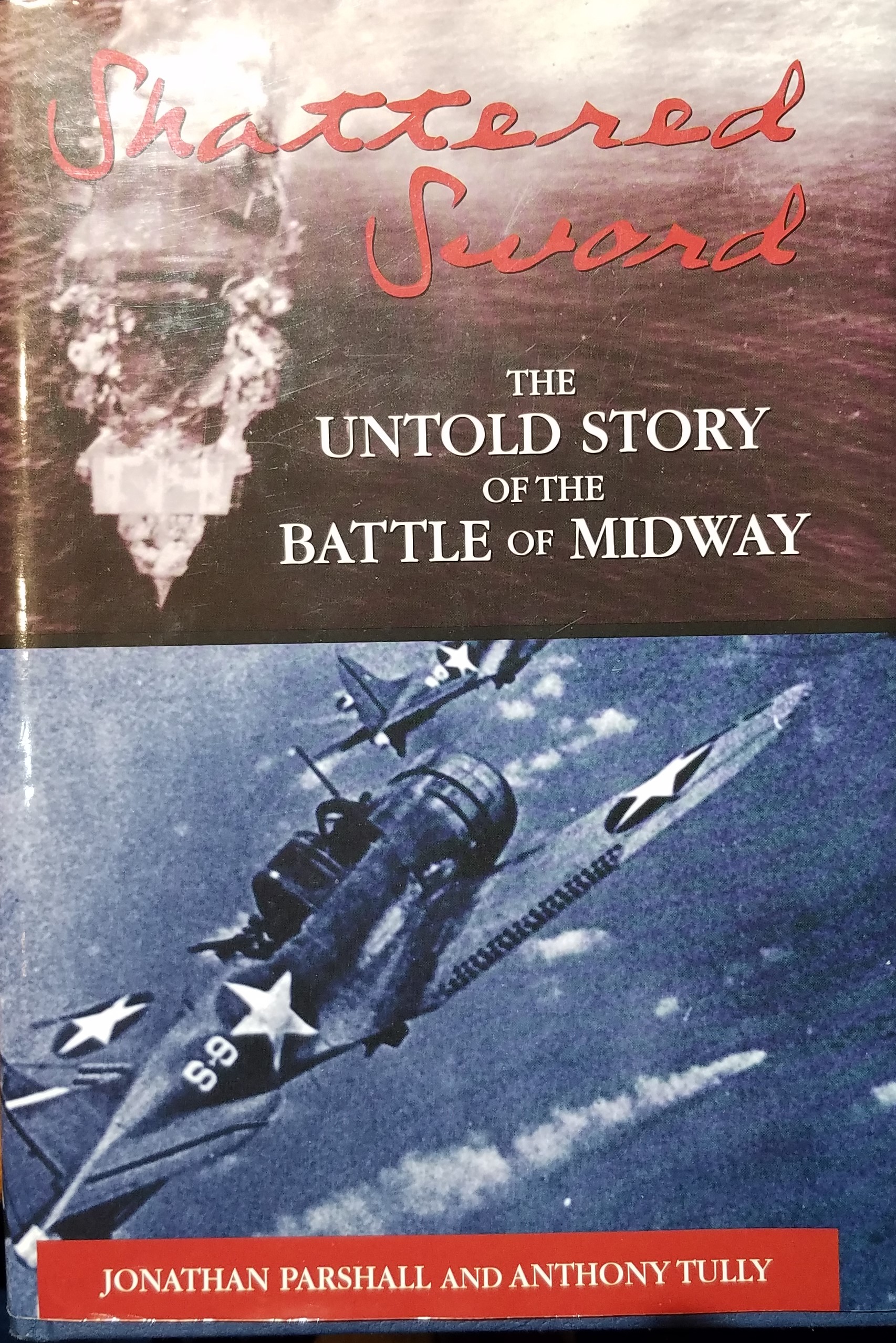
Book Review: Shattered Sword: The Untold Story of the Battle of Midway

 Review of Shattered Sword: The Untold Story of the Battle of Midway, by Jonathan Parshall and Anthony Tully.


I enjoy military history, especially when it’s wrapped around the events and happenings of World War 2. Usually, the author is trying to tell the story in a way both accurate and compelling, explaining and exploring command decisions and engagements, and the manner in which the battlefield itself, the action of individual units, and the vagaries of combat shaped the outcomes.

But Shattered Sword is in a class by itself. The writers have an agenda much larger than most—they intend to correct the received narrative of the battle of Midway, an erroneous narrative that has held sway for half a century. Their comprehensive research, which relies heavily on Japanese primary sources, has proven that most, if not all, of the popular accounts of the battle are significantly flawed, especially as regards the ultimate question of why the American naval forces won.

The book was a delight to read. The authors begin by delving deeply into the backgrounds of each of the principal characters, as well as the cultural ethos of the Imperial Japanese Navy. They explore the merits and demerits of each of the Japanese carriers and carrier aircraft. They expose the mind-numbing and initiative-stealing complexity of the overall Japanese battle plan for Midway. The entire process of preparing and arming the planes and spotting the flight deck for a strike is analyzed, down to the length of time a Zero’s powerplant needs to be warmed up in order to prevent damage to the engine upon launch.

I found the parts on Japanese naval doctrine, carrier operations, damage control, and air defense to be fascinating. Spoiler: the study of Japanese carrier operations became a major piece of evidence in substantiating the authors’ claims regarding the flaws in the received narrative, evidence that is buttressed by photographs taken during the battle.

The American side of the battle is also explored extensively, so the reader gets a sense for the simultaneity of the actions on the bridges and flight decks of ships on both sides of the conflict, as well as the strike and opposing defense aircraft. The reader is given precise timestamps (down to the minute) when the various decisions, communications, and actions were taken.

The book includes charts and drawings showing the relative dispositions of the carriers and their escorts, and once the attacks begin the direction of approach of the enemy aircraft. Eleven appendices detail the names of the personnel, the order of battle, technical details of the carriers, and a host of other matters that will be a goldmine for any writers or researchers that come after Parshall and Tully.

The book is fascinating, even gripping in places, exhaustively researched, and extensively documented. The authors successfully attain their agenda of correcting the record—conclusively in my opinion. Shattered Sword is the definitive resource for accurate information about the battle of Midway. Five stars, highly recommended.

Sunday, May 30, 2021

A Memorial Day Tribute

 I suspect that any man on the front lines of heavy fighting in World War 2 came home somewhat surprised that he had survived. One of the things I admire about my dad and all those who flirted with death is that day after day and night after night they answered the call, strapped themselves in the cockpit or hunkered down in the foxhole and faced the same terrors again. And again. And again. And again.

To all those men and women who have sacrificed so much, whether in WW2 or modern-day anti-terrorist operations--thank you. You have done your part to keep this country free and safe. I can only hope that those of us not in the military do our part as responsible stewards of the gift we've been given, a gift purchased by the blood, sweat, and tears of those who have served. My dad was one of those who served (1942-1966).


During his first tour in 1944, Dad was aboard theYorktown (CV-10) flying with fighter squadron VF-5. During his second tour he was on the light carrier Belleau Wood (CVL-24) flying with VF-30. At this time in his career dad was flying the F6F Gruman Hellcat.


It has been said that war is composed of a recurring cycle of days of boredom followed by moments of sheer terror. I think you'll see that in what follows below. It's an excerpt from my father's wartime diary during part of his second Pacific Tour, from February 1 to February 19, 1945. 

[Note to those not familiar with carrier operations: the LSO is the Landing Signal Officer (you'll encounter this in the February 11th entry). He is a very experienced pilot standing on the carrier who observes aircraft in the landing pattern and "waves them off" if the deck is not clear or if the pilot is not "in the groove" for a safe landing.]

--------------------------

Thursday and Friday, February 1 and 2, 1945, At Sea

Crossed the international date line so the date moved up one day today. We were paid today. Broke out the dice table, 20 of the boys put up $20 apiece and they form the syndicate which operates the board. I paid out all my money so the crap game doesn't worry me any.

Saturday, February 3 - Monday, February 5, 1945, At Sea

All routine days at sea so to save time & space I've combined 3 days on this page. During this period I have written over 20 letters. We refueled the cans on the 3rd. It seems odd to be steaming along through waters that were exceedingly dangerous this time last year. We passed within 50 miles of one Jap held island in the Marshalls. Passed Eniwetok our base by only 60 miles. We went within 200 miles of Truk, still Jap held. On the night of the 5th we had our first real GQ. Radar picked up a bogey which proved to be a cloud formation. During this period I & my team hasn't flown - just stood Cond. II.

Tuesday, February 6, 1945, At Sea

Stood condition II today. Thought we might have some fun this P.M., our ship rec'd a report that a large number of planes were seen taking off from Truk by one of our patrol bombers nothing developed from this however. We had 8 planes up on CAP this PM. My team is next to fly. Gunndaker settled at the ramp and broke his hook off on the ramp, he went into the barriers. Smitty who had just landed and taxied forward of the barriers was still in his plane, Gunners plane smacked into the tail of his. Gunners plane is a washout, Smittys is badly damaged, neither pilot was hurt. We get in Ulithi tomorrow AM. Hope we get some mail.

Wednesday, February 7, 1945, Ulithi Lagoon

Dropped anchor at about 1300. I have witnessed an impressing sight. Never on the face of the earth has such a fleet been assembled at one place as here in this lagoon. As far as you can see for miles around there are hundreds of ships. Ulithi is a typical atoll, very little land just a coral reef around a large lagoon.

The air group did not get mail though the ship did, sure makes me mad. This is about as poor a ship as I've ever seen. I have refrained from mentioning it prior to this because I thought things might change.

Tonight we received a shock, we are going to hit Tokyo Bay on a 2 day strike prior to a landing on Iwo Jima. This will be the first carrier strike on the Jap Homeland. Rather a dubious honor I'd say.

Thursday, February 8, 1945, Ulithi Lagoon

Still no mail. With the knowledge of where we are going this no mail deal is really setting hard on the squadron. Morale is very low. I tried to go to the mail ship myself but was unable to get there. We have no movies, no mail, no shore recreation no sun bathing and no athletics, all this is sure adding up to a unhappy squadron.

On top of all this comes word that the skipper and the executive officer will not get to participate in the Tokyo strike due to the fact that they know too much to run the risk of falling into Jap hands. This is also bad because the squadron feels like this will be a suicide raid, secretly I'm afraid it is.

Friday, February 9, 1945, Ulithi Lagoon

I spent all PM attempting to run down squadron mail with no success, there has been a foul up somewhere. It will be a long time now before we get mail.

Air Group and ship morale is very low, that's bad before a raid but it is strictly the ships fault. This is going to be a hell of a tour of duty unless changes are made.

We were briefed today on rescue facilities tough raid coming up. Sure would like to hear from my little girl. The letters we mail here won't be [mailed ?] for three weeks so it will be a long time before my little girl and the folks hear from me.

Saturday, February 10, 1945, At Sea

Hoisted the hook about 1030. I might mention that I am once again in Task Force 58 we are in group one under my old captain Jocko Clark. This is a large task force.

We did not get our mail this A.M. so we have the long prospects of no mail. Ship had gunnery practice in the P.M. Landed our 2 replacement aircraft aboard around noon. Briefing every day on Tokyo Bay area. Have a full schedule tomorrow I have 2 flights.

Sunday, February 11, 1945, At Sea

This is the darkest day I've ever had in my life. Young and Wescott were killed this AM on our first flight. We took off around 0700 on a strike against a spar towed by a CV. Young went in right after take off before he had rendezvoused. According to Lee who was right behind him he started his left turn and settled right into the sea, his plane blew up. Evidently he was working on something in the cockpit and just flew in. Wescott who was a spare was launched in his place. The hop went off OK and was 3 hrs & 1/4 long. I landed first, Curry got a waveoff, then Lee came aboard followed by Wescott, for some unknown reason, the deck crew held Wescott aft of the barriers and due to carelessness the L.S.O. gave Curry a cut with Wescott still aft of the barriers. Curry's hook pulled out on no. 5 wire and he crashed on top of Wescott. Wescotts death was merciful, the planes caught on fire immediately and Curry was very fortunate to get out unhurt.

Wescott's body was not saved as the planes burned for 15 minutes and finally had to be pushed over the side still burning. It was not Curry's fault at all nor was it Wescott's fault, it was the L.S.O. fault for giving Curry a cut, the LSO was busted down. Even if Curry's hook hadn't of broken he would have still crashed into Wescott.

Naturally Curry was all broken up and the Doc gave him some knock out pills and put him to bed. Team 9 was scheduled to fly again in the P.M. So with two substitutes Lee and I flew again, Lee didn't want to fly nor did I but I believe it was best we did.

This is the termination of team 9. We no longer have enough pilots for nine teams. The skipper since he does not have combat experience nor do none of his team has asked me to lead his 2nd section. Since I've lost my team, I don't care where or if I fly, I wouldn't have been prouder of my boys than if they were aces.

Monday, February 12, 1945, At Sea

I can't realize Wescott and Young are gone. Curry is coming around OK. We have convinced him that it wasn't his fault. I have some awfully tough letters to write soon.

I flew a scouting CAP this PM with the skipper. I find that I have the first strike against Japan with him, we are assigned to 27,000 ft against air opposition if there are no air borne aircraft we have 4 important fields to strafe. I guess the skipper convinced them that he should be allowed to go in over Japan. Lee & Curry fly tomorrow.

D-6, Tuesday, February 13, 1945, At Sea

I didn't fly today. Curry did however, and I'm glad because I was afraid he was going to be nervous. The Task Groups refueled today. The weather is getting cool.

D-5, Wednesday, February 14, 1945, At Sea

Flew a 3 ½ CAP over the Logistic support group. No Bogies. Spent most of the day being briefed. We hit Japan on D-3 day, day after tomorrow, good night!

D-4, Thursday, February 15, 1945, At Sea

Flew a 3 ½ hr. CAP with the skipper got a vector bogey which turned out to be a PB4Y-2 [??]. One other Group CAP splashed a Betty. Tomorrow is the big day, I'm in a VF sweep against Tokyo Bay area at 1055 big day ahead!

Tokyo Raid, D-3, Friday, February 16, 1945, At Sea

To tired to write much. 0-0 weather so strike wasn't very successful, very cold snowing in fact. The 4 of us shot down a Dinah the credit will probably go to the skipper & his wing man but we all had a hand in it. All of our boys returned safely. Will add more tomorrow am too tired to write now.

I couldn't believe it, there I was flying around in a lazy orbit off the coast of Japan gazing at the snow shrouded Fuji San [??], its the most beautiful mt. I've ever seen. I tallyhoed a Dinah and a Emily we got the Dinah but the skipper dropped the ball and let someone else beat us to the Emily. Because of extremely bad weather we did not attack the fields we were supposed to but were ordered to cover the rendezvous point while the other groups carried home the attack. Oscar kept popping down through the clouds but would not stay down long enough for us to engage them. Score for the squadron today was one dinah, 1 grace, 1 frank, and 1 oscar. Evenson was high with two. Extremely bad weather kept the task force from attack but also kept our planes from delivering a good punch.

Tokyo Raid, D-2, Saturday, February 17, 1945, At Sea

Same story, extremely bad weather kept the raids from being extensive. I flew a scouting CAP with Reber on my wing. Part of the time we were on instruments, never could we go above 500 ft. Snowed and rained all 3 ½ hr of the hop.

Aygher and Clark got in some good licks on a air strip 80 miles down the coast from Tokyo Bay, they met no opposition and succeeded in burning up numerous planes on the ground. All hands returned safely.

Retirement, D-1, Sunday, February 18, 1945, At Sea

Proceeding South today for our refueling rendezvous [off ] of Iwo Shima tomorrow. Weather some better. Flew a 3 hr. antisnooper patrol with Jake as a wingman. The Boys have got a good one on me, I requested permission to strafe a rock, yep old Eagle eye Cobb slipped up. While in my sector I noticed something on the surface of the water some 60 miles from the Task Group. I called the ship and they said they had no surface contacts in that area and for me to go and investigate. About 10 miles from the object I decided it was a Sampan under sail and requested permission to attack, almost immediately I realized it was nothing but a rock and shamefully informed the base as such. The ship had me turn on emerg. IFF and orbit it so they could get a fix on it and chart it. Can you imagine a lone rock in the middle of the ocean with no other land in sight? Dahms [??] shot down a Nick today.

D DAY, IWO JIMA INVASION

Monday, February 19, 1945, At Sea

We refueled today while the Marines were landing on Iwo Jima. The baby flat tops furnished the air support. We may participate in it tomorrow.

Wonder of wonders we got mail today though not much. I heard from Helen and the Folks though so I am happy. Flew a CAP this PM, no excitement.

-------------------------

Thanks for serving, Dad--you were a great example. Love you. Miss you.


Monday, April 22, 2019

Book Review: Carrier, A Guided Tour of an Aircraft Carrier, by Tom Clancy

While Clancy's book SSN (my review is here) is oversold by its cover, Carrier is undersold--and is much, much better than SSN. Clancy does far more than just giving us a tour of a modern supercarrier (although he does do that, and does it very well). He gives us a much more in-depth look at the Navy itself, and its evolution in ships, aircraft, and technology since the '50s. I was gratified to see that he didn't pull any punches, but exposed various areas of weakness in leadership, vision, willingness to employ new technology, spats and turfism with the other uniformed services, and so forth.

But he doesn't throw the Navy under the bus--he also reports how those longstanding problems are being resolved with a new generation of leadership. Overall, Clancy makes a good cheerleader for the USN, but he does it with eyes wide open. Be aware that the book was written in 1999, so some of the material is dated.

At the end of the book Clancy writes a brief scenario involving Sri Lanka, India, and Pakistan. It's short and entertaining, but suffers from a similar problem that the scenarios in SSN suffer from: everything works right for the good guys, and everything goes wrong for the bad guys. The scenario is not designed to be realistic, but rather to display capabilities. Even so, it would have been a little more gripping if the US had not been overwhelmingly successful.

I read this book while researching carrier operations for my own novel, Pacific Threat, a tale that is set in 1988. Clancy's Carrier delivered. Four stars.