Showing posts with label Ministry. Show all posts

Saturday, January 23, 2021

Book Review: Dangerous calling by Paul Tripp

Some writers make a living off cheap shots. It’s pretty easy to create a patina of profundity by manipulating guilt in your readers. It’s been done all too often in Christian circles, especially in books dealing with the modern church or modern ministry. That is not what Paul Tripp does in his terribly convicting book, Dangerous Calling, as he takes the reader on a tour of the lethal dangers associated with the ministry.

None of the hazards he explores come from the outside—they all come from within the minister himself. Pride, anger, hypocrisy, the danger of celebrity, the danger of personal isolation, thinking one has “arrived,” thinking that theological knowledge equals spiritual maturity, are just some of the minefields and pitfalls Tripp covers. It’s a wake-up call, whether you’ve been in ministry for forty years, or have just entered the ministry.

Tripp’s warnings are all the more powerful as he makes it clear that he himself has failed multiple times in multiple ways. He bares his soul—and his sins—to the reader. I think the book gains in two ways from Tripp’s painful self-disclosures. First it encourages those of us who struggle with transparency to become transparent ourselves, knowing that we are safe and forgiven in the grace of Christ. Second, when I see what Tripp struggles with, I know he knows what he is talking about. It’s not pastoral practice according to the ivory tower; it’s blood-and-guts practical.

But the book is not a negative downer. Each chapter contains reminders of the love and grace of Christ for broken sinners like us, and practical steps and suggestions for accountability, transparency, and a renewal of our love for Christ and passion for ministry.

Read this book. It might save both your marriage and your ministry. Five stars. Highly recommended.

Tuesday, October 1, 2019

For Christian workers you've never heard of


Now the names of the twelve apostles are these: The first, Simon, who is called Peter, and Andrew his brother; and James the son of Zebedee, and John his brother; Philip and Bartholomew; Thomas and Matthew the tax collector; James the son of Alphaeus, and Thaddaeus; Simon the Zealot, and Judas Iscariot, the one who betrayed Him.” (Matthew 10:2–4)

Looking over the list of Jesus’ disciples, I see interesting distinctions. Jesus had an inner circle composed of Peter, James, and John. Peter was singled out as the disciples’ primary spokesman in the early days of the church. There were twelve, but only Peter, John, and Matthew became writers of Scripture. After Acts 1:13, most of the twelve you never hear of again, at least not in Scripture. At first glance, they seem to play nothing more than bit parts.

After Acts 1:13, Andrew’s name disappears from the text, yet he is the one God used to announce the coming of Messiah to Peter (John 1:40). Philip the apostle likewise disappears, whereas a different Philip, the deacon/evangelist, appears sixteen times from Acts 6 on. Even though Matthew writes one of the gospels, his name also disappears from the New Testament.

After Acts 1:13, Bartholomew, Thomas, James son of Alphaeus, Simon the Zealot vanish into history, known only through tradition (and there our knowledge is not completely reliable).

That same pattern continues today. God promotes some of His servants to the role of well-known writers (for instance, David Powlison, or R.C. Sproul). Others are famous preachers (John MacArthur, John Piper). But most of God’s faithful servants you’ve never heard of and never will this side of eternity.

God has made ten-city servants and five-city servants (Luke 19:11-19), five-talent servants and two-talent servants (Matt 25:14-28). When Jesus prophesied of Peter’s future martyrdom, and Peter asks about John’s future (John 21:18-23), Jesus response is basically, my plans for him are none of your business—you be faithful to what I have called you to do.

Are you one whom Jesus has called to labor in obscurity? Do you sometimes look around at the apparent success of others and wonder why you don’t see the same fruitfulness in your own work? Do you feel sometimes as if you don’t receive recognition for your labors, while others around you are recognized for theirs?

Five things to keep in mind: (1) the same pattern of recognition/obscurity can be seen in Jesus’ hand-picked disciples—it’s not just you. (2) If you know Christ you enjoy the same redemption as do your better-known brothers and sisters in Christ. (3) Those better-known believers sometimes suffer from things you might know nothing of—physical ailments, family heartaches, loss, etc—and face pressures and difficulties you might not experience. Celebrity has its own dangers you’ll not face. (4) God has formed you for your unique ministry—it is your faithfulness, not your “success” that He will reward. If you labor in obscurity it is because God has given you that path out of His love for you. God who sees in secret will one day reward you openly (Matt 6:4). (5) Heed the counsel God gave to Baruch, Jeremiah’s secretary: “‘But you, are you seeking great things for yourself? Do not seek them; for behold, I am going to bring disaster on all flesh,’ declares the Lord, ‘but I will give your life to you as booty in all the places where you may go.’ ”” (Jeremiah 45:5).

Keep at it, my brothers and sisters. God sees your heart, and it is your heart He rewards (Matt 6:33). “Therefore, my beloved brethren, be steadfast, immovable, always abounding in the work of the Lord, knowing that your toil is not in vain in the Lord.” (1 Corinthians 15:58)

Wednesday, May 29, 2019

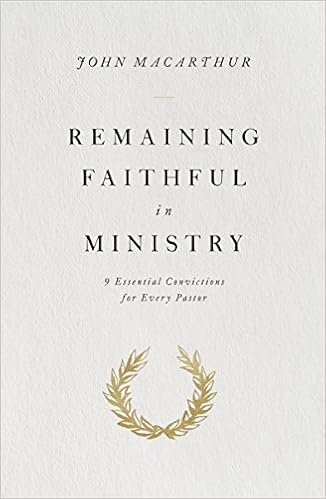
Book Review: MacArthur's Remaining Faithful in Ministry


Often it is the slender books, the brief books, that are most profound. In this class I would include such writings as Andrew Murray’s Humility: the Journey toward Holiness, Tozer’s Knowledge of the Holy, and Stott’s Basic Christianity. I can now add MacArthur’s RemainingFaithful in Ministry to this list. At just seventy-seven pages it is a book that punches far above its weight.

MacArthur writes on selected texts from 2 Corinthians 1-4, drawing nine points of faithful ministry out of Paul’s testimony to the Corinthian church. In one sense it is standard MacArthur: solid yet accessible exegesis, comparing Scripture with Scripture, delving into Greek terms when it enhances the meaning of the English text, combined with biblically faithful application. The power of his writing lies wholly within his skillful use of the biblical text.

The subtitle is 9 Essential Convictions for Every Pastor, and the book delivers abundantly on that theme. Every man in pastoral ministry should read this book and come under the weight of its convictions. Five stars, highly recommended.

Monday, November 30, 2015

Hey, brothers, they’re eating our lunch!

Sitting in my sun room, marveling over Romans 5. On the other side of the glass is our suet feeder, and a Red-bellied woodpecker is having a hissy fit. Seems that the sparrows have taken a liking to her suet cake and she’s not reconciled to the idea of sharing. Funny: I don’t recall giving that suet cake to her.

Anyway, she’s (I am informed by a bird identification site that my greedy little feathered friend is of the female variety) busy fending off the sparrows, clambering around the feeder daring any bird to come close.

Problem is, that suet feeder has two sides. So while she is guarding side A, the sparrows are pigging out on side B. They’re eating her lunch. Guess who’s not eating her lunch. She isn’t. She’s so distracted that she’s not getting a bite while the sparrows are having a feast (and a load of fun at her expense).


One would think from watching this little display of greed and turfism that birds have a sin nature. Well, Paul does say the whole creation groans . . . .

This reminds me of how easy it is to get distracted in our preaching, teaching, and study. Sometimes we preachers can get off-track by the garden variety heresies such as those promoted by modern lightweights like Joel Osteen and others. Or think of how many of us get distracted by themes such as satan and demons, spiritual warfare and bondage, varieties of eschatology, or other very legitimate but lesser topics. “Lesser than what?” you ask dubiously. Well, lesser than the Gospel, for instance. Lesser than our union with Christ and all the implications that flow from it. Lesser than the nature and attributes of God, whom to know aright is life eternal. We need to concentrate on keeping the main thing the main thing.

I’ve read that when banks teach tellers to spot counterfeit cash, they don’t spend a great deal of time studying the counterfeits. Rather, they spend a lot of time handling the real McCoy so that when a counterfeit passes through their hands they can spot it immediately because it feels wrong.

And that’s what we should be doing. Unless God has given you a polemic, apologetic ministry (and perhaps, in truth, He has), the best way to protect your flock from the wolves is to consistently, day-in-day-out, teach truth and as the occasion presents itself contrast the truth with error. When the text touches on demons, spiritual warfare, eschatology, etc, then so do we. But the bulk and the main of our ministry ought to be the systematic, expositional, verse-by-verse presentation of the Christ-centered, Gospel-centered Word of God.

I solemnly charge you in the presence of God and of Christ Jesus, who is to judge the living and the dead, and by His appearing and His kingdom: preach the word; be ready in season and out of season; reprove, rebuke, exhort, with great patience and instruction. For the time will come when they will not endure sound doctrine; but wanting to have their ears tickled, they will accumulate for themselves teachers in accordance to their own desires; and will turn away their ears from the truth, and will turn aside to myths. (2 Timothy 4:1-4, NASB)

In 2 Timothy 4:1-4, Paul gives us a balanced view of asserting truth and confronting error. It's important to draw a distinction between confronting false teachers and instructing confused believers. It’s easy to be distracted and become unbalanced in our ministries and to spend too much time talking about false teachers and  their ministries. Paul does confront false teachers (for example, 2 Tim 2:16-17), and so should we. But a close reading of Paul shows him focusing on the teaching, reproving, and correcting of the sheep (see 2 Tim 2:23-26).

Nor am I suggesting that we pit expositional preaching/study against topical preaching/study—there’s a valuable place for both—but I am saying this: nothing will ground your flock so deeply as a consistent ministry of expositional preaching that enables them to keep texts in context with both the surrounding passages and the overall history of redemption.

It might take longer to see results with this sort of ministry, but in the long run you will spend less time putting out little doctrinal fires in your congregation because you’ve enabled them to connect the dots for themselves. Protect them from the wolves not by teaching them about wolves but by drawing their attention to the Shepherd.

Preach the Word, bathe them in truth, and the Spirit will give your flock discernment as needed. Otherwise the lightweights will be eating our lunch.

Now, what was I doing? Ah, yes, Romans 5. Guess I got distracted . . . .