Friday, October 4, 2019

The Great Separation


Genesis 1 is a straight-forward account of the creation of the heavens and the earth. Multiple themes appear in this chapter, most of which highlight aspects of God’s character. His divine power is on display, His goodness is revealed, His creational intent is revealed—that mankind should fill and subdue the earth (this is not a command to exploit, but to be a steward exercising benevolent responsibility). His creative genius is manifested—an aspect of God’s character that becomes ever clearer the more we learn of the complex and symbiotic systems of both the animate and inanimate parts of the cosmos.

We also learn that God is a God of order, who brings forth order out of chaos. This is an attribute of God seen through the divine separations that appear in Genesis 1. He separates light from darkness (v 4), the waters below the expanse from those above (v 7), the waters below from the dry land (v 9), the heavenly bodies that separate day from night, again, separating light from darkness (vv 14, 18). And though the verb itself does not appear, He separates man from all other creatures by declaring him to be made “in His own image” (v 27).

God’s sense of order is further seen in the separation of the ability to reproduce: His created beings multiply after their “kind,” horses producing more horses, not producing birds. The principle of separation is revealed in the Law, as the children of Israel were not to mix seed in their fields, nor wear garments of mixed material (Leviticus 19:19), nor plow with a mixed team (Deuteronomy 22:10), and so on. These laws were designed to reinforce to the Israelites that God is a God who separates things according to their nature. The principle of separation is revealed in a spiritual sense as God calls His people to be separate from the rest of the world (Leviticus 20:24, 26). The Bible speaks of two separate spiritual seeds, or lineages: the seed of the woman and the seed of the serpent—the Devil (Genesis 3:15).

So fast-forward to the present day. Creation has been finished for a long time, the Old Testament era is in the rear-view mirror, the Law has been fulfilled by Christ. In what sense is God’s attribute of order, manifested by separating things, still operative? Since God does not change in His essential character (Malachi 3:6), He must still be separating things as He maintains order in His creation. And indeed He does. For instance, He calls Christians to be separated from the world (2 Corinthians 6:17).

But there is a tragic, final separation coming when He makes a new heavens and earth (2 Peter 3:13). That final separation is mentioned many times in Scripture. One place is in Matthew 13:24-30, 36-43. There Jesus relates a parable of the kingdom of heaven in terms of a wheat field into which an enemy (Satan) secretly sows tares, or darnel. At the end of the age, the angels will separate the wheat, the “sons of the kingdom,” from the tares, the “the sons of the evil one.”

Into which group will you fall? Make no mistake—no matter when the final separation occurs, you will be alive and conscious. You will participate, willingly or not. When God separates you into your destination—whether heaven or hell—He is acting in complete consistency with His character. In Scripture He has forewarned us repeatedly, making it very clear what we must do to be saved, to be a “son of the kingdom.”

“. . . Jesus came into Galilee, preaching the gospel of God, and saying, “The time is fulfilled, and the kingdom of God is at hand; repent and believe in the gospel.”” (Mark 1:14–15)

Wednesday, October 2, 2019

When despair threatens to overcome faith


When John the Baptist was imprisoned he probably had a good idea of what his fate would be. He’d gone from being the most impactful evangelist of his day to a dark, dank prison cell, and now his faith was shaken despite his track record with Jesus. He’d reluctantly baptized Jesus (Matt 3:13-15) while acknowledging that he himself should be the one being baptized, he’d seen the Holy Spirit alight upon Jesus like a dove (John 1:32), and seen his closest disciples become the followers of Jesus (John 3:30). He had awareness of his own redemptive-historical role (John 3:27-29).

And in the darkness of a prison cell he wrestled with nagging doubts. Finally he succumbed to his fears and sent a delegation of his remaining disciples to ask Jesus point blank: Are you really the Messiah? (Matt 11:3). Perhaps John expected that as the herald of the Coming One he himself would have a glorious end, would see the kingdom inaugurated, would see Herod and the Romans overthrown. Perhaps he didn’t expect his life to end this way. Are you really the Messiah?

The answer he received was interesting. It was oblique, not direct. Go and tell John what you see and hear (Matt 11:4). Jesus went full Isaiah with John, citing Isaiah 35:5 and 61:1. Both passages are of the glories of the coming kingdom (see all of Isaiah 35 and 61).

But here are two interesting points: first, instead of giving a direct yes, Jesus was saying, John, here is the Scripture, and here is what you see: compare them and draw your own conclusions. Jesus was gently nudging John back to his wavering faith.

The second point is that both Isaiah passages are passages of comfort—not rebuke: “to bring good news to the afflicted... to comfort those who mourn...” (Isaiah 61:1-2); “encourage the exhausted and strengthen the feeble, say to those with anxious heart, take courage, fear not...” (Isaiah 35:3-4).

This is especially remarkable when compared to the way Jesus addresses the crowd around him when the disciples of John depart (Matt 11:7-19). He goes full Malachi which, contextually, is a book of dire warning: God will send Elijah before the great and terrible day of the Lord, to restore His people to repentance, lest He “come and smite the land with a curse” (Malachi 4:6).

The difference between the modes of address has to do with the difference between the two audiences: fearful doubt in the darkness of great trial, versus persistent unbelief in the face of obvious evidence.

Be not shaken, Christian, by nagging doubt in the presence of unexpected trial and suffering. John the Baptist was the greatest of prophets, yet even he fell into fearful doubt in the gloom of his cell. Jesus dealt with him very gently, sending him back to the Scripture to strengthen his faith. Paul was the greatest of apostles, yet there were times he despaired of life in his own sufferings (2 Corinthians 1:8). When Paul came through his trial, looking back he saw that the same events which had shaken his faith eventually worked to strengthen it (2 Corinthians 1:9).

““A bruised reed He will not break And a dimly burning wick He will not extinguish; He will faithfully bring forth justice.” (Isaiah 42:3)

Tuesday, October 1, 2019

For Christian workers you've never heard of


Now the names of the twelve apostles are these: The first, Simon, who is called Peter, and Andrew his brother; and James the son of Zebedee, and John his brother; Philip and Bartholomew; Thomas and Matthew the tax collector; James the son of Alphaeus, and Thaddaeus; Simon the Zealot, and Judas Iscariot, the one who betrayed Him.” (Matthew 10:2–4)

Looking over the list of Jesus’ disciples, I see interesting distinctions. Jesus had an inner circle composed of Peter, James, and John. Peter was singled out as the disciples’ primary spokesman in the early days of the church. There were twelve, but only Peter, John, and Matthew became writers of Scripture. After Acts 1:13, most of the twelve you never hear of again, at least not in Scripture. At first glance, they seem to play nothing more than bit parts.

After Acts 1:13, Andrew’s name disappears from the text, yet he is the one God used to announce the coming of Messiah to Peter (John 1:40). Philip the apostle likewise disappears, whereas a different Philip, the deacon/evangelist, appears sixteen times from Acts 6 on. Even though Matthew writes one of the gospels, his name also disappears from the New Testament.

After Acts 1:13, Bartholomew, Thomas, James son of Alphaeus, Simon the Zealot vanish into history, known only through tradition (and there our knowledge is not completely reliable).

That same pattern continues today. God promotes some of His servants to the role of well-known writers (for instance, David Powlison, or R.C. Sproul). Others are famous preachers (John MacArthur, John Piper). But most of God’s faithful servants you’ve never heard of and never will this side of eternity.

God has made ten-city servants and five-city servants (Luke 19:11-19), five-talent servants and two-talent servants (Matt 25:14-28). When Jesus prophesied of Peter’s future martyrdom, and Peter asks about John’s future (John 21:18-23), Jesus response is basically, my plans for him are none of your business—you be faithful to what I have called you to do.

Are you one whom Jesus has called to labor in obscurity? Do you sometimes look around at the apparent success of others and wonder why you don’t see the same fruitfulness in your own work? Do you feel sometimes as if you don’t receive recognition for your labors, while others around you are recognized for theirs?

Five things to keep in mind: (1) the same pattern of recognition/obscurity can be seen in Jesus’ hand-picked disciples—it’s not just you. (2) If you know Christ you enjoy the same redemption as do your better-known brothers and sisters in Christ. (3) Those better-known believers sometimes suffer from things you might know nothing of—physical ailments, family heartaches, loss, etc—and face pressures and difficulties you might not experience. Celebrity has its own dangers you’ll not face. (4) God has formed you for your unique ministry—it is your faithfulness, not your “success” that He will reward. If you labor in obscurity it is because God has given you that path out of His love for you. God who sees in secret will one day reward you openly (Matt 6:4). (5) Heed the counsel God gave to Baruch, Jeremiah’s secretary: “‘But you, are you seeking great things for yourself? Do not seek them; for behold, I am going to bring disaster on all flesh,’ declares the Lord, ‘but I will give your life to you as booty in all the places where you may go.’ ”” (Jeremiah 45:5).

Keep at it, my brothers and sisters. God sees your heart, and it is your heart He rewards (Matt 6:33). “Therefore, my beloved brethren, be steadfast, immovable, always abounding in the work of the Lord, knowing that your toil is not in vain in the Lord.” (1 Corinthians 15:58)

Tuesday, August 13, 2019

Book Review: Matt Waymeyer's A Biblical Critique of Infant Baptism


Matt Waymeyer has constructed a tour de force in the debate between paedobaptists (those who hold to infant baptism) and credobaptists (those who hold to believer baptism). Careful argumentation, careful exegesis, and excellent documentation define his contribution to the debate. If it were possible to characterize the sum of his arguments in a single sentence, it might be this one, which appears in the book’s final paragraph: “In the end, it appears that the paedobaptist interpretation of these various passages assumes the view that it must first demonstrate.” [130-131]

Waymeyer is irenic in his polemic, which is refreshing. He considers his debate opponents to be valued members of God’s family and treats them that way. This is in sharp contrast to how some others have carried on the debate. I love Calvin’s Institutes, but Calvin’s treatment of this issue is far more heavily weighted with invective and insult than any genuine attempt at exegesis. Waymeyer does not fall into that trap.

The first chapter explores the absence in the New Testament of any command to baptize infants, a remarkable observation when you consider the importance paedobaptists attach to the rite. The second chapter details the fact that, contrary to claim, there simply is no clear example in the NT of infants being baptized.

Waymeyer marches through Acts 2:39, 1 Corinthians 7:14, Mark 10:13-16, and Ephesians 6:1 in chapter 3, demonstrating that these texts do not support the paedobaptist position. Heavily footnoted, the chapter interacts with the writings and interpretations of both sides.

Paedobaptists claim that baptism is the new circumcision and demonstrates the continuity between the old and new covenants. This replacement is the keystone of the paedobaptist argument. Waymeyer deals with this in chapter 4. His careful consideration of Genesis 17:10-14, Romans 4:11-12, Colossians 2:11-12, and Acts 15:1-29 yields solid exegetical reasons as to why the paedobaptist position is extremely unlikely if not impossible to maintain. He concludes, “Not only does no single passage of Scripture teach this kind of replacement, but an overall comparison of the two rites yields a degree of discontinuity that completely undermines the case for infant baptism.” [71-72]

Chapter 5 (“The Discontinuity of Redemptive History”) explores the divide between the two positions in theological terms, the paedobaptists seeing significant continuity and their opponents seeing a significant discontinuity between the New and Old Testaments. Waymeyer examines the newness of the New Covenant and the nature of the New Testament Church, as contrasted with OT Israel.

Finally, the author wraps up his argument by taking a close look at the rite of baptism itself. In particular, Waymeyer investigates Matthew 28:18-20, Acts 2:38, 1 Corinthians 1:13-15, and 1 Peter 3:21. He concludes, “The notions associated with the ordinance of baptism—such as repentance, faith, discipleship, and calling on the Lord for salvation—are of such a nature that they involve conscious intelligent understanding, and for this reason, infants should not be baptized.” [109]
Waymeyer offers an appendix (“The Newness of the New Covenant Revisited”) which deals with substantial points, such as the meaning of the “knowledge of God” in Jeremiah 31:34, “covenant breakers” in the church, Hebrews 10:26-31, etc. This appendix is, like the rest of the book, well worth the time.

A short read (131 pages), Biblical Critique nonetheless contains a comprehensive look at the debate between the two opposing sides. Waymeyer has compiled the best arguments of each respective position and dealt with them in an exegetically detailed and theologically responsible way. No matter which side of the debate the reader finds himself on, Biblical Critique is an important contribution to the ongoing discussion. Five stars, highly recommended.

Tuesday, August 6, 2019

The Oil Change


“I wouldn’t publish that story, if I were you,” my wife said, raising her eyebrows. It’s a look she reserves for when I’m about to do something really dumb.
“I don’t know why not. After all, it’s true.”
“Yes, but people might think you’re stu—.” She caught herself and didn’t finish. Somehow I knew the missing word wasn’t ‘stupendous.’
“Ah, c’mon, babe. They already know I’m not a car guy. My Dakota, er, Ranger proves that.”
I decided to publish anyway, which I reckon I don’t need to tell you since you’re reading it at the moment.
So the Dak—, um, Ranger needed an oil change. Actually it needed it about four months ago so I figured I’d better get right to it, rather than putting it off. I do like to be timely about these things.
I drove it over to the oil change place, and found that I was the only customer—a bit of luck I would later be quite thankful for. So they guided me right into the service bay and began their interrogation.
“So how are your wipers, sir?”
“Wipers are fine, don’t bother with ‘em.”
“And how about your transmission fluid?”
“Fluid’s fine, leave it alone.”
“We’re running a special on flushing your radia—”
“NO thank you! Just want the oil changed.”
“Your cabin air filter is looking a little dingy.”
“Oil. Change. Just change the oil,” I said, feeling a little snippy. “I don’t want anything else.”
“I understand that, sir, but we just want to make sure that you’re aware of all our services. Would you like your lawn mowed?”
I just glared at him and didn’t answer.
He looked at me and rolled his eyes. “Got it. Oil change.”
He shoved a little box in my face. “Keys. Put ‘em in there.”
What? Do they think I’m stupid? Do they think I’d really start the truck when their head is under the hood? Anyway, I frowned at him and dropped my keys in the little box.
“Pop the hood, please, sir.”
I reached down and pulled the release. Nothing happened. I groaned. I seemed to remember that this had happened before and I’d had a dickens of a time releasing the hood. I yanked the release again. Nothing. Again, harder. Nothing.
So I reached way under the dash, curled my fingers around the cable trying to exert more force on it than the lever did.
Nothing.
After being so grouchy about the oil change I felt a little sheepish. I poked my head out the window. “I’ve had trouble with this before. Could you bang on the hood?” So while they waled away at my hood I grabbed the lever and pulled again and again.
Nothing.
Finally I got out of the truck, stood on the front bumper, put my full weight on the hood, and sort of bounced on it. The mechanics all kind of backed away from me at that point.
Nothing.
Oh, well. We all jointly decided that the oil change would have to wait for another day. They gave me my keys back, and started motioning for me to drive away. I think they really wanted me to leave. I started the truck, reached for the emergency brake release and—oops. No wonder the hood didn’t pop up.
Feeling really stupid, I turned off the truck, reached for the hood release lever, and the hood popped up as nice as you please.
I didn’t bother to explain. It was at this time I was very thankful there were no other customers in the store. Wouldn’t want anyone to know about this anyway. I’d never live it down.
When I was finally driving away, it occurred to me: the hood release problem I thought I remembered? It never happens on the truck. It happens on my Ford Vue.


Saturday, July 27, 2019

Book review of Theistic Evolution: A Scientific, Philosophical, and Theological Critique


Theistic Evolution: A Scientific, Philosophical, and Theological Critique
Full disclosure first: I am committed to young-earth creationism, because I believe that is the best understanding of the biblical record. 

Theistic Evolution does not promote such a position. It is, rather, a tour-de-force of the best arguments of the Intelligent Design (ID) movement. The ID movement leaves aside the question of the age of the earth and instead directly attacks the main vehicle of evolution: random change over time coupled to natural selection of the fittest. ID argues that the panoply of created things clearly displays the marks of design, and therefore the existence of a Designer. This is set in opposition to the notion of theistic evolution, in which it is argued that, yes, God is there, but his act of creation was limited to producing the initial cosmic conditions and the inherent properties of nature. From that point forward, God steps out of the picture and allows what he has created to coalesce randomly over time, eventually producing the world as we see it today. One of the arguments of many proponents of theistic evolution is that, other than the initial creation, any further act of God must be undetectable.

The authors of the essays in Theistic Evolution have compiled a compelling case, both negatively against the possibility of evolution and positively for the contention that the cosmos and all that is in it displays purpose and intention, and therefore is evidence of a Designer.

The book is composed of three major sections. The first section deals with the scientific critique of theistic evolution (and therefore evolution itself, since theistic evolution is built on it). Nine chapters virtually destroy the case for evolution, drawing from chemistry, information theory, DNA, and embryology. Seven more chapters attack the idea of universal common descent (the “amoeba to man” idea). The final chapter of the first section details how scientists are pressured to conform to prevailing theories.

Section two confronts theistic evolution from a philosophical standpoint. In nine chapters, the various authors address themselves to the philosophy of science, the inadequacies of methodological naturalism, the problem of evil, the origin of the moral conscience and more.

The last section, five chapters, addresses the failure of theistic evolution to deal with the biblical and theological data. For someone committed to Scripture, this is the best part of the book. The authors of the essays demonstrate that theistic evolution undermines twelve creation events and multiple important biblical doctrines, and does not comport with the clear statements of either the Old or New Testaments. Theistic evolution is held up against the historic positions of theologians over the last 2000 years and found wanting.

Do not expect the book to argue for young-earth creationism, because it does not. It appears that the authors of the essays (at least the majority) are more comfortable with an old-earth position (but one that clearly involves belief in an actual, historical Adam and Eve supernaturally created as the very first humans, and who fell into sin, becoming responsible for the advent of death). But young-earth creationists should not reject this book. It is a strong polemic against any form of evolution, and the arguments of the authors are, almost in their entirety, arguments that young-earth creationists will find equally useful.

Five stars, highly recommended.

Friday, July 12, 2019

Book Review: The Virtue of Nationalism


Yoram Hazony has constructed a brilliant defense of nationalism over against the utopian vision of imperialists such as the UN and the EU. He also has an interesting take on why Israel is so hated by Europeans, and why the Palestinians, Muslims, and much of the Third World get by with so little censure by the UN and the EU. Carefully argued, carefully documented, Hazony makes a powerful and scholarly case for his contentions. The logic of his argument is painstakingly constructed and easy to follow--he communicates it well as a writer and a thinker. Hazony puts forward a thesis that is difficult to refute; I find myself agreeing with him in his main points.

Criticism: Hazony appears to write as, at most, a deist. God is an uninvolved bystander if He even exists. Hazony treats the OT as if one of its main purposes is establishing the "right" kind of government for Israel. In other words, Hazony treats reality as if the big story is the unending struggle of politics, philosophies, and peoples--a struggle that has neither beginning nor end. He seems to completely miss the big story of the Old Testament (the promised coming of Messiah). He's unable to deal with (or at least, does not deal with) the fundamental reality of the nature of man: that each person is intrinsically morally corrupt, and that this moral corruption becomes part of the fabric--and the explanation--of our actions, politics and philosophies. Consequently, his unrelenting logic and excellent argument about relations among peoples and nations would only be completely true in a world in which God does not exist or is not involved, and in which all men are not morally corrupt. But that is not the world we live in, with the result that his argument is incomplete and at some levels inadequate when he gets to the reasons for the hatred and violence we see in the world.

Good book, well worth reading. The criticisms above do not vitiate his main point of the virtue of nationalism.

Sunday, June 16, 2019

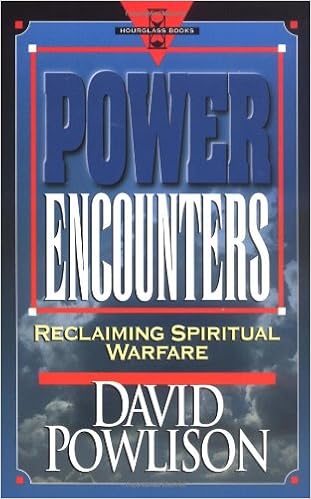
Book Review: David Powlison's Power Encounters: Reclaiming Spiritual Warfare


One of the things that struck me first about this book was the irenic way Powlison handles those he disagrees with. The doctrine of spiritual warfare has a wide variety of self-styled experts vying for the attention of Christians. Many of these “experts” appear to draw their doctrine of demonology and spiritual warfare more from the writings of novelist Frank Peretti than from Scripture.

Practitioners and writers on spiritual warfare typically concentrate on what Powlison terms the Ekballistic Ministry Mode (EMM). The Greek derivation of ekballistic means “to cast out.” The idea of identifying, naming, and then casting out demons is the central feature of EMM. Sin, rather than being sourced from our old nature, is largely seen as the product of demons of lust, greed, etc.

Powlison challenges the entire EMM schema. He does so without using any cheap shots (which would be frankly easy to do, given some of the ideas of EMM practitioners). Rather, he makes his points with careful, contextual, exegetical precision, dismantling the careless interpretations of the scripture texts normally cited in support of an EMM-style ministry. In fact, I would say the skillful exegesis Powlison employs is the defining characteristic of this little book.

Another treasure of Power Encounters is the wise manner in which Powlison distinguishes between moral evil and situational evil. His point is that the distinction between the two different kinds of evil calls for a different response to each, a matter that EMM completely overlooks.

Powlison’s answer to EMM is what he calls “classic mode” ministry: helping Christians deal with troublesome sin in their lives, as well as demonic oppression, by taking them straight to the cross. The gospel is the most powerful weapon. It is the only weapon needed to completely defeat the forces of darkness.

The worst part of Power Encounters is that it has gone out of print. That should never have been allowed to happen to a resource this valuable. Every pastor and biblical counselor should have a copy of this little book. Used bookstores are charging three figures for old copies. I purchased mine from biblicalcounselingbooks@gmail.com and more are available from them. They have secured permission to make reprints. For a slender book weighing in at 160 pages, $30 was a fairly steep price. It was worth every penny. Five stars, highly recommended.

Wednesday, May 29, 2019

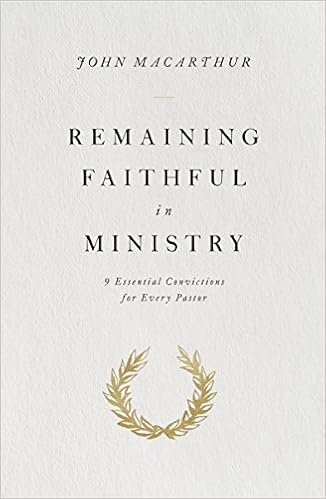
Book Review: MacArthur's Remaining Faithful in Ministry


Often it is the slender books, the brief books, that are most profound. In this class I would include such writings as Andrew Murray’s Humility: the Journey toward Holiness, Tozer’s Knowledge of the Holy, and Stott’s Basic Christianity. I can now add MacArthur’s RemainingFaithful in Ministry to this list. At just seventy-seven pages it is a book that punches far above its weight.

MacArthur writes on selected texts from 2 Corinthians 1-4, drawing nine points of faithful ministry out of Paul’s testimony to the Corinthian church. In one sense it is standard MacArthur: solid yet accessible exegesis, comparing Scripture with Scripture, delving into Greek terms when it enhances the meaning of the English text, combined with biblically faithful application. The power of his writing lies wholly within his skillful use of the biblical text.

The subtitle is 9 Essential Convictions for Every Pastor, and the book delivers abundantly on that theme. Every man in pastoral ministry should read this book and come under the weight of its convictions. Five stars, highly recommended.

Wednesday, May 1, 2019

Review of Dean Inserra’s The Unsaved Christian: Reaching Cultural Christianity with the Gospel


The Unsaved Christian is a great book, and is going to be discomfiting for many people who view themselves as right with God, but whose views on that score are wholly without warrant.

First, a bit of historical perspective: parts of the United States were swept by revivalism in the 18th and 19th centuries. Much good came out those revivals, but there were also some results that were not particularly praiseworthy. One of them was a reductionism of redemption: in many cases it was reduced to a “decision” rather than a whole-life reorientation around repentance and faith in Jesus Christ as Lord and Master. Salvation is not less than a decision, but it is much more than that.

Add to that an unbalanced emphasis on eternal security (especially in the mid to late 20th century), virtually separating the doctrine of assurance from the “new life” aspect of regeneration. And add to that a sort of “second-blessing” theology that teaches the decision to yield to Jesus as Lord and Master is separate from the decision to trust Him as Savior, and what you wind up with is a culture that views salvation as little more than checking the right boxes. Salvation becomes a cultural inheritance of white, conservative, flag-waving Americans, something akin to joining the Republican party.

Dean Inserra’s book is a gentle but firm expose of that problem: cultural Christianity is not biblical Christianity, and it is decidedly not a “Christianity” that saves. He deals with a variety of flavors of it: moral theism, watered-down mainline Protestantism, the Bible Belt cultural ambience, the confusion of patriotism with Christianity, and so on. One particularly good chapter explores the Christmas and Easter attendance phenomenon and yields some rather surprising observations.

Inserra is not swinging a club—he’s not browbeating. He’s quite gentle, in fact, and includes questions at the end of each chapter for self-evaluation. But he also pulls no punches. Chapter 3 is entitled “Civic Religion: Generic Faith that Demands and Asks Nothing of Its Followers.” His view of the true gospel, biblical faith, salvation, the effects of regeneration, and so on are fully orthodox.

Buckle your spiritual seatbelt, put on your crash helmet, and read this book. Here at Bible Fellowship, we’re going to go through this book in Sunday School. It’s too important to leave sitting on the shelf. For some, it might make an eternity of difference. Five stars, highly recommended.